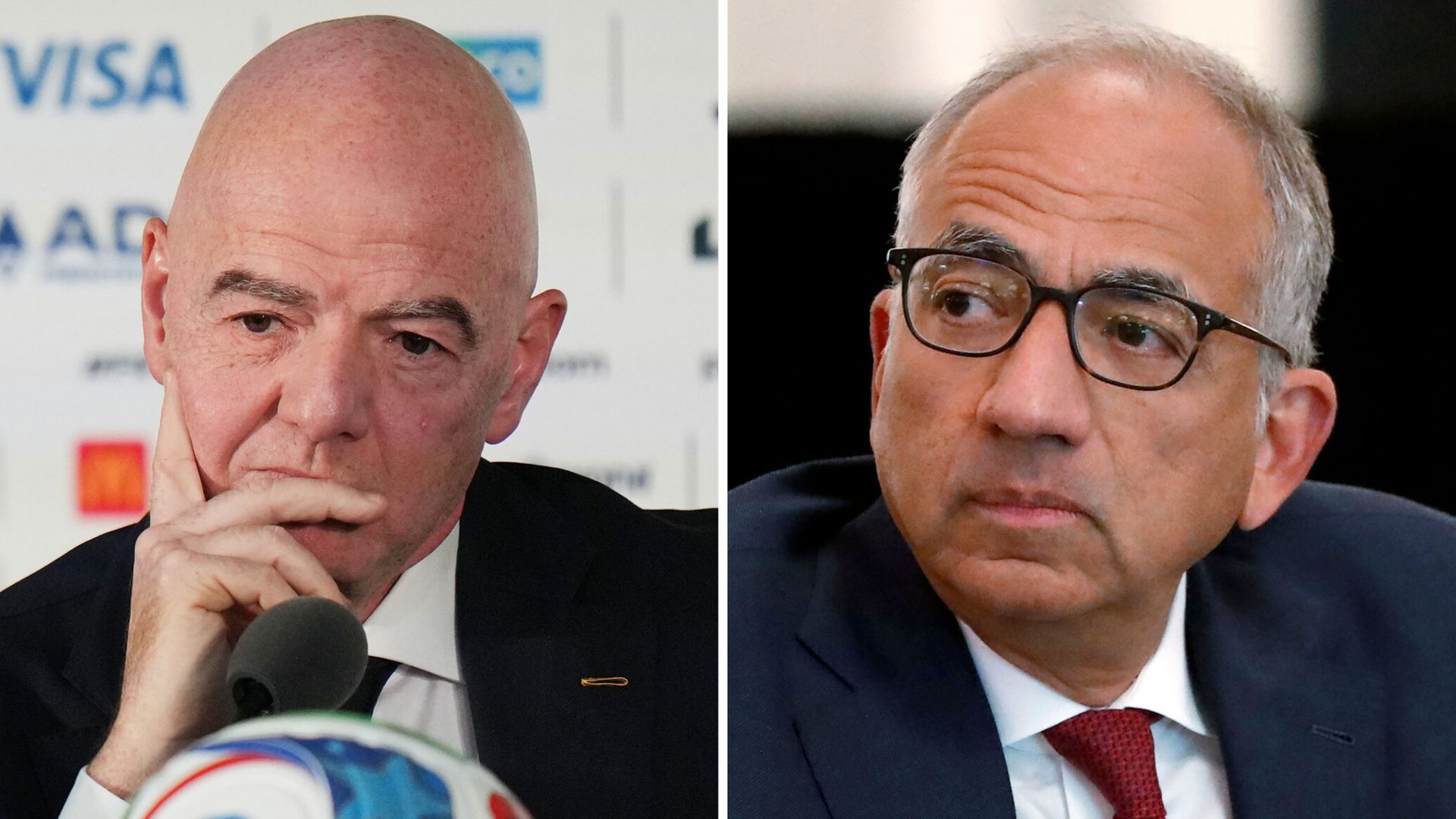
Power smells like polished mahogany and expensive cologne. It echoes in high-ceilinged Zurich boardrooms where men in bespoke suits dictate the pulse of a global obsession. You sit at the edge of the table. You look at the papers. You realize the numbers do not add up to a sport anymore, but to an appetite.
Gianni Infantino wants more. More tournaments. More matches stitched into an already exhausted calendar. More billions funneled into coffers that never seem satisfied. The FIFA president looks at football and sees an infinite well.
Then, someone speaks.
Not with a whisper, but with a sentence that carries the weight of an entire career sliding off a cliff.
If that means I lose my job, so be it.
Those words did not belong to a rebel in the streets. They belonged to a high-ranking official inside the machine. A man who looked at the proposed expansion of the World Cup, at the relentless stripping away of rest for human athletes, and decided that silence was too high a price for a paycheck.
We forget that football is made of flesh and bone. We watch it through high-definition screens, glowing rectangles that flatten reality into entertainment. We see the overhead kick. We see the celebration. We do not see the cartilage grinding to dust. We do not see the father flying across time zones twice a week, missing his daughter's first steps, chasing a ball that has become heavier with every corporate sponsorship deal inked in secret.
Consider what happens when a calendar expands endlessly.
The math is brutal. There are only three hundred sixty-five days in a year. The human body requires recovery. Muscles tear. Tendons snap. Yet the modern governing body treats players like replaceable inventory in a warehouse that never closes. Push them harder. Stretch the tournament. Add another group stage. Who cares if they break? There is always another kid running barefoot in a dust lot, waiting to take their place.
This is the cold machinery of modern sports administration. It operates on spreadsheets and projection models. It calculates broadcast rights down to the microsecond. But it lacks a pulse.
When a top FIFA official publicly drew a line in the sand, he did something rare. He introduced humanity back into a room that had systematized greed.
Let us step inside that room for a moment. Imagine the pressure. The whispered warnings in the corridors. The subtle shifts in body language from colleagues who prefer to keep their heads down, collect their bonuses, and smile for the cameras. Compliance is comfortable. Dissent is lonely.
To stand up against an expansionist agenda means risking exclusion. It means inviting retaliation. Bureaucracies do not forgive internal friction. They grind it down until it disappears.
Yet, the official chose friction.
Why? Because the math of the expanded World Cup fails the most basic test of reality. It dilutes the magic. When every summer features a bloated tournament, the tournament ceases to be an event. It becomes white noise. It transforms from a sacred quadrennial festival into a relentless commercial loop.
Scarcity creates value. When you can have football every single day of the year, packaged, branded, and sold at a premium, you stop loving it. You start consuming it. There is a vast, suffocating difference.
History is littered with organizations that swallowed their own tails. Rome had its bread and circuses until the grain ran thin and the empire cracked from within. Modern football risks the same fate. It relies on the emotional investment of billions of fans who treat the sport as an article of faith. They endure bad weather, overpriced tickets, and heartbreak because they believe, deep down, that the game belongs to them.
When the people running the sport treat it purely as a growth stock, that faith frays.
The official who put his career on the line understood this intangible asset. Trust. Once burned, it takes generations to regrow.
We have watched this play out in other domains. Corporate monopolies push until the system shatters. Silicon Valley algorithms optimize our attention until we burn out. Music, art, literature—all subjected to the relentless demand for higher output, faster delivery, cheaper production. The soul gets squeezed out of the product until only the husk remains.
Football is dangerously close to becoming a husk.
When players are forced to play seventy or eighty matches a season, the quality degrades. The spectacle becomes cautious. Exhausted athletes cannot sprint with the same fury. They manage games. They conserve energy. The poetry vanishes, replaced by industrial efficiency.
And for what? More revenue streams for federations that already sit on hundreds of millions in reserves. The money does not trickle down to the grassroots pitches where rusted goals stand in muddy fields. It pools at the top, sloshing around in executive bonuses and political patronage projects designed to secure votes for the next election cycle.
It is a closed loop of self-preservation masquerading as global development.
When the dissenting official spoke out, he punctured that illusion. He named the elephant in the boardroom. He reminded everyone present that institutions are made of choices, not gravity. Infantino’s vision is not a law of physics. It is a choice. And choices can be contested.
We need more voices willing to risk unemployment for integrity. In sports, in business, in journalism, in life. We live in an era that rewards compliance and penalizes moral friction. Algorithms promote the smooth and the agreeable. Corporations promote the team player who never asks uncomfortable questions.
Quiet. Obedient. Replaceable.
Break the mold.
The official who stood up against the expansionist tide might win or lose his specific bureaucratic battle. Infantino holds the cards, the votes, the machinery. Change at the top of these monolithic bodies rarely happens overnight. But seeds do not need to sprout immediately to change the landscape. They need to break the surface.
Think about the young player watching this unfold from a television screen in a cramped apartment. He does not care about broadcast rights. He cares about heroes. He cares about integrity. When he sees a man with everything to lose look an absolute ruler in the eye and say no, he learns a lesson far more valuable than any tactical briefing.
He learns that courage is real.
The match will kick off. The stadium lights will blaze against the night sky, burning enough electricity to power a small town. The fans will roar, wrapped in flags of red, blue, and green. The ball will roll.
On the surface, nothing has changed. The empire continues its march.
But beneath the turf, a crack has appeared. Someone drew a boundary. Someone decided that there are things more valuable than a seat at the high table.
Silence was an option. It always is. It is the easiest choice in the world.
He chose differently.
And somewhere in the quiet spaces of the footballing world, a collective breath was let out, waiting for the rest of us to find our voice.
.png/revision/latest?cb=20201025153043)