The forest floor does not care about your fears. It cares about moisture, about the decaying scent of leaf litter, about the silent, thermal pulse of life sliding through the brush. To most of us, that rustle in the grass is an eviction notice from peace. It triggers an ancient, hardwired terror. A sudden spike of adrenaline. A desperate urge to retreat.
China. A province where the mountains rise like ancient, moss-draped ribs from the earth. Here, the boundary between human civilization and the wild is porous. It leaks venom.
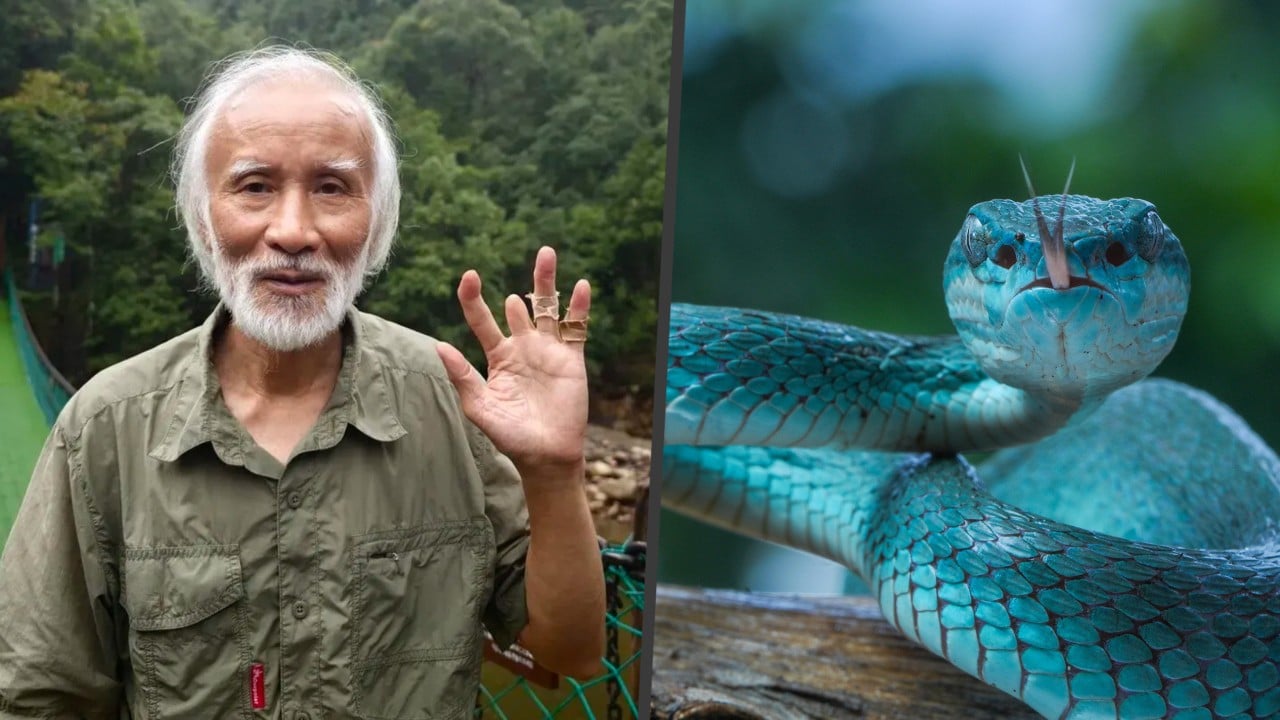
Meet the snakeaholic.
He is not a scientist in a sterile laboratory, peering down through expensive glass at a specimen twitching in a Petri dish. He is a man who walks where others refuse to look. He counts scales in the dark. He reads the subtle, shifting geometry of a coiled body before it strikes. He knows the precise, rhythmic percussion of a pit viper’s warning rattle better than he knows the pop songs on the radio.
Then came the day the forest bit back.
It happened in an instant. A blur of copper and muscle. Pain, fierce and white-hot, blooming through flesh. When you spend your life studying animals that kill with a single drop of fluid, you accept the terms of the contract. The venom courses, burning through tissue, destroying cells, threatening the very architecture of the body. Antivenom saves the life, but it cannot always save the extremities.
Necrosis. The tissue dies. The finger had to go.
Most people would take that missing digit as a punctuation mark. A full stop. A clear, unmistakable message from the universe to pack up the notebooks, hang up the heavy boots, and find a nice, safe desk job where the only danger is a papercut.
He stayed.
Consider what happens next. Instead of retreating into bitterness, he doubled down. He looked at his scarred hand—missing a piece, forever altered by the very creatures he loved—and saw a badge of mutual understanding. The forest had left its mark on him, just as he had left his footprints on its trails.
To understand why someone dedicates their entire existence to protecting creatures that most of humanity would happily eradicate with a shovel, you have to abandon the human metric of utility. We like animals that purr. We tolerate animals that bark. We romanticize creatures that look like us or act like us. Snakes do none of those things. They have no eyelids. They do not smile. They wear their skin like a cold, dry suit of armor and glide without limbs, defying the geometry of mammalian motion.
They are alien. And because they are alien, they are hated.
Fear breeds destruction. Every year, thousands of snakes are beaten to death out of sheer panic. People encounter a rat snake or a bamboo viper near a rural home, assume the worst, and swing a stick. They do not pause to consider the ecological calculus. They do not think about the rats, the mice, the exploding populations of agricultural pests that would overrun the fields if the serpents vanished.
He walks into those villages. Not with condemnation, but with education.
Imagine standing in a crowded courtyard in rural China, holding a six-foot-long predator wrapped calmly around your forearm. The villagers recoil. Children hide behind their mothers' skirts. Old men grip their walking sticks a little tighter.
He doesn't yell. He speaks softly, pointing out the belly scales, explaining how the animal hunts, showing that it wants nothing to do with human flesh. Flesh is too big to eat. Flesh is a threat, not a meal. He teaches them to respect the space, to sweep the yard, to clear the brush, to coexist.
Slowly, the pitch of the panic changes. The raised sticks lower. Curiosity replaces terror.
That is the true work. The snakes need protection from habitat loss, from the illegal wildlife trade, from the traditional medicine markets that value them dead rather than alive. But more than that, they need someone to bridge the chasm between human ignorance and wild survival.
Losing a finger changes the way you grip things. It changes how you hold a pen, how you cook a meal, how you tie your shoes. For him, it also changed how he handles his subjects. It introduced a permanent, physical vulnerability into every interaction. There is no room for complacency when you are working with elapids and vipers with one less digit to spare. Every movement must be calculated. Every reaction must be pre-meditated.
Yet, the passion remains unblunted.
We live in a culture obsessed with comfort. We sanitize our environments. We pave over the dirt, spray pesticides until the lawns are unnaturally green, and seal ourselves inside climate-controlled boxes. Anything that reminds us of the raw, unpredictable danger of the natural world is deemed a nuisance to be eliminated.
The snakeaholic rejects that sterility. He chooses the mud. He chooses the humidity. He chooses the cold, dry coil of a creature that could end him in seconds, simply because he believes that a world without them is a diminished, impoverished place.
The forest keeps its secrets. The rain falls on the canopy, washing away footprints, erasing the temporary structures we build to tame the earth. But the scars remain. They are written into bone and skin, a silent language spoken only by those who refuse to look away from the wild.