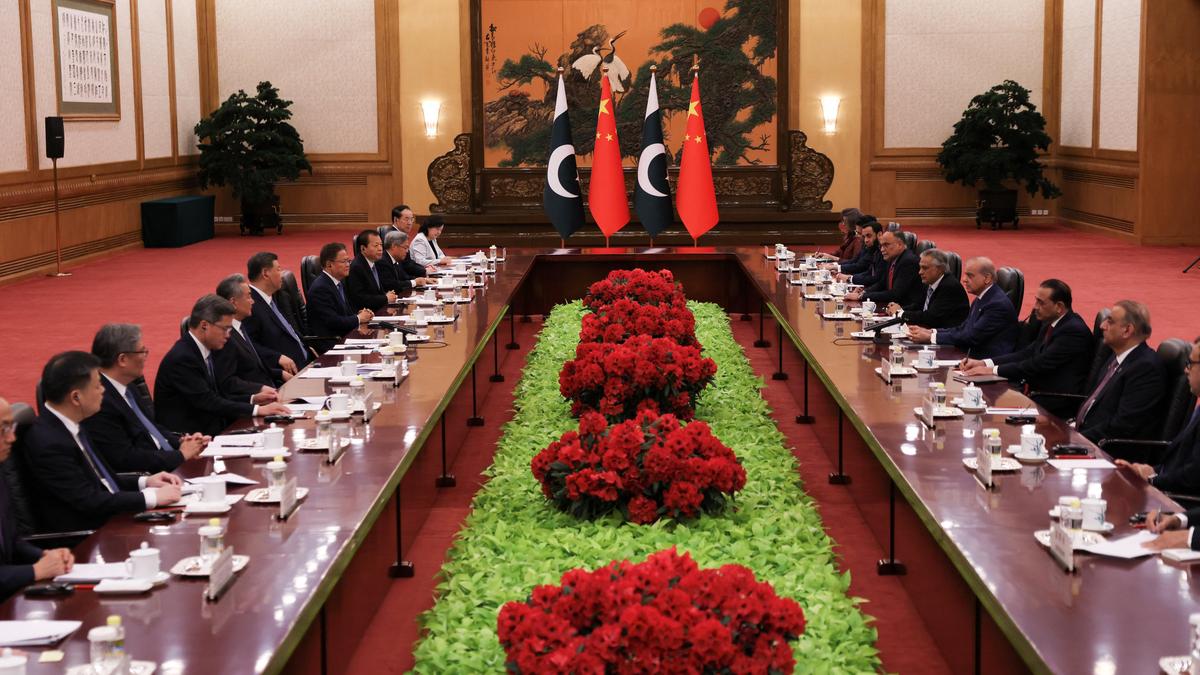
The global press corps is currently obsessing over a standard-issue photo op in Beijing. Mainstream outlets are printing predictable headlines about Chinese President Xi Jinping meeting Pakistani Prime Minister Shehbaz Sharif as the United States-Iran conflict threatens to boil over. The lazy consensus among analysts is that Pakistan, flanked by its powerful Chinese patron, is operating as a grand diplomatic bridge to de-escalate the Middle East crisis.
This analysis is not just superficial. It is completely backwards.
I have watched state delegations waste years chasing regional stability through hollow mediation structures, and this latest performance follows the same broken script. The narrative that Islamabad is playing the neutral arbiter between Washington and Tehran—backed by Beijing’s quiet diplomatic machinery—ignores the brutal structural realities facing all three actors. Pakistan is not mediating out of geopolitical strength or altruistic concern for regional stability. It is leveraging a manufactured diplomatic role to escape an existential economic collapse and secure a sovereign bailout.
The Myth of the Neutral Mediator
Mainstream reports point to the presence of Pakistani Army Chief Asim Munir in Beijing as proof of a high-stakes security mission. They remind us that Pakistan hosted face-to-face talks between American and Iranian officials, treating the failure of those talks as a mere tactical bump in the road.
Let us destroy that illusion immediately. Diplomatic mediation requires leverage, economic insulation, and strategic trust. Pakistan possesses none of these.
Islamabad is currently suffocating under a massive external debt crisis. Its economy survives on emergency lifelines from the International Monetary Fund and rolling over short-term loans from Gulf monarchies and Beijing. A country that relies on foreign capital to keep its central bank liquid cannot dictate terms or act as a guarantor of peace between a global superpower and a revolutionary regional state.
When Sharif thanks China for supporting peace initiatives, he is not talking about the Middle East. He is talking to his primary creditor. The direct talks hosted in Islamabad were not a triumph of Pakistani statecraft; they were a convenience for Washington and Tehran, both of whom required a plausible, disposable venue to exchange opening demands without committing to formal diplomacy. The moment Iran accused the United States of making excessive demands, the façade cracked. Pakistan could do nothing to bridge that gap because Pakistan has zero economic or military chips in the game.
What Beijing is Actually Buying
The conventional foreign policy establishment views China's endorsement of Pakistan's mediation as part of a grand strategy to build an alternative international order. They look at the 75th anniversary of China-Pakistan relations and see an unbreakable traditional friendship.
This is sentimental nonsense. Beijing does not deal in sentiment; it deals in balance sheets and supply line security.
For China, the ongoing conflict involving Iran is a direct threat to its energy corridors, specifically the oil flowing through the Strait of Hormuz. China imports roughly 40 percent of its crude oil from the Persian Gulf. If those shipping lanes are choked by ongoing military strikes, China's economic engine takes a massive hit.
Beijing’s strategy is not to replace the United States as the Middle East's policeman. That is a costly, thankless job that Chinese leadership is more than happy to avoid. Instead, Beijing uses Pakistan as a geopolitical buffer and a diplomatic proxy. By publicly praising Sharif’s constructive role, Xi Jinping achieves two distinct goals:
- It projects the image of a responsible global superpower engaged in peace-building without requiring China to take any actual diplomatic risks or alienate its trading partners in the West.
- It provides a political justification to continue propping up the Pakistani state, ensuring that the China-Pakistan Economic Corridor (CPEC) does not completely collapse under the weight of Islamabad’s domestic instability.
If you believe this meeting was about mapping out a peace plan for Tehran, you are missing the real ledger. This is about protecting investments in Gwadar Port and ensuring that Pakistan's military remains stable enough to protect Chinese infrastructure projects from domestic insurgencies.
The Flawed Premise of Regional Peace Talks
The public constantly asks variants of the same question: Can China and Pakistan successfully mediate a permanent ceasefire between the US and Iran?
The question itself is flawed because it assumes that both combatants actually want a third-party resolution. They do not.
The structural divide between Washington and Tehran cannot be resolved by an over-leveraged South Asian state or a cautious East Asian superpower. The United States is locked into a strategy designed to degrade Iran's regional influence and proxy networks. Iran views its military posturing as an existential defense mechanism against Western encirclement.
When a country like Pakistan steps in to mediate, it is treated by the major powers as a mail courier. Couriers do not negotiate treaties; they deliver messages. The moment General Asim Munir displayed public bonhomie with US Vice President J.D. Vance, it was a public relations win for the Pakistani military establishment, signaling to domestic audiences that they are still relevant on the world stage. It changed absolutely nothing about the strategic calculations in Washington or Tehran.
The Cost of Geopolitical Posturing
There is a dark side to this diplomatic theater that mainstream commentators refuse to acknowledge. By positioning itself as a central mediator in a volatile conflict, Pakistan is playing a highly dangerous game with its own economic survival.
Saudi Arabia and the United Arab Emirates—two of Pakistan’s most critical financial lifelines—view Iran’s regional ambitions with deep suspicion. While Riyadh and Abu Dhabi have engaged in their own cautious diplomacy with Tehran, they look askance at any non-Arab nation attempting to broker a separate peace that might legitimize Iran's regional posture.
If Pakistan miscalculates and appears too soft on Tehran in an effort to please Beijing, it risks alienating the Gulf monarchies that routinely roll over billions of dollars in central bank deposits. This is the trade-off that the Pakistani leadership faces:
- The China Route: Pleasing Beijing by acting as a diplomatic shield, hoping for debt restructuring and continued CPEC funding.
- The Gulf Route: Maintaining the strict neutrality demanded by Riyadh to ensure the next multi-billion-dollar bailout package remains viable.
Sharif is walking a razor-thin tightrope, and a single misstep will trigger an economic default that no amount of diplomatic praise from Beijing can fix.
Disruption of the Conventional Narrative
Let us strip away the diplomatic jargon from the state media releases and look at the raw mechanics of what occurred in Beijing.
| Mainstream Narrative | The Structural Reality |
|---|---|
| Pakistan is an emerging power broker mediating a historic Middle East peace crisis. | Pakistan is a distressed debtor nation utilizing diplomatic hosting duties to maintain international relevance and secure financial relief. |
| China is actively intervening to resolve the conflict through a joint diplomatic front with Islamabad. | China is outsourcing diplomatic risk to a proxy while protecting its own energy corridors and infrastructure investments. |
| High-level meetings between Xi and Sharif are focused on charting a new regional security architecture. | The meetings are focused on managing Pakistan's crippling debt to China and protecting Chinese citizens working on CPEC projects. |
Stop reading the official communiqués about mutual trust and shared futures. The Great Hall of the People was not hosting a peace summit on Monday. It was hosting a strategic renegotiation between a global creditor and its most dependent debtor, wrapped in the flag of Middle Eastern diplomacy to make it look palatable to the world.
The diplomatic efforts will continue to drag on, not because the mediators lack sincerity, but because the mediators lack power. Pakistan will keep sending its generals to Tehran and its prime ministers to Beijing, and the mainstream media will keep writing breathless articles about a looming regional realignment.
Do not buy the hype. The war in the Middle East will be resolved or escalated based entirely on the cold calculations of the primary combatants. Everything else occurring in Beijing is just high-stakes theater designed to keep the lights on in Islamabad.