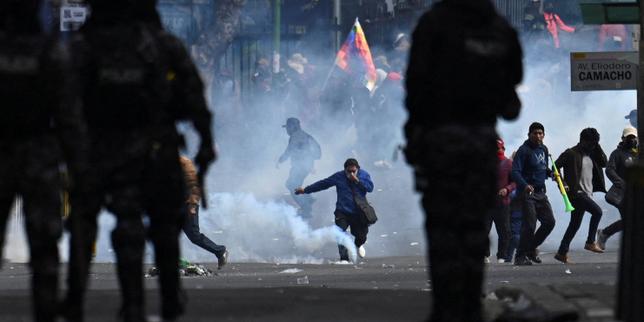
The electoral victory of Rodrigo Paz in late 2025 ended nearly two decades of Movement Towards Socialism (MAS) governance, signaling a sharp pivot toward market-oriented economic policies. Six months into his administration, however, the executive branch faces an escalating wave of national road blockades, coordinated labor strikes led by the Central Obrera Boliviana (COB), and systemic urban unrest.
The standard narrative attributes this volatility to ideological resistance from displaced socialist factions. This diagnosis misinterprets the structural mechanics of the crisis. Paz’s primary challenge is not merely political friction; it is a binding macroeconomic constraint inherited from the systemic depletion of Bolivia's natural gas reserves, combined with a volatile clash between institutional shock therapy and the embedded legal and social veto power of the country’s popular syndicalist organizations.
The Macroeconomic Framework: The Hydrocarbon Capital Deficit
To evaluate the constraints operating on the current administration, one must first model the structural decay of Bolivia's primary economic engine over the preceding two decades. The "Social-Communitarian Productive Economic Model" implemented under MAS relied heavily on the nationalization of hydrocarbons to fund extensive domestic subsidies, public investment programs, and fixed currency pegs.
[Declining Gas Fields] ---> [Asshed Export Revenues] ---> [Severe Dollar Scarcity] ---> [Inflation & Fuel Shortages]
This model contained an structural vulnerability: a failure to reinvest capital into upstream exploration. The resulting production curve created an acute balance-of-payments crisis that matured precisely as Paz assumed office.
The Fiscal Contraction Mechanism
- Hydrocarbon Depletion: Aggregate natural gas production fell from a peak of approximately 60 million cubic meters per day (MMmcd) in 2014 to under 35 MMmcd by 2025. This production collapse converted Bolivia from a net energy exporter into a vulnerable importer of refined liquid fuels.
- The FX Liquidity Squeeze: The decline in export volumes, paired with a rigid dollar-peg maintained until the late-stage collapse, systematically drained the Central Bank of Bolivia’s (BCB) net international reserves.
- The Import-Subsidy Trap: The state retained a statutory monopoly on the import of diesel and gasoline, selling it domestically at heavily subsidized, below-market prices. As international prices decoupled from fixed domestic retail caps, the fiscal cost of these subsidies escalated, directly widening the non-financial public sector deficit.
By the time the Paz administration initiated its transition toward market liberalization, inflation had structurally breached 23%, fueled by a parallel, unregulated market for US dollars and severe local supply bottlenecks at retail service stations. The administration’s corrective policy framework—designed to reduce state spending, privatize state-managed entities via executive decrees such as DS5503, and attract foreign direct investment (FDI)—was introduced into an economy experiencing an acute stagflationary shock.
The Political Economy of Syndicalist Resistance
The administration's stabilization agenda underestimates the institutional architecture of Bolivia’s social landscape. Under the 2009 Constitution, the country operates less as a traditional representative democracy and more as a hybrid plurinational state where organized social movements hold de facto legislative and territorial veto power.
The Sectoral Coalition Model
The resistance paralyzing Bolivia's transit networks is not an uncoordinated outburst; it is a highly structured mobilization managed by an interlocking matrix of rural and industrial syndicates. The resistance operates across three main axes:
- The Agrarian and Coca-Grower Blocs: Controlling the critical arterial highways connecting the agricultural lowlands (Santa Cruz) to the political center (La Paz) and the valleys (Cochabamba). By establishing over 30 active transit blockades, these groups disrupt internal supply chains, instantly exacerbating urban food inflation.
- The Industrial Labor Union (COB): Operating as a centralized bargaining unit, the COB initiated an indefinite general strike following the May 1st cabildo (popular assembly) in El Alto. Their structural lever is the threat of total suspension of formalized urban economic activity.
- The Mining Cooperatives (FENCOMIN): These independent mining associations possess highly organized, self-financed workforces. Their entry into the anti-government front was triggered by administrative friction—specifically, the executive branch's refusal to grant immediate audiences regarding the expansion of concession areas and the restructuring of state mining enterprises.
This popular bloc views the transition toward economic liberalization not as a technical correction, but as an existential threat to the legal frameworks that guaranteed communal land rights and resource rents. When the administration deploys law enforcement to clear arterial roads, it triggers an escalatory cycle: state enforcement is categorized as political repression, which in turn solidifies the internal cohesion of the social movements and shifts their demands from policy modifications to an explicit ultimatum for the president's resignation.
The Trilemma of Economic Liberalization
The core vulnerability of the Paz administration's strategy can be understood through an adaptation of the classic policy trilemma. In a post-socialist extractive economy with high informality, an executive cannot simultaneously achieve:
- Rapid Fiscal Austerity (eliminating fuel subsidies and cutting state expenditures).
- Democratic and Constitutional Stability (avoiding mass civil unrest and maintaining institutional norms).
- Pro-Market Institutional Reform (privatizing assets and shifting toward international capital markets).
                 [1] Rapid Fiscal Austerity
                     /                \
                    /                  \
                   /                    \
                  /      POLICIES       \
                 /      CANNOT FULLY     \
                /       CONVERGE HERE     \
               /                          \
[2] Democratic Stability ------------ [3] Pro-Market Reform
The administration has prioritized Objectives 1 and 3. By advancing liberalization via fast-tracked executive decrees to bypass a fragmented and highly polarized legislature, the government has compromised Objective 2.
The administration’s stated goal is to unlock the country’s vast lithium and untapped mining resources by partnering with foreign capital, particularly from Western markets and the United States. However, international capital requires long-term legal security and regulatory predictability. The visible erosion of domestic stability, characterized by power outages, localized looting, and threats of wider civil conflict, creates a paradox: the aggressive implementation of pro-market reforms disrupts the foundational stability required to attract the very capital those reforms seek to court.
Furthermore, the administration's reliance on external economic aid as a stabilizing bridge is constrained by timing. While negotiations for structural adjustment loans or bilateral credits can take quarters to materialize, the daily fiscal burn rate of importing fuel under a depleted treasury requires immediate liquidity. The parallel currency market acts as an uncoordinated, regressive tax on the population, inflating the cost of basic consumer imports before any structural benefits of market deregulation can trickle down to the informal labor sector, which constitutes over 70% of the active workforce.
Strategic Trajectories and Risk Assessment
The Paz administration cannot resolve the current crisis through a simple binary choice between total state enforcement or complete capitulation. The escalation of nationwide blockades for over 16 consecutive days suggests that a continuation of the current policy trajectory will likely induce institutional paralysis.
To break the deadlock, the executive branch must shift from an absolute decree-based approach to a transactional political strategy. This requires segmenting the opposing social coalition. While the political leadership of the MAS remnants seeks to leverage the unrest to force an early presidential transition or secure legal immunity for past leaders, the constituent unions (such as FENCOMIN and specific regional sectors of the COB) are motivated by distinct economic demands regarding work concessions, local autonomy, and targeted inflation relief.
The administration’s viable path to stabilizing the state requires a sequenced framework:
- De-escalate the Absolute Subsidy Rollback: Transition from immediate, blanket price liberalizations to a tiered, targeted voucher system for public transit and agricultural transport. This preserves a portion of the fiscal savings while mitigating the direct inflationary shock on the lowest income deciles.
- Establish Direct Sectoral Negotiations: Bypassing the broad political front to negotiate directly with key material actors like FENCOMIN. Addressing specific administrative demands regarding mining concession boundaries can detach these high-leverage groups from the broader blockading coalition.
- Formalize Reform through Legislative Compromise: Rather than relying exclusively on controversial decrees like DS5503, the executive must build shifting legislative majorities in a diverse parliament. Securing legislative ratification for infrastructure and extraction projects, even at the cost of offering greater regional revenue-sharing allocations to the departments, is the minimum requirement to signal genuine legal security to international investors.
Failure to execute a structural pivot of this nature risks converting a temporary balance-of-payments crisis into a structural breakdown of state authority, where the territorial control of the executive is increasingly confined to major urban administrative centers while rural transit and strategic resource zones become functionally ungovernable.
Bolivia's departure from socialist rule: Will pro-market Rodrigo Paz deliver?
This broadcast offers essential macroeconomic and political context regarding the historical transition from twenty years of MAS governance to the market-oriented policies of the Rodrigo Paz administration, highlighting the structural energy and currency crises that underpin the current civil unrest.