The water in a competitive swimming pool is never truly still. Even after the swimmers climb out and the ripples die down, a microscopic hum remains, a ghost of chemical friction and heavy breathing.
In 1992, in Barcelona, a fourteen-year-old girl stood at the edge of that water. Her name was Sarah Storey. She was born with a left hand that did not fully form, a structural detail that the world categorized as a limitation. But the water does not care about anatomy; it only cares about force and fluid dynamics. That teenager dove into the pool and swam until she won two gold medals.
Then she kept swimming. For more than a decade, through Atlanta, Sydney, and Athens, the pool was her universe. She gathered five gold medals in the water. She became a fixture of British greatness before she was old enough to rent a car.
But bodies are beautiful, fragile machines that eventually rebel against monotony.
By 2005, a persistent, brutal ear infection crippled her ability to train in the water. The pool, her sanctuary for thirteen years, became a hostile environment. Imagine the psychological cliff of that moment: everything you are, everything you have engineered yourself to be since childhood, is suddenly locked behind a door you cannot open.
Most people would look at five Paralympic gold medals, smile, and settle into the quiet comfort of a legacy.
Storey bought a bike.
The Metamorphosis
Switching sports at twenty-seven is not an athletic pivot; it is an act of violent reinvention.
Swimming relies on long, sleek muscles and upper-body torque. Cycling demands a monstrous cardiovascular engine and legs capable of enduring a slow, burning suffocation. The transition was agonizing. Storey pushed her body so hard into this new discipline that she ran herself straight into the brick wall of chronic fatigue syndrome. Four years of physical hell followed.
She coached herself through the darkness. She studied the telemetry of her own exhaustion.
When she emerged, she was no longer just a swimmer who happened to ride a bike. She was a cycling savant. By the time the London 2012 Games arrived, she was so dominant that she nearly forced her way onto the able-bodied Olympic team pursuit squad.
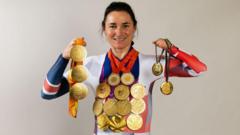
The medals did not just return; they multiplied. Fourteen gold medals on the track and the open road. Nineteen Paralympic golds in total across her life, alongside twenty-nine World Championship titles.
Numbers like that lose their meaning after a while. They become abstract, like the distance between stars. To understand the gravity of Dame Sarah Storey, you have to look past the metal around her neck and look at the calendar.
Nine Paralympic Games. Thirty-five years as an international athlete.
Sports systems are designed to chew teenagers up and spit them out by their mid-twenties. To survive at the absolute pinnacle of global sport for three and a half decades requires a specific, quiet kind of madness. It means waking up to an alarm at 5:00 AM in the freezing rain of a Manchester winter, decade after decade, long after you have proven everything to everyone.
The Quiet Room in Macclesfield
And then, on a random Thursday, the clock simply runs out of ticks.
Sitting in a busy cafe in Macclesfield, holding a cup of coffee while the world bustled past outside, the forty-eight-year-old grandmother of British sport decided she had reached the final turn. She announced her retirement from elite international competition.
She did not do it because her body broke.
"Physically, I fully believe that I could be on that start line in Los Angeles, confident of defending my two titles from Paris," she noted. The machine is still working perfectly. The lungs still draw fire; the legs still produce the watts.
But the invisible stakes had shifted.
The tragedy of elite sport is that it requires an absolute, borderline pathological selfishness. Every meal, every hour of sleep, every family vacation is sacrificed to the god of the podium. For thirty-five years, Storey lived under that tyranny. Her parents had warned her when she was a child to always have another string to her bow, to prepare for the day the cheering stopped. She listened.
She realizes that her voice is now more dangerous to the status quo than her legs.
Para-sport is at a delicate, frustrating crossroads. Despite the glossy montages and the occasional burst of prime-time television coverage during a Paralympic summer, the reality on the ground remains stubbornly segregated.
"There's also no doubt in my mind that, within Para sport, we have stalled somewhat since London 2012," Storey admitted. The momentum of that golden London summer has slowed to a crawl. In the United Kingdom, she has spent years banging her head against bureaucratic walls, advocating for combined national championships where disabled and non-disabled cyclists race on the same roads on the same weekend. The authorities have repeatedly demurred.
You can ignore an athlete on a bicycle. You cannot ignore a legend with a microphone and a lifetime of receipts.
The Final Chord
Leaving sport while you are still unbeaten is a luxury afforded to almost no one. Most athletes are forced out by injury, age, or selection committees that simply stop calling. They leave smelling of liniment and regret.
Storey walks away as the reigning Paralympic champion, having taken double gold in Paris. She leaves on her own terms, stepping back two years before what would have been a historic tenth Games in Los Angeles.
She took a last sip of her coffee, smiled, and hurried off to her next appointment. She has active travel policies to write, infrastructure to redesign, and an entire sporting establishment to drag into the modern era.
Behind her, the international cycling circuit will keep spinning, but the air feels a little thinner now. A kid who dove into a pool in Spain more than thirty years ago changed the geometry of what we think a human body can endure. The bike is back in the garage. The jersey is packed away. The long lap is finally over.