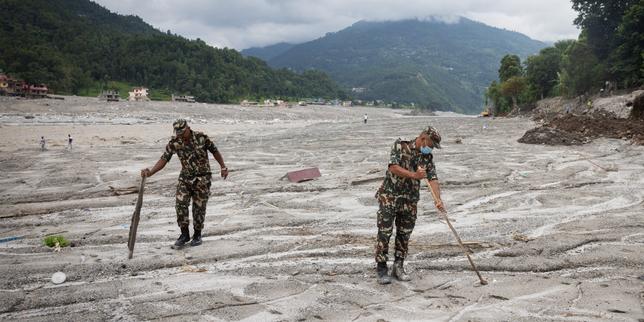
Disaster response in high-altitude environments is governed by severe logistical friction, where topological barriers dictate rescue velocity more than financial capital or political will. Following the catastrophic glacier collapse and subsequent flash floods in Nepal, the operational reality on the ground exposes the limits of traditional emergency management frameworks. When thousands are missing and infrastructure is pulverized, recovery operations transition from standard humanitarian efforts to complex supply-chain engineering problems under extreme constraints.
The Three Vectors of Operational Friction
The persistence of search operations despite mounting days elapsed highlights three distinct variables that restrict rescue efficacy: topological isolation, payload delivery constraints, and structural obstruction within subterranean zones.
Topological isolation remains the primary bottleneck. Mountainous terrain disrupts terrestrial supply lines, fracturing regional connectivity when bridge networks and arterial roads collapse. Ground units cannot deploy heavy earth-moving machinery efficiently because transit routes are severed by debris fields and unstable mudflows.
Payload delivery constraints compound this isolation. Aerial logistics, typically the default intervention vector for inaccessible zones, face severe performance degradation at high altitudes. Thin air density reduces helicopter lift capacity, preventing heavy-lift aircraft from landing at localized operational nodes to offload vital stabilization equipment or structural shoring gear. Logistics planners must constantly optimize payload weights against altitude density altitudes, resulting in fractional equipment delivery compared to baseline urban disaster response.
Subterranean obstructions define the final vector. Rescue vectors focusing on tunnels and enclosed infrastructure face high risks of secondary collapses. Shifting sediment, residual water pressure, and compromised structural integrity require slow, manual excavation techniques rather than rapid mechanical clearing.
The Temporal Decay Function of Survival Probability
In mass casualty events caused by glacial floods, the survival probability of trapped individuals follows a steep negative exponential curve relative to time elapsed. Beyond the initial golden hours, survival rates depend entirely on micro-environmental factors such as air pockets within blocked tunnels or pockets protected from direct hydraulic impact.
As days turn into weeks, the operation shifts phase profiles. The primary objective transitions from acute trauma rescue to body recovery and structural triage for displaced populations. Managing tens of thousands of destroyed or uninhabitable housing units introduces a secondary humanitarian crisis that competes directly with ongoing search assets for logistical bandwidth. Shelter, potable water distribution, and disease vector control require immediate resource diversion from the primary disaster epicenters.
Financial Allocation and Resource Liquidity
External interventions, such as emergency funding appeals launched by international bodies like the United Nations, serve to inject necessary capital liquidity into a strained national treasury. However, capital availability does not immediately translate to physical throughput. Financial resources cannot bypass the physical limits of narrow mountain passes or accelerate the stabilization of saturated hillsides.
The allocation function must prioritize dual-track execution: maintaining high-intensity subterranean excavation where live extraction remains statistically plausible, while simultaneously staging reconstruction materials for the post-emergency housing phase. Centralized command structures must dynamically reallocate rotor hours between search teams and supply drops to prevent secondary mortality among vulnerable populations exposed to elements without shelter.
Prioritize localized equipment staging platforms at mid-altitude transitional hubs to bypass heavy-lift helicopter limitations, deploying specialized light-payload drone reconnaissance to map structural voids before committing manual extraction teams into unstable tunnels.
Crue au Népal : des disparus toujours en vide ?
This video provides a direct look at the ongoing search operations inside tunnels and the specific challenges faced by rescue teams days after the disaster in Nepal.