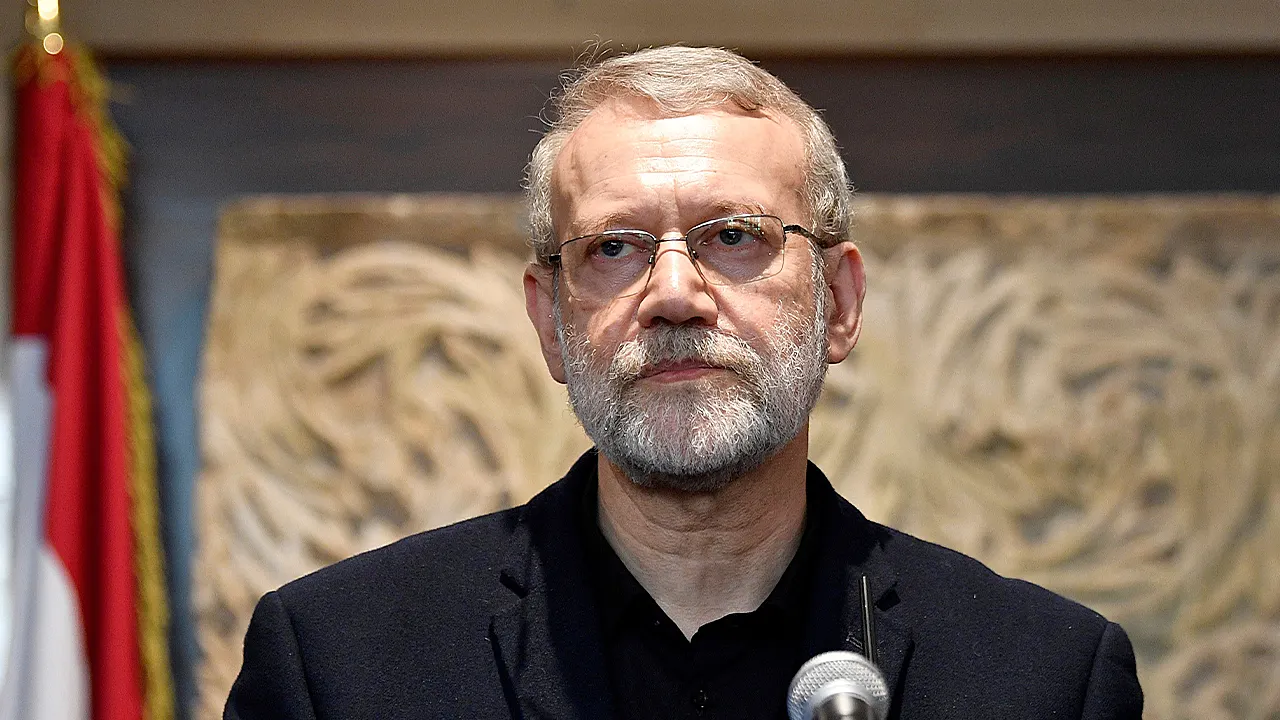
The removal of Ali Larijani from the Iranian political chessboard via an Israeli kinetic strike does not merely eliminate a high-ranking official; it destroys the primary connective tissue between the Islamic Revolutionary Guard Corps (IRGC), the clerical establishment, and the pragmatic technocracy. Larijani functioned as the ultimate hedge against systemic volatility. His death forces the Iranian regime into a binary state—total radicalization or structural paralysis—by removing the only actor capable of translating ideological mandates into functional diplomacy.
The Triad of Larijani’s Strategic Utility
To understand the magnitude of this vacuum, one must quantify Larijani’s role across three distinct operational domains. He was not a "moderate" in the Western sense; he was a stabilizer of the absolute autocracy.
- The Legislative-Security Pivot: As a former Speaker of the Parliament and Secretary of the Supreme National Security Council, Larijani held the blueprints for the regime's most sensitive files, including the nuclear program and the 25-year strategic pact with China.
- The Dynastic Buffer: Belonging to the influential Larijani family, he represented a landed, scholarly aristocracy that provided the Supreme Leader with an alternative to the pure military-industrial complex of the IRGC.
- The Backchannel Architect: Larijani was the rare figure who possessed the ideological "purity" to satisfy the hardliners while maintaining the linguistic and diplomatic fluency required to negotiate with Beijing, Moscow, and, covertly, Washington.
The Strategic Miscalculation of the Succession Crisis
The timing of this strike intersects with the internal struggle to succeed Ayatollah Ali Khamenei. In the Iranian political ecosystem, power is not strictly constitutional; it is managed through a "Council of Shadows." Larijani was the leading candidate to head the Expediency Council, the body designed to resolve deadlocks between the Parliament and the Guardian Council.
His removal eliminates the "Middle Path." The Iranian political spectrum has now been compressed. This creates a dangerous feedback loop:
- Decreased Friction: Without Larijani’s pragmatic skepticism, the IRGC faces fewer internal hurdles when proposing escalatory regional measures.
- Information Asymmetry: Larijani often acted as a reality-check for the Office of the Supreme Leader. His absence increases the likelihood of "groupthink" within the inner circle, where ideological fervor replaces cold-eyed geopolitical assessment.
- Succession Narrowing: The pool of viable candidates who can command the respect of both the traditional clergy and the modern military has effectively shrunk to near-zero. This paves the way for a "Military-Clerical" hybrid state, potentially led by Mojtaba Khamenei, which lacks the traditional checks once provided by the Larijani bloc.
The Cost Function of Kinetic Decapitation
Israel’s strategy of targeted liquidation operates on a specific cost-benefit calculus. By targeting Larijani, Israel has signaled that it no longer distinguishes between the "Grey Zone" negotiators and the "Red Zone" military commanders.
The immediate tactical gain for Israel is the disruption of the Iranian-Syrian-Lebanese logistical chain, a file Larijani was reportedly overseeing to stabilize the "Axis of Resistance" after the degradation of Hezbollah’s leadership. However, the long-term structural impact is the "Decapitation of the Brain" rather than the "Hand." While killing a general like Soleimani disrupts operations, killing a strategist like Larijani disrupts the philosophy of the state.
The Breakdown of the Diplomatic Insulation
Larijani was the primary architect of the "Look to the East" policy. He understood that Iran’s survival depended on its ability to act as a crucial node in the Belt and Road Initiative. Without his personal relationships in Beijing, Iran’s leverage in the 25-year agreement may weaken. Chinese officials value continuity and personal loyalty; the sudden removal of their primary interlocutor creates a "Trust Deficit" that the IRGC—viewed by Beijing as a volatile and unpredictable partner—cannot easily fill.
The Radicalization of the Iranian Interior
Internal stability in Iran relies on a delicate balance between the "Bazaaris" (merchant class), the "Mostazafan" (the oppressed/working class), and the "Aghazadeh" (the children of the elite). Larijani was the patron of the elite technocracy. His death sends a chilling message to the Iranian bureaucracy: loyalty and high-level service provide no immunity.
This creates a "Brain Drain" within the security apparatus. High-level officials who previously viewed themselves as protected diplomats now realize they are legitimate military targets. This realization leads to two possible behaviors:
- Defection or Withdrawal: Essential technocrats may distance themselves from high-stakes files to avoid Israeli crosshairs.
- Total Commitment to Escalation: If diplomacy offers no safety, the remaining leadership may conclude that only the ultimate deterrent—nuclear breakout—provides personal and national security.
The Failure of the Iranian Intelligence Shield
The fact that Larijani was located and neutralized highlights a catastrophic failure in Iranian Counter-Intelligence (CI). The IRGC’s CI unit has been compromised for years, as evidenced by the assassination of Mohsen Fakhrizadeh and the theft of the nuclear archives.
The penetration of the inner sanctum suggests that the Israeli Mossad has achieved "Information Supremacy" within the Iranian capital. Every meeting, every safe house, and every transport route is potentially compromised. For a regime built on secrecy and the "shadow" nature of its powerbrokers, this transparency is a terminal threat. It forces the leadership into deep bunkers, further isolating them from the reality of the Iranian street and the international community.
The Mechanism of Modern Attrition
We are witnessing a shift from "Symmetric Warfare" to "Systemic Attrition." Israel is not attempting to invade Iran; it is systematically removing the "Processors" of the Iranian state.
- Tier 1 Targets: Field Commanders (Soleimani, Sayyed Razi Mousavi).
- Tier 2 Targets: Scientists (Fakhrizadeh).
- Tier 3 Targets: Strategic Architects (Larijani).
By removing the Tier 3 layer, Israel ensures that even if Iran has the weapons and the soldiers, it lacks the intellectual infrastructure to deploy them effectively in a grand-strategic context.
The Resulting Geopolitical Pivot
The death of Ali Larijani marks the end of the "Dual-Track" Iranian foreign policy. For decades, Tehran played a "Good Cop, Bad Cop" routine with the West and regional rivals. Larijani was the quintessential "Good Cop" for the hardline establishment.
With his removal, the "Bad Cop"—the IRGC’s Quds Force—is the only voice left in the room. This simplifies the West’s policy options but increases the volatility of the region. There is no longer a credible partner for a "Grand Bargain." Any future negotiations will be purely transactional and highly fragile, as the remaining Iranian leadership lacks the domestic political capital to sell a compromise to their own radical base.
The Iranian state must now decide if it will double down on the IRGC's vision of a "Garrison State" or if it will collapse under the weight of its own internal contradictions. The loss of Larijani means the regime has lost its most effective pressure valve.
The strategic play for regional actors is no longer to wait for Iranian moderation. The moderation engine has been destroyed. All future planning must assume a "Maximum Friction" environment. The removal of Larijani is not an isolated event; it is the final signal that the era of the Iranian "Grey Zone" is over. The conflict has moved into the "White Light" of direct, unmitigated confrontation. Defense postures must shift from containment to active disruption, as the Iranian center of gravity has shifted from the boardroom to the bunker.