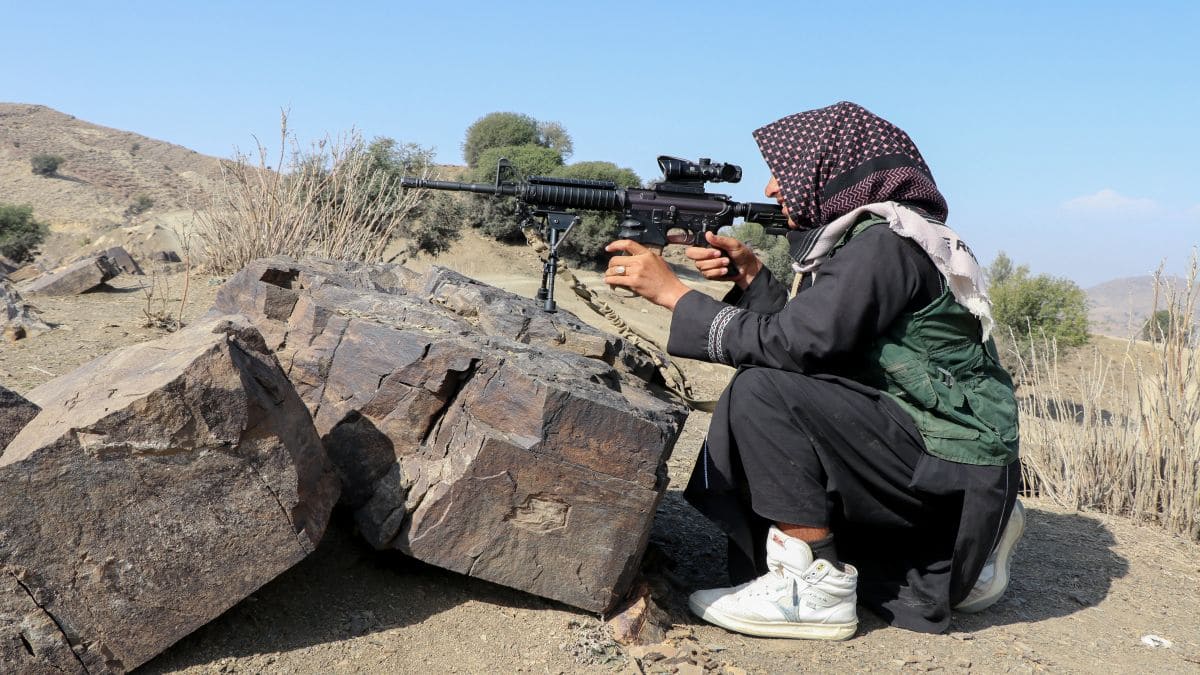
A man named Gul Khan stands on a jagged limestone ridge in the Spin Ghar mountains. Below him, the earth is the color of toasted almonds, scarred by dry riverbeds that look like veins. Gul doesn't see a border. He sees his brother’s house. He sees the graveyard where his grandfather is buried. He sees the narrow, dusty path his goats have trodden for forty years.
Then he sees the fence.
It is a double-row of chain-link topped with coils of razor wire, glinting like silver teeth in the harsh high-altitude sun. To a diplomat in a cooled office in Islamabad or a Taliban official in Kabul, this is the Durand Line. To Gul, it is a physical wound cut through the heart of his inheritance.
We are taught that borders are the skin of a nation. They are supposed to be protective, defining, and stable. But some borders are more like a jagged glass shard left in a wound that refuses to heal. The Durand Line is not a wall between two different worlds; it is a blade that dropped across a single living body in 1893 and has been twisting ever since.
The Ghost of Sir Mortimer
To understand why soldiers are firing rockets across these mountains today, we have to look at a piece of paper signed 133 years ago. Imagine a Victorian gentleman named Sir Mortimer Durand. He is the Foreign Secretary of British India, a man of maps and ink. He is worried about Russians. In the 19th-century "Great Game," the British feared the Russian Empire would sweep down through the mountain passes to seize the crown jewel of India.
Durand sat down with Amir Abdur Rahman Khan of Afghanistan. With a few strokes of a pen, they drew a line 2,640 kilometers long.
It was a "buffer." It was a "sphere of influence." It was also a disaster.
The line was drawn with zero regard for the people living on the ground. It didn't follow ethnic boundaries. It didn't respect watersheds. It simply sliced the Pashtun tribal lands in half. Overnight, families became citizens of two different entities. Villages were split down the middle. One side of the street was technically the British Empire; the other was the Emirate of Afghanistan.
The British left in 1947. They packed their tea sets and their cricket bats and left behind a map that was a ticking time bomb. Pakistan inherited the line as its international border. Afghanistan, however, never truly accepted it. They argued that a treaty signed with a colonial power vanished the moment the colonizer hopped on a boat home.
A Fence of Two Billion Dollars
For decades, the border was a ghost. It existed on maps, but the mountain tribes ignored it. They crossed with their livestock, their trade goods, and their brides. It was an "open" frontier, porous as a sponge.
That changed when the world caught fire. After decades of war, insurgency, and the rise of the Taliban, Pakistan decided that the "ghost" needed to become a wall. They spent over $500 million—some estimates suggest the total security infrastructure costs near $2 billion—to build a massive fence along nearly the entire length of the line.
Construction was a feat of brutal engineering. Engineers used moved heavy machinery up slopes where even pack mules struggle. They built over 1,000 outposts. They installed cameras and sensors.
Pakistan’s logic was simple: we cannot stop the flow of militants, smugglers, and chaos if our front door has no lock. They wanted a "regulated" border. They wanted to know who was coming in and who was going out.
But for the people living there, the "lock" felt like a cage.
Consider the hypothetical, but very real, plight of a merchant in Chaman. For generations, his family moved flour and fruit between markets that happened to be in different countries. Now, he faces biometric scans, long queues, and the sudden closure of gates. When the gates shut because of a diplomatic spat in the capital, his pomegranates rot in the sun. His livelihood vanishes because of a line drawn by a dead Englishman who never saw these mountains.
The Paradox of the Taliban
The strangest twist in this narrative is the current "open war" between Pakistan and the Taliban government in Afghanistan.
When the Taliban retook Kabul in 2021, many in Islamabad breathed a sigh of relief. They expected a friendly, grateful neighbor. Instead, they found a group of nationalists who, despite their shared religious fervor, are even more stubborn about the border than the governments before them.
Taliban fighters have been filmed literally pulling down sections of the fence with tractors. They refuse to recognize the Durand Line as a permanent border. To them, it is an "artificial" imposition. This has led to a surreal irony: Pakistan, which supported the Taliban for years, now finds itself in deadly skirmishes with them over the very fence Pakistan built to keep the "bad actors" out.
The stakes aren't just about pride. They are about the Tehrik-i-Taliban Pakistan (TTP). These are militants who launch attacks inside Pakistan and then vanish into the Afghan mountains. Pakistan demands the Afghan Taliban stop them; the Afghan Taliban suggests the problem is internal to Pakistan.
The border is no longer just a line on a map. It is a pressure cooker. When the pressure gets too high, the artillery starts singing.
The Invisible Stakes
Why should someone sitting in a coffee shop in London or a high-rise in New York care about a fence in the Hindu Kush?
Because this is where the world’s security is weighted. This isn't just a "regional dispute." It is a flashpoint for global extremism, nuclear-armed stability, and the future of Central Asian trade. If the Durand Line "breaks"—if the conflict escalates into full-scale war—the ripples will be felt in energy prices, migration patterns, and international security.
But more importantly, we should care because of the human cost of "certainty."
We crave borders because they provide order. We like to know where "us" ends and "them" begins. But the Durand Line proves that order imposed from the top down, without the consent of the people living under it, is nothing but a slow-motion explosion.
Every time a drone hums over the border or a soldier at a checkpoint asks for a passport from a man who is just trying to visit his dying aunt five miles away, the wound reopens. The "open war" isn't just about territory. It is a struggle between the modern idea of a nation-state and the ancient reality of a people.
The Weight of the Wire
The tragedy of the Durand Line is that there is no easy "fix." Pakistan cannot simply tear down the fence and invite chaos. Afghanistan cannot simply accept a border that cuts through its ethnic soul. They are locked in a grim dance, circling a line that was never meant to last this long.
Late in the evening, when the wind howls through the Khyber Pass, you can hear the fence hum. It’s a low, vibrating sound—the wind catching the chain-link. To the soldiers on either side, it’s the sound of duty. To the politicians, it’s the sound of sovereignty.
To Gul Khan, sitting on his ridge, it sounds like a funeral dirge for a world where a man could walk to his brother’s house without asking a ghost for permission.
The sun sets behind the peaks, casting a long, dark shadow that stretches across the valleys. In the dark, the fence disappears, and for a few hours, the land looks whole again. But the sun always comes back up, and the wire is always there, waiting to catch the light and remind everyone that the blade is still in the wound.
The earth stays silent, indifferent to the ink and the wire, bearing the weight of a border that refuses to stay dead.
Would you like me to analyze the specific historical treaties that preceded the 1893 agreement to see where the legal cracks first appeared?