Silence.
That is the first thing you notice when a rumor hits a trillion-dollar company, not the noise, not the frantic typing on Slack, and certainly not the press releases drafted by crisis communications teams at three in the morning. It is the sudden, suffocating vacuum that forms inside an executive conference room when everyone realizes the founder might be human after all.
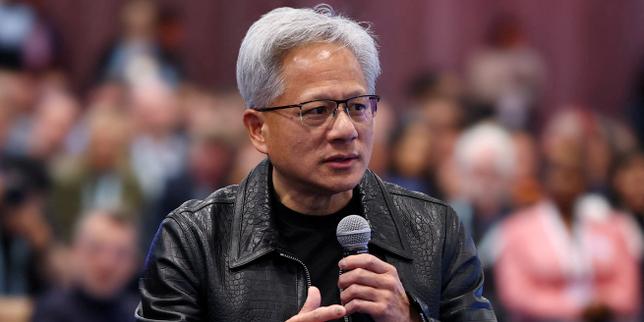
For the past few years, Jensen Huang has been less of a chief executive and more of a secular saint in Silicon Valley. Wearing his signature black Tom Ford leather jacket under the harsh stage lights of keynote arenas, the co-founder of Nvidia built an empire on silicon, audacity, and the relentless drumbeat of artificial intelligence. Wall Street worshiped him. Engineers revered him. He was the rare tech titan who seemed untouched by the messy, tabloid-friendly scandals that had claimed so many of his peers—the messy divorces, the boardroom coups, the whispered allegations of blurred lines between power and intimacy.
Then came the report.
Quietly, almost clinically, business outlets began circulating a story that stripped away the mythos in a single afternoon: a new report alleging that Jensen Huang had a romantic relationship with an Nvidia executive.
No explosions. No immediate stock market collapse. Just a cold, hard headline sitting on the screens of institutional investors, board members, and tens of thousands of employees who had staked their careers on a culture supposedly built on pure, unadulterated meritocracy.
The Anatomy of a Trillion-Dollar Blind Spot
To understand why a single allegation about a personal relationship inside a semiconductor giant carries the weight of a seismic shift, you have to step outside the gossip column and walk onto the floor of a corporate boardroom.
I remember sitting across from a general counsel at a mid-sized software firm a few years ago, watching him stare at an internal audit report with the pale, hollow look of a man watching his life’s work dissolve. His company wasn't worth three trillion dollars, and his CEO didn't wear a leather jacket. Yet the mechanics of the crisis were identical. When the person at the absolute apex of a hierarchy—the individual who decides who gets promoted, who gets equity, and whose project survives the quarterly review—enters into an intimate relationship with someone beneath them on the organizational chart, the entire architecture of trust begins to warp.
Consider a hypothetical scenario to see how this plays out in real time. Imagine a senior vice president at a major chipmaker—let's call her Elena. Elena has spent twelve years grinding through eighty-hour weeks, sacrificing weekends, and leading a hardware division that routinely outperforms expectations. She is next in line for a coveted seat on the executive leadership team. Then, she learns that a peer—let's call him Marcus—who has been quietly dating the chief executive, just received the promotion instead.
Did Marcus earn it on merit? Perhaps. He might be brilliant. He might have worked just as hard as Elena.
That is the tragedy of power dynamics at the top: once the line is crossed, truth becomes irrelevant, and perception becomes absolute law. Elena will never believe the promotion was fair. Neither will the three hundred engineers reporting to her. The invisible currency of the company—the shared belief that hard work and talent are the only metrics that matter—evaporates overnight.
This is why corporate governance boards have spent the last decade rewriting their playbooks with ruthless precision. Think back to 2019, when McDonald’s fired CEO Steve Easterbrook over a consensual relationship with an employee, only to later sue him when investigators uncovered a pattern of concealed relationships and stock grants. Or look at Intel in 2018, when Brian Krzanich resigned after the board discovered a past consensual relationship with a staffer that violated the company’s non-fraternization policy. In both cases, the companies weren't acting as moral police. They were acting as risk managers trying to prevent a catastrophic collapse of internal credibility.
What the Allegations Actually Mean for Nvidia
When a report alleges that Jensen Huang had a relationship with an Nvidia executive, the immediate question from retail investors is simple: Will this hurt the stock?
The honest answer is messy, uncomfortable, and far more nuanced than a ticker symbol can capture.
First, let us separate verified corporate reality from speculation. Nvidia has not collapsed, nor has the company confirmed the details of the report in a way that suggests imminent leadership removal. In fact, corporate history shows that founders who deliver unprecedented shareholder returns are often granted a longer leash by their boards than hired-gun executives. When a leader takes a company from a niche graphics card maker to the foundational backbone of global artificial intelligence, board members tend to look for reasons to preserve stability rather than trigger chaos.
Yet stability at the top does not guarantee immunity from the consequences below.
Under standard corporate governance frameworks—the kind enforced by institutional giants like BlackRock and Vanguard, who hold massive stakes in Nvidia—disclosure is everything. Most Fortune 500 companies maintain strict codes of conduct regarding workplace relationships, particularly when a reporting line or compensation decision is involved. If a relationship between a CEO and an executive was disclosed to the board, vetted by independent directors, and walled off from any direct supervision or pay decisions, the governance fallout can often be contained. The board documents the conflict, establishes a firewall, and moves on.
If it was not disclosed, the story changes entirely.
Secrecy turns a personal matter into a fiduciary failure. Boards do not fire titans because they fall in love; boards fire titans because they lie, conceal, or create unmitigated legal liability for the shareholders. When a CEO hides a relationship with a subordinate executive, every bonus approved, every stock option granted, and every strategic pivot championed by that executive becomes tainted by the possibility of favoritism. It opens the door to shareholder derivative lawsuits, regulatory scrutiny, and bitter internal mutinies from rival executives who suddenly realize the game was rigged.
The Myth of the Flat Organization
For years, Jensen Huang has famously boasted about Nvidia’s unconventional management structure. Unlike traditional corporations burdened by layers of middle management, Huang has maintained roughly forty to sixty direct reports. He doesn't hold regular one-on-one meetings. He prefers open forums where problems are dissected in front of peers, insisting that information should flow freely without political filtering.
It is a fascinating philosophy, and until recently, it looked like pure genius. By keeping the hierarchy flat, Huang stayed close to the engineering truth and moved faster than bloated competitors like Intel or AMD.
Paradoxically, a flat hierarchy makes the allegations surrounding Huang even more fraught.
Think of a traditional corporate pyramid like a suspension bridge—the weight is distributed across dozens of cables, towers, and anchorages. If one cable snaps, the bridge sways, groans, and holds. Now think of Nvidia’s flat structure like a bicycle wheel. Every single spoke connects directly to the central hub. There are no buffers. There are no secondary layers of insulation.
When you have fifty executives reporting directly to one man, that man is the sole sun in their solar system. He controls their visibility, their budgets, their access to the strategic core of the company, and their financial destiny. In such an environment, the boundary between personal affection and professional favoritism isn't just blurry—it is virtually impossible to police. Even if the CEO exercises superhuman restraint, the sheer concentration of authority means the rest of the executive team is forced to wonder whether the rules of gravity apply equally to everyone in the room.
I have watched brilliant teams tear themselves apart over far less. Years ago, while advising a fast-growing hardware startup, I saw two co-founders build a product that could have redefined their sector. One of the founders began a quiet relationship with the head of product. Within six months, the engineering leads stopped speaking candidly in meetings. They assumed anything said in confidence would reach the founder’s pillow by midnight. Ideas dried up. Candor died. By the time the board intervened, the best engineers had already updated their resumes and walked out the door. The company didn't fail because its technology was flawed; it failed because the room stopped being safe for the truth.
The Human Weight Behind the Headlines
It is easy, sitting behind a screen thousands of miles from Santa Clara, to reduce a report like this to a chess match of board seats, bylaws, and stock valuations. We treat executives like avatars in a financial simulation, forgetting the sheer, grinding human reality that underpins these stories.
Running a company at the bleeding edge of global technology is an isolating, all-consuming existence. Jensen Huang has spent over three decades at the helm of Nvidia, surviving near-bankruptcy in the late nineties, enduring years of Wall Street skepticism, and working at a pace that would break most people in a month. When you spend fourteen hours a day inside a pressure cooker, sharing the burden with the few people who actually understand the stakes, emotional and romantic boundaries are tested in ways that outsiders rarely appreciate.
None of that excuses a lapse in governance, nor does it erase the very real power imbalance that exists whenever a chief executive becomes involved with a colleague. Empathy for the human condition does not require blindness to the mechanics of power.
And what about the executive at the center of the report? In almost every corporate scandal of this kind, the spotlight burns disproportionately on the woman or the subordinate partner, reducing decades of technical expertise, leadership, and sacrifice into a single, reductive footnote. Whether a relationship was fully consensual, mutually supportive, or fraught with unspoken pressure, the professional cost is rarely shared equally. The founder remains the face of the empire, protected by legacy and market cap, while the executive’s entire career is suddenly viewed through a prism of doubt.
That asymmetry is the quietest, sharpest injustice in corporate life.
Where Silicon Valley’s Culture War Meets Reality
If you zoom out, this story isn't really about one man or one company. It is about a collision between two eras of Silicon Valley.
For decades, the tech industry operated under a kind of unspoken frontier law. Founders were treated as visionary rebels who shouldn't be constrained by the stuffy corporate rules of East Coast banks or Midwestern manufacturers. If a brilliant engineer built a world-changing platform, boards looked the other way on erratic behavior, blurred personal boundaries, and informal governance. Results were the ultimate absolution.
That era is dying, and its exit is messy.
Today, Nvidia is not a scrappy startup fighting for survival in a strip mall off the freeway. It is a systemic pillar of the global economy. Sovereign nations negotiate with its leadership for compute capacity. Pension funds rely on its dividends and growth to pay teachers and firefighters. When a company reaches that scale, it forfeits the luxury of frontier informality. Institutional investors demand predictable, transparent, and unassailable governance—not out of puritanism, but because billions of dollars depend on the certainty that the company is governed by rules rather than whims.
When a report emerges alleging a relationship between the CEO and an executive, the market watches the board’s response like a hawk. Shareholders aren't asking for a public flogging. They are looking for evidence of an adult in the room. They want to know that the independent directors asked hard questions, reviewed compensation records, verified whether policies were followed, and ensured that no shareholder assets were compromised.
Silence from the boardroom, or a dismissive wave of the hand, sends a chilling message: The rules are for the rank and file, and the king answers to no one.
The Cost of Looking Away
Every organization eventually reveals what it truly values when its most indispensable person is tested.
It is effortless to enforce a code of conduct when a mid-level manager in regional sales violates company policy. Human resources drafts the paperwork, security deactivates the badge, and the company congratulates itself on its integrity. The real test of character—for a board, for an executive team, and for a corporate culture—arrives when the person standing in the gray zone is the one who built the castle.
I think back to the countless conversations I’ve had with young engineers and mid-career managers who idolize figures like Huang. They buy the books, watch the keynotes, and study the management philosophies with genuine devotion. They want to believe that if they work hard enough, think clearly enough, and execute relentlessly, the system will reward them fairly.
When rumors of favoritism or undisclosed relationships swirl at the very top of the pyramid, it doesn't just create a legal headache for general counsel. It punctures that belief. It teaches the next generation of builders that proximity to power matters more than excellence, and that transparency is only mandatory until it becomes inconvenient.
At the end of the day, silicon wafers can be etched with nanometer precision, and neural networks can be trained on trillions of parameters, yet the most fragile component of any enterprise remains stubbornly analog. It is the quiet, unspoken contract between those who lead and those who follow—a contract that takes decades to earn, seconds to fracture, and far more than a leather jacket to repair.