Dawn in eastern Colorado does not break with a trumpet blare. It seeps in, a slow bleeding of indigo into amber across an ocean of grass that looks entirely empty until you learn how to look.
To the untrained eye rushing down Interstate 70, this corner of the state is nothing. It is a brown void, a flat expanse of wind-scoured earth where cattle ribs poke against dry pastures and telephone poles march toward a flat horizon. People drive through it to get somewhere else. They curse the wind that rocks their sedans and sigh at the monotony.
They are missing the theater.
Out here, in the quiet pockets where the shortgrass prairie still breathes untouched by the plow, something ancient is disappearing in plain sight. If you stop the car before the sun clears the horizon, turn off the engine, and just listen, you might catch it: a hollow, bubbling booming sound. Co-oo-oo-hoo. It sounds like someone blowing across the top of an empty glass bottle, rhythmic and persistent, echoing across the frost-biped turf.
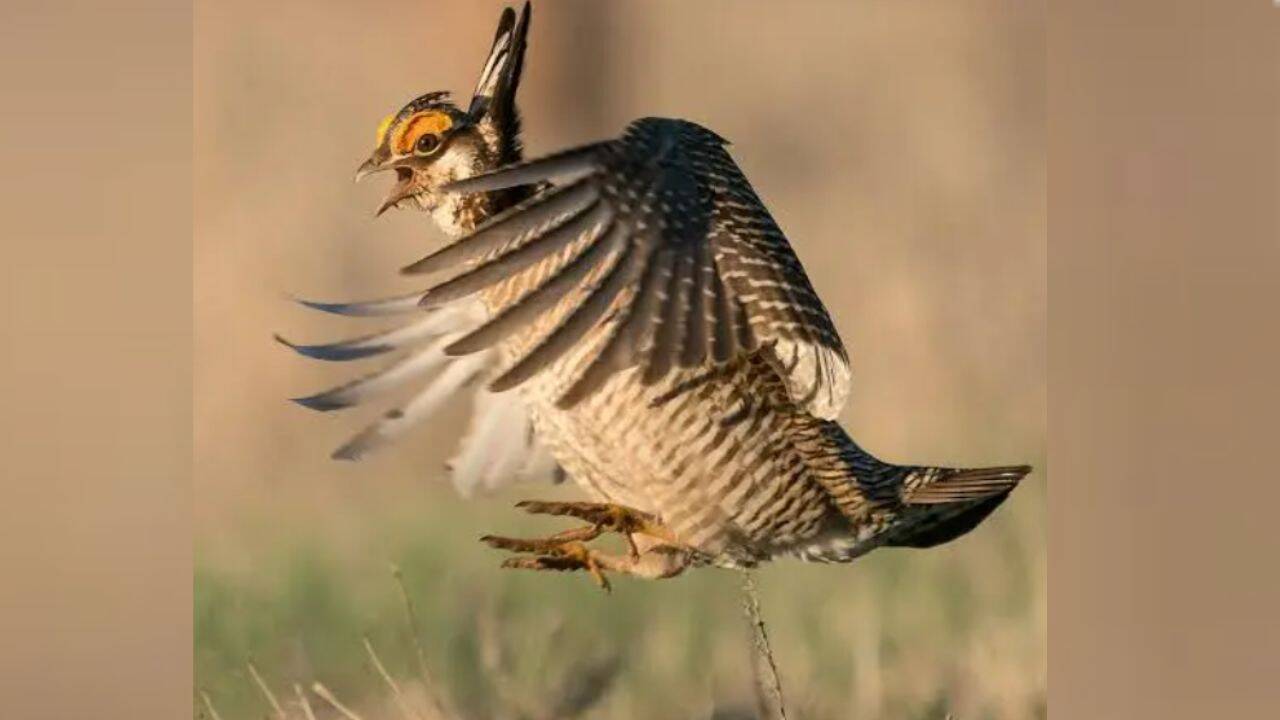
That is the sound of a male lesser prairie-chicken trying to convince the world he is worth noticing.
He is not a large bird—barely heavier than a book, painted in barred patterns of brown and buff that mimic the withered grass blades around him. But on a spring morning, he transforms. He stamps his feet into a furious, vibrating tattoo against the dirt. He inflates bright orange air sacs on the side of his neck until they look like twin ripe oranges, and he snaps his tail feathers open like a deck of cards. He dances. He struts. He leaps into the air, ghost-walking across the lek, fighting his rivals for the right to pass down a lineage that has danced on these very plains for ten thousand years.
Except the audience is vanishing.
Step back fifty years, and these birds were a fixture of the American interior, spilling across five states in numbers so vast they felt permanent. Today, they are ghosts haunting the margins. Agriculture carved up their homes. Oil pumps knocked down their rhythm. Power lines turned their sky into a gauntlet of wire traps. By the time conservation biologists began tracking their numbers with desperate urgency, the lesser prairie-chicken had quietly slipped toward the edge of oblivion, a casualty of progress that didn't even notice it was running something precious over.
This is the invisible story of land conservation. We talk about ecosystems in dry, bureaucratic spreadsheets—acreage targets, zoning permits, mitigation credits, population indices. We reduce survival to percentages. But what is actually happening out here is an eviction.
Consider what happens when a native grassland is plowed under for dryland wheat or subdivided into ranchettes. You aren't just moving animals; you are unpicking a tapestry sewn over millennia. The lesser prairie-chicken is what biologists call an indicator species, which is a sterile way of saying they are the canary in the coal mine. They need large, unbroken tracts of shrub-steppe and sand sagebrush. They cannot adapt to the fragmentation of their world. When the chicken goes, the pronghorn feels the squeeze. The burrowing owl loses a neighbor. The soil microbiota shifts. The whole machinery of the prairie begins to fray at the edges.
For decades, the story of this bird has been one of retreat. Every year, the perimeter shrank. Every spring, the booming grounds grew quieter, swallowed by the hum of center-pivot irrigation rigs and the creeping tide of asphalt.
Then came a shift that caught quiet observers by surprise.
In a decisive move that rewrites the usual script of loss, Colorado didn't just write another policy paper or hand out another advisory pamphlet. The state, working in concert with relentless conservation partners, did something radical and permanent. They bought the land.
Two thousand one hundred acres of it.
The acquisition of this ranch in southeastern Colorado is not merely a real estate transaction. It is an act of defiance against the narrative of inevitable extinction. It means that an entire ecosystem, complete with the sandy soils, the native grasses, and the hidden leks, has been locked away from the plow, the bulldozer, and the subdivision stake. It is a sanctuary carved directly out of the economic pressures that threaten to flatten everything wild.
When you walk that newly secured ground today, the air smells of crushed sage and sun-baked earth. There are no crop rows here. There are no fences cutting the landscape into hostile geometries. It looks remarkably ordinary, which is precisely the point. Conservation isn't always about saving towering mountain peaks or roaring waterfalls; sometimes it looks like a flat, dusty pasture where nothing seems to be happening until you notice the intricate dance of life unfolding in the grass.
The purchase secures a crucial stronghold for the lesser prairie-chicken, anchoring a population that desperately needed a safe harbor. But the broader implications stretch far beyond one species of grouse. It represents a growing recognition that protecting biodiversity isn't a luxury we indulge when times are good. It is the baseline condition for our own survival. A healthy prairie holds water, traps carbon, resists erosion, and buffers against the brutal droughts that sweep the high plains. When we save the chicken's dance floor, we protect the watershed beneath our feet.
There is a vulnerable honesty required when looking at the state of our natural world. We cannot pretend that buying a single ranch solves a continental crisis. The threats facing the shortgrass prairie are structural, economic, and deeply entrenched. Climate shifts, habitat fragmentation, and industrial pressures will continue to batter these frontiers. There are days when the scale of the loss feels overwhelming, when the silence of an abandoned lek feels like a verdict already rendered.
Yet, standing on that ranch as the wind ripples across the grama grass, it is impossible to give in to despair.
Nature has an astonishing capacity for resilience if we simply give her room to breathe. Stop turning the soil, pull back the livestock at the right moment, let the native seeds germinate in the spring rain, and the wild comes rushing back into the vacuum. The birds do not need an invitation; they just need the door left unlocked.
The sun climbs higher over the eastern plains, burning the last blue shadows off the dirt. The temperature rises, the wind picks up its steady, rhythmic sigh, and the morning display on the lek begins to fade into the quiet hum of the afternoon. The dancers retreat into the cover of the sagebrush, resting up for tomorrow's dawn, unaware of property deeds, state budgets, or the frantic human arguments over their future.
They only know that today, the grass is still here. And for now, that is enough to keep the dance going.


