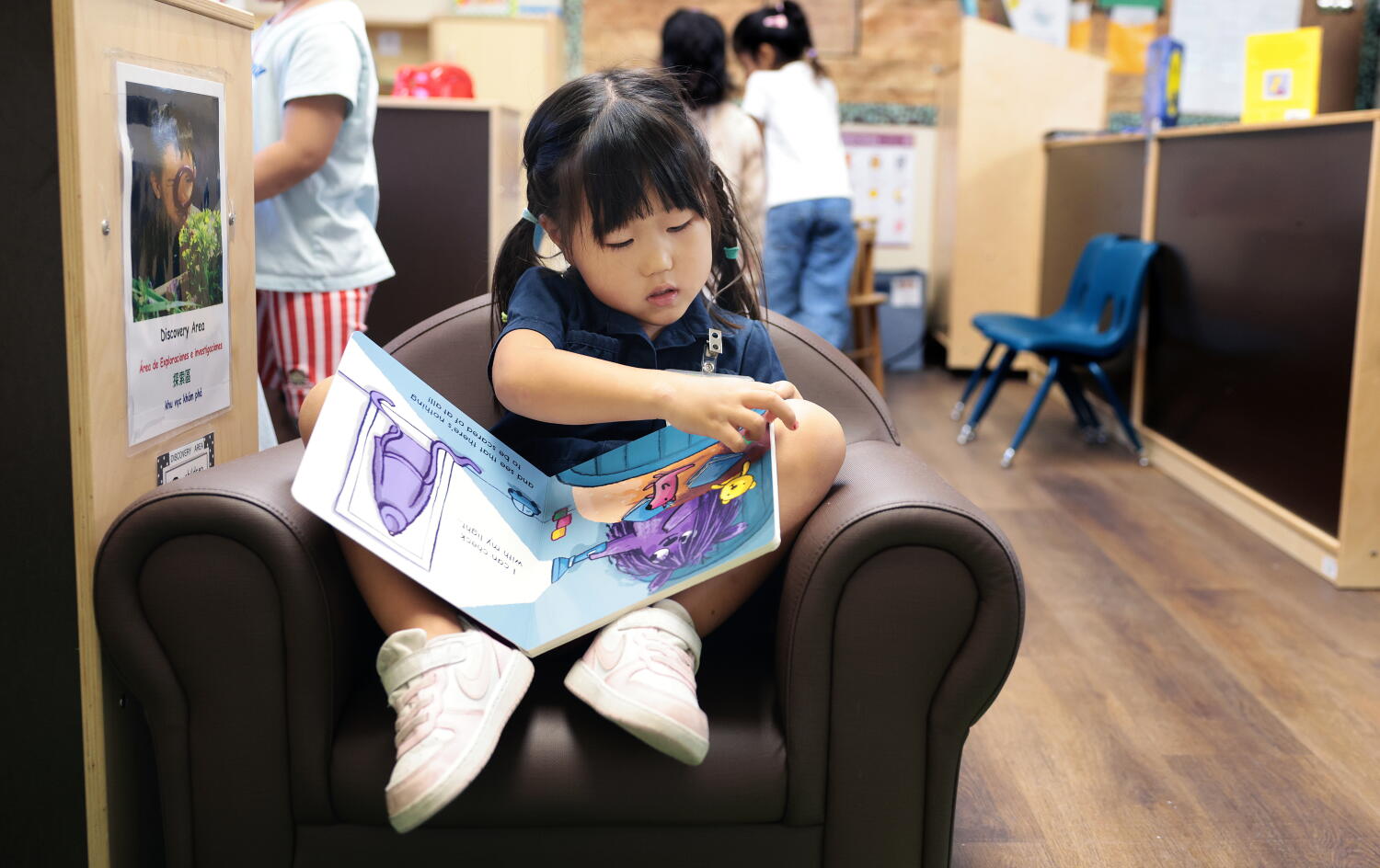
Maria wakes up before the sun hits the corrugated metal roofs of East Los Angeles. Her kitchen smells of scorched coffee and the faint, sweet promise of masa warming on a cast-iron comal. By six o'clock, she is buttoning her four-year-old daughter Sofia into a bright yellow cardigan, whispering reassurances in Spanish. Sofia speaks a hybrid language—a spontaneous dialect born of grandmotherly lullabies and toddler television shows, heavy on Spanish nouns and English syntax.
At seven-thirty, Sofia steps across the threshold of a local Head Start program. Here, the air smells of pine cleaner, Elmer's glue, and baked goldfish crackers. A teacher kneels, meeting the child at eye level. Discover more on a connected topic: this related article.
"Good morning, Sofia," the teacher says, smiling. "Ready to play?"
"Buenos días," Sofia replies, clutching a stuffed rabbit. Further reporting by TIME delves into related perspectives on the subject.
"English only, sweetie," the teacher responds gently, though the rule carries the weight of a lead weight dropped onto tile.
This daily interaction, multiplied across thousands of classrooms from Pacoima to San Pedro, is the quiet epicenter of a brewing political storm. When federal policy proposals surface to mandate English-only instruction for early childhood education programs like Head Start, they are drafted in air-conditioned Washington D.C. boardrooms where spreadsheets replace human breathing. But their shockwaves shatter against the reality of Los Angeles, a city where linguistic diversity isn't an elective credit. It is oxygen.
To understand what happens when you attempt to vacuum a child's native tongue out of a classroom, you must first understand how a four-year-old learns to trust the world.
The Anatomy of a First Classroom
Education policy often reads like an engineering manual. It assumes inputs equal outputs. Pour English in at age four; harvest fluent, standardized citizens at age seven.
Human development is messier.
Consider the cognitive architecture of a child whose brain is actively wiring itself during preschool years. Neurologists call this a period of radical synaptic pruning and formation. Words are not mere labels attached to objects; they are the emotional currency of safety. When a child falls on the playground and scrapes a knee, the cry of ¡Ayúdame, mami! or Help me! is an involuntary reflex of vulnerability.
If a teacher responds with a bureaucratic command to switch codes—to silence the language of comfort—something subtle and tragic happens inside the child's developing psyche. The classroom stops being a sanctuary. It becomes a courtroom.
Los Angeles County is a linguistic mosaic unlike almost anywhere else on earth. In the sprawling neighborhoods served by Head Start, children arrive speaking not only Spanish, but Mixtec, Zapotec, Armenian, Korean, Tagalog, and Mandarin. Head Start was originally designed in 1965 as an equalizer—a weapon against generational poverty. Its architects recognized a fundamental truth: you cannot teach a hungry child, and you certainly cannot teach a terrified one.
Proponents of English-only mandates argue from a place of urgency. They claim that early immersion is the only path to American integration, that holding onto native languages delays assimilation, and that a single linguistic standard ensures fairness.
The logic is seductive in its simplicity. It is also entirely contradicted by decades of developmental research.
What the Data Actually Tells Us
Let us look past the rhetoric and examine the mechanics of bilingualism in early childhood.
When a child enters preschool with a strong foundation in their home language, that native tongue acts as the scaffolding for all future learning. Cognitive flexibility—the ability to switch between tasks, solve complex problems, and inhibit impulsive reactions—is consistently higher in bilingual children. The brain of a dual-language learner is essentially a master juggler, constantly exercising its executive function.
When policy dictates that the scaffolding must be kicked away, the structure wobbles.
Data from early childhood education studies consistently demonstrate that children forced into abrupt, English-only environments often experience what educators call the "silent period." They stop talking altogether. Not because they are learning rapidly, but because they are paralyzed by the fear of making a mistake. In a Head Start classroom, where social-emotional development is supposed to be the primary currency, a silent child is a struggling child.
Imagine walking into a room where everyone is speaking a language you only half-understand. The jokes fly past you. The subtle cues of tone and sarcasm are invisible. You nod when others laugh, hoping nobody notices your confusion. Now imagine you are four years old, away from your mother for the first time, and the primary mechanism you use to express fear, joy, and curiosity has been declared contraband.
That is not education. That is silencing.
The Los Angeles Microcosm
Los Angeles is a city built by immigrants who understood that cultural preservation and civic participation are not mutually exclusive. Walk down Olympic Boulevard on a Saturday morning, and you will hear commerce conducted in three languages within a single block.
To impose an English-only mandate on Los Angeles Head Start centers is to ignore the unique socioeconomic fabric of the region. Many families enrolled in these programs live in mixed-status households where English is secondary or tertiary. Grandparents live under the same roof, speaking only their indigenous or ancestral tongues. If Head Start teachers are legally barred from using a child's home language to bridge the gap, the vital bridge between home and school collapses.
Teachers find themselves in an impossible ethical bind. They became educators because they love children, not because they wish to act as linguistic border guards.
"How do you comfort a crying child who only knows how to say tengo miedo if you are forbidden from saying I'm here, you are safe in Spanish?" asks Elena Morales, a twenty-year veteran of Eastside preschool programs. Her eyes reflect the exhaustion of a profession constantly battered by shifting political winds. "You don't teach them English faster. You just teach them that their feelings don't matter until they translate them into your preferred vocabulary."
The irony is thick. Head Start was created to bridge the achievement gap before kindergarten. Yet, enforcing linguistic uniformity during these critical formative years risks widening the exact gap the program was built to close. Children who are made to feel ashamed of their linguistic heritage early on are more likely to disengage from school entirely by the time they reach adolescence.
The Human Stakes
Policy debates in Washington frequently abstract human beings into data points. We talk about "outcomes," "compliance metrics," and "efficiency models."
Let us bring it back to Sofia.
By December, Sofia’s yellow cardigan is a little worn at the cuffs. She has learned some English words—circle, line up, please. But her laughter has dimmed. At home, she has begun asking her mother why they don't speak American at the dinner table. Her mother, who works twelve-hour shifts packing medical supplies and studies English at night, feels a cold knot form in her stomach.
The policy hasn't just targeted Sofia; it has driven a tiny, invisible wedge between a mother and her daughter. Language is intimacy. When you regulate how a child speaks, you regulate how they love, how they remember, and how they connect to their past.
The true cost of an English-only Head Start mandate in Los Angeles cannot be measured on a spreadsheet. It is measured in the hesitation of a four-year-old raising her hand, then lowering it because she cannot find the right syllables. It is measured in the erosion of trust between marginalized communities and the public institutions meant to uplift them.
Language should be a bridge, not a barricade. As the debate over early childhood education continues to rage in political arenas far from the sun-baked asphalt of Southern California, the children of Los Angeles remain in the balance. They are learning more than vocabulary in those classrooms; they are learning whether the world values who they are, or only who it wants them to become.