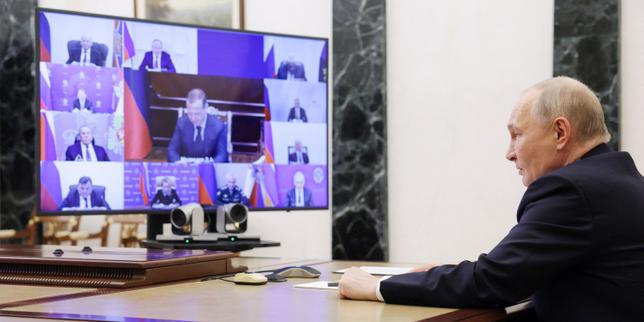
Vladimir Putin doesn't want a nuclear war, but he desperately wants you to think he’s considering one. Every time a Western shipment of long-range missiles or modern tanks crosses the Ukrainian border, the rhetoric from Moscow shifts. We see the same pattern of televised warnings, strategic "exercises" near the border, and cryptic talk about updated military doctrines. It’s a wearying cycle of brinkmanship that has many people wondering if we’re actually closer to the end of the world than we’ve been since 1962.
But if you look past the frightening headlines, you'll see a very specific, calculated strategy at work. This isn't madness. It’s a tool. The Kremlin uses its nuclear arsenal as a psychological shield to compensate for its conventional military shortcomings. They can’t win a direct, high-intensity conflict against the combined might of NATO, so they use the threat of "unthinkable" escalation to keep the West from going all-in. It’s about creating hesitation. It’s about making the cost of supporting Ukraine look just a little too high for the average voter in Paris, Berlin, or Washington. If you liked this piece, you might want to read: this related article.
The doctrine of escalation to de-escalate
There’s a concept that military analysts have debated for years known as "escalate to de-escalate." Essentially, the idea is that if Russia finds itself losing a conventional war, it might use a single, low-yield tactical nuclear weapon. The goal wouldn't be to destroy an entire city. Instead, it would be a "demonstration strike" meant to shock the opponent into freezing in their tracks. It’s the ultimate "stop or I’ll blow us both up" move.
Russian officials, including former President Dmitry Medvedev, have become the loud, aggressive face of this strategy. Medvedev’s social media feeds are a constant stream of apocalyptic threats. While many in the West have started to tune him out as a "crying wolf" scenario, that’s exactly the dangerous territory we’re entering. If the West stops taking the threats seriously, the Kremlin might feel the need to do something more drastic to regain its "credibility." For another angle on this story, see the latest update from The Guardian.
The current reality is that Russia has modified its nuclear doctrine to lower the threshold for use. They’ve stated that an attack by a non-nuclear state (like Ukraine) supported by a nuclear power (like the US or UK) could be grounds for a nuclear response. This is a direct attempt to redraw the red lines that the West has consistently ignored over the last two years.
Why the red lines keep moving
Since February 2022, the Kremlin has drawn dozens of "red lines." First, it was the delivery of Javelin missiles. Then it was HIMARS. Then it was Leopard tanks, followed by F-16s, and eventually, the use of Western weapons to strike targets inside Russian territory. Each time, the West crossed the line, and each time, the Russian response was... more of the same.
This creates a "boiling frog" effect. By gradually increasing support, the West has avoided a sudden, massive provocation that might trigger a nuclear reflex. However, this also means we’re in a constant state of high-tension experimentation. We are testing how much "pain" the Russian state can take before it decides that the survival of the regime is at stake. To Putin, the war in Ukraine isn't just a regional conflict; it's an existential battle against Western encroachment. When a leader believes their life or legacy is on the line, the nuclear button becomes a more logical option than it would be for a rational, secure state.
Tactical vs Strategic weapons
Most people hear "nuclear" and think of the total annihilation of New York or Moscow. That’s strategic nuclear warfare, and it remains highly unlikely because of Mutually Assured Destruction (MAD). Neither side wants to rule over a pile of radioactive ash.
The real danger lies in tactical nuclear weapons. These are smaller, designed for use on a battlefield to destroy a specific military formation or a logistics hub. Russia has a massive numerical advantage in this category, with an estimated 1,500 to 2,000 warheads.
- Yield: Some tactical warheads have a yield of less than one kiloton. For context, the Hiroshima bomb was about 15 kilotons.
- Delivery: These can be fired from the same Iskander missile systems Russia uses daily in Ukraine.
- Purpose: To break the will of the Ukrainian military and force the West to negotiate on Moscow’s terms.
Using one of these wouldn't necessarily start World War III immediately, but it would shatter the "nuclear taboo" that has held since 1945. The global fallout—political, economic, and literal—would be impossible to contain. China and India, Russia's most important remaining partners, have made it very clear that they view the use of nuclear weapons as a hard limit. If Putin goes nuclear, he likely loses Beijing, and that’s a price he probably can't afford to pay.
The role of Belarus and the move Westward
In 2023, Russia began moving tactical nuclear warheads into Belarus. This wasn't a move that changed the military balance—Russia can already hit any target in Europe from its own territory—but it was a powerful symbolic move. It pulled Belarus even closer into Moscow’s orbit and forced NATO’s eastern flank, particularly Poland and the Baltic states, to rethink their entire security posture.
Poland has since expressed interest in joining NATO’s nuclear sharing program. This is exactly the kind of escalation cycle that makes the situation so volatile. Every "defensive" move by one side is seen as an "offensive" provocation by the other. We are back in a Cold War mindset, but without the clear communication channels and "hotlines" that kept the world safe in the 80s.
How to read the signals in 2026
When you’re trying to figure out if the threat is real or just more noise, stop listening to the politicians. Watch the military movement. Strategic nuclear forces are kept in a state of constant readiness, but moving tactical warheads out of storage is a visible process. US and Allied intelligence satellites monitor these storage sites 24/7.
If there’s a real move toward nuclear use, we’ll see:
- Increased activity at known nuclear storage "S" sites.
- Dispersal of mobile launchers into forests.
- Changes in the encrypted communication patterns of the 12th Main Directorate (the branch of the Russian MoD that handles the "special" munitions).
So far, despite all the shouting on Russian state TV, Western intelligence hasn't seen the physical movements that would suggest an imminent strike. The "menace" remains largely verbal.
Dealing with the permanent threat
We have to accept that nuclear blackmail is now a permanent feature of European security. As long as the war in Ukraine continues and the Russian military feels backed into a corner, these threats will happen. Ignoring them entirely is reckless, but paralyzing ourselves because of them is exactly what the Kremlin wants.
The best way to counter this isn't through more rhetoric. It’s through clear, private signaling. The Biden administration and its successors have reportedly told Moscow exactly what the "catastrophic" consequences would be for Russia if they used a nuke. This likely includes the conventional destruction of the Black Sea Fleet or the dismantling of Russian forces within Ukraine by NATO air power. By keeping the response conventional but overwhelming, the West maintains a credible deterrent without immediately jumping to the end of the world.
Don't let the fear-mongering on social media get to you. The nuclear card is played when you have few other cards left. It’s a sign of weakness, not strength. Stay informed by following credible defense analysts who focus on satellite imagery and verified troop movements rather than just translated clips of Russian talk shows. Understand that in this shadow war of nerves, your anxiety is the target. Don't let it hit.
To stay grounded, focus on the specific military capabilities being deployed. Watch the movements of the 12th Main Directorate. Look for reports from the ISW (Institute for the Study of War) or Janes. These sources prioritize physical evidence over political posturing. If the trucks aren't moving at the storage sites, the nukes aren't moving to the front. It’s as simple as that.