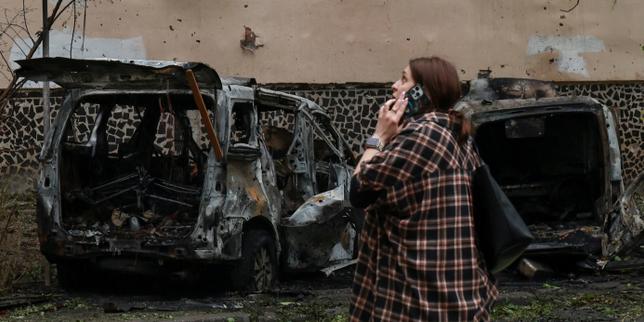
The recent escalation of "massive attacks" across the Ukrainian theater represents a shift from tactical skirmishing to a coordinated strategy of nationwide infrastructural exhaustion. When President Volodymyr Zelensky reports strikes across the entire geography of the state, he is describing a deliberate application of the Deep Battle doctrine, intended to paralyze the rear echelons and induce a systemic collapse of civil and military logistics. This is not merely a series of disparate strikes but a calculated attempt to overwhelm the Ukrainian Integrated Air Defense System (IADS) through volume, variety, and velocity.
The death toll, while a tragic metric of human cost, serves as a lagging indicator of a much larger strategic intent: the forced transition of Ukraine into a "degraded state" where the cost of maintenance exceeds the capacity for defense.
The Triad of Modern Aerial Siege
To understand the mechanics of these massive strikes, one must categorize the incoming threats into three distinct operational layers. Russia utilizes these layers to exploit specific vulnerabilities in Western-supplied defense architectures.
- Saturation Drones (Shahed-class): These low-cost, low-speed loitering munitions are the primary tool for air defense depletion. Their objective is not always to hit a target but to force the engagement of expensive surface-to-air missiles (SAMs). This creates an unfavorable economic exchange ratio, where a $20,000 drone consumes a $2 million interceptor.
- Subsonic and Supersonic Cruise Missiles (Kh-101, Kalibr): These represent the precision strike layer. They utilize complex flight paths and terrain-following technology to bypass radar detection. Their primary targets are high-value "bottleneck" infrastructure, such as electrical substations and thermal power plants (TPPs).
- Hypersonic and Aero-ballistic Assets (Kinzhal, Iskander-M): Reserved for high-priority targets, these munitions move at speeds that minimize the reaction window for defense batteries like the MIM-104 Patriot. Their use signals a target of extreme strategic importance or an attempt to demonstrate the fallibility of "impenetrable" air shields.
The synchronization of these three layers creates a target saturation bottleneck. By timing the arrival of drones and missiles simultaneously, the attacker forces the defender to prioritize targets in real-time, often leading to "leakers"—missiles that pass through because the defense fire-control system is overwhelmed or out of ammunition.
The Calculus of Grid Fragility
The stated objective of these strikes is often "demilitarization," but the operational reality focuses on Energy System Decapitation. A modern state cannot sustain a prolonged high-intensity conflict without a stabilized power grid. The energy system is the "force multiplier" for all other sectors:
- Logistics: Electric locomotives handle the vast majority of heavy freight and troop movements. Grid failure necessitates a pivot to diesel-electric or pure diesel, which increases the fuel consumption rate of the military and creates a secondary supply chain vulnerability.
- Communications: Digital command and control (C2) structures rely on localized power. While Starlink and satellite communications provide a workaround, the ground-based hardware requires consistent charging and cooling, which becomes a logistical burden in a blackout.
- Manufacturing: Domestic production of drones and artillery shells requires stable industrial-grade power. Intermittent outages introduce defects in precision manufacturing and reduce the total monthly output (TMO).
The current wave of strikes targeting the entire country aims to prevent the "islanding" of the Ukrainian grid. By hitting nodes across the East, West, North, and South simultaneously, the Russian military prevents Ukraine from rerouting power from unaffected regions to those in crisis.
Defensive Asymmetry and the Interceptor Deficit
Ukraine’s defense strategy is currently constrained by a fundamental mismatch between the cost of defense and the cost of aggression. In a war of attrition, the side that can produce and deploy assets more cheaply wins the long-term logistical battle.
The "interceptor deficit" is the primary risk factor. Ukraine’s dependence on Western partners for sophisticated interceptors creates a "stop-start" defensive capability. If the delivery of Patriot, IRIS-T, or NASAMS missiles lags behind the rate of Russian launches, Ukraine is forced into a triage defense.
In a triage defense scenario, the military must choose between protecting:
- Critical civilian infrastructure (power plants, water treatment).
- Front-line troop concentrations and command centers.
- Strategic population centers (Kyiv, Lviv).
Every choice to defend one category leaves the others exposed. The recent reports of at least six deaths and strikes across the country indicate that the defensive umbrella is being stretched to its breaking point, allowing more kinetic energy to reach the "soft targets" of the interior.
The Psychological Dimension of Geographic Totality
By striking "throughout the country," the Russian command is engaging in Strategic Terror Logistics. The goal is to destroy the concept of a "safe rear." When the entire geography is under threat, the psychological burden on the civilian population increases, and the government is forced to keep air defense assets dispersed.
If the threat were localized to the front line, Ukraine could concentrate its best systems to protect its maneuvering brigades. By forcing the defense to be everywhere, Russia ensures that the defense is strong nowhere. This dispersion is a classic military maneuver to create "thin spots" in the line that can be exploited by subsequent missile waves.
Operational Constraints and the Hypothesis of Depletion
While the current strikes are massive, they are not infinite. A data-driven analysis must acknowledge the limitations on the Russian side:
- Production Cycles: Despite a shift to a war economy, the production of high-end components (microchips, precision guidance sensors) remains vulnerable to sanctions and supply chain friction. The "gaps" between massive strikes often correlate with the time needed to manufacture a new "salvo-weight" of missiles.
- Launch Platforms: The number of Tu-95MS and Tu-160 bombers, as well as Kalibr-capable ships in the Black Sea, is finite. Maintenance cycles and Ukrainian strikes on airbases (like Engels-2) act as a governor on the frequency of these attacks.
However, the hypothesis that Russia would "run out of missiles"—a common narrative in early 2023—has been proven false. They have instead transitioned to a sustainable strike rate, where the cadence of attacks is calibrated to match their production output and the perceived depletion of Ukrainian SAM stockpiles.
The Strategic Play: Counter-Infrastructural Parity
Ukraine’s response has shifted toward a strategy of Asymmetric Parity. Unable to match the sheer weight of Russian missile salvos, Ukraine has utilized long-range indigenous drones to target Russian oil refineries and fuel depots. This is a "Value-Chain Attack" designed to create an economic mirror to the kinetic pressure they are facing.
The logic is simple: if Ukraine cannot stop the missiles, it must make the cost of launching them unsustainable by hitting the revenue source (oil exports) and the fuel logistics that power the Russian war machine.
Implementation of a Hardened Defense Architecture
To survive this phase of the conflict, the Ukrainian strategy must evolve beyond simple interception. The focus must shift toward Passive Defense and Redundancy:
- Physical Fortification: Enclosing high-value transformers in concrete shells and "Hesco" barriers to mitigate the effect of shrapnel and near-misses.
- Decentralized Power: Moving away from large-scale thermal power plants toward a distributed network of smaller, gas-turbine or renewable-hybrid nodes that are harder to target and easier to repair.
- Electronic Warfare (EW) Dominance: Expanding the use of wide-area GPS jamming and spoofing to degrade the accuracy of cruise missiles and drones, turning precision weapons into "dumb" munitions that are more likely to hit empty fields than critical nodes.
The current situation is a race between the Russian capacity for destruction and the Ukrainian/Western capacity for replenishment and adaptation. The "massive attacks" are not the end-game; they are the opening of a high-stakes phase where the winner will be determined by the ability to maintain a functional state under the constant pressure of kinetic attrition.
The strategic priority for the coming quarter is clear: the acquisition of high-volume, low-cost kinetic interceptors (such as Gepard ammunition and laser-guided rockets) to decouple the air defense mission from the high-cost SAM systems. Failure to achieve this decoupling will lead to a gradual hollow-out of the Ukrainian interior, regardless of the tactical successes on the front lines.