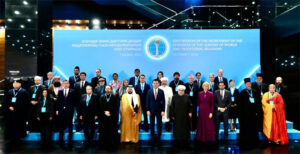
Western foreign policy wonks love a feel-good story about interfaith dialogue. For over two decades, the narrative surrounding Central Asia has been spoon-fed to international think tanks as an inspiring march toward ecumenical harmony. Every three years, Astana rolls out the red carpet for the Congress of Leaders of World and Traditional Religions. Clerics in immaculate robes, robed patriarchs, and smiling imams gather inside the gargantuan Palace of Peace and Reconciliation to sip tea beneath a Norman Foster pyramid—whoops, let us avoid that banned vocabulary—beneath a massive glass pyramid designed by a famous British architect, talking about peace, love, and understanding.
The lazy consensus in every mainstream commentary is that Kazakhstan is a miracle of organic tolerance. The conventional line goes that having survived Soviet state atheism and a sprawling mosaic of over one hundred ethnic groups, this steppe nation naturally evolved a unique formula for peaceful coexistence.
It is a comforting illusion. And it is completely wrong.
Kazakhstan has not spent twenty-three years holding hands across the faith divide because of some romantic commitment to pluralism. It has done so because the alternative is civil fracture, radical insurgencies leaking across porous southern borders, and the total destabilization of a critical energy corridor situated right between Russia and China. What journalists call tolerance is actually high-stakes state containment. It is geopolitical risk management masquerading as spiritual diplomacy. And understanding that distinction changes everything about how you look at the region.
The Myth of Organic Coexistence
Walk the streets of Almaty or Shymkent, and you see real diversity. Mosques stand blocks away from Russian Orthodox cathedrals. But do not mistake the absence of immediate street brawls for grassroots enlightenment.
State control over religious life in Kazakhstan is absolute. If you want to operate a mosque, a church, or any spiritual community, you do not simply rent a storefront and start preaching. You register with the state. You pass background checks. Your sermons are monitored, your literature is audited, and independent religious practice outside approved channels is treated not as a matter of conscience, but as a potential threat to national security.
When the government organizes its massive interfaith summits, it is not facilitating a spontaneous spiritual awakening. It is projecting an image of stability to foreign investors and domestic extremists alike. The message broadcasted from Astana is clear: we control the narrative, we define acceptable belief, and we hold a monopoly on public morality.
Western analysts routinely misread this top-down authoritarian architecture as liberal progress. They see a synagogue, a church, and a mosque in the same city and assume it happened through grassroots goodwill. In reality, it works because the state acts as an uncompromising referee that keeps every faction securely inside a heavily guarded box.
Why the Standard Model Breaks Down
The traditional playbook for studying religious freedom assumes a neat binary. On one side, you have secular democracies that protect individual conscience; on the other, you have authoritarian regimes that suppress it. Kazakhstan defies that lazy dichotomy, which is why outsiders constantly misdiagnose it.
The state is not secular in the Western separation-of-church-and-state sense. Nor is it a theocracy. It is a pragmatic autocracy that views uncontrolled religion as a combustible fuel. Look at what happened during the January 2022 unrest. While those protests began over liquefied petroleum gas prices and economic grievances, the underlying friction exposed how quickly societal fractures can turn violent in a region flanked by radicalized zones in Afghanistan and unstable neighbors in Central Asia.
When religious groups operate outside state oversight, the government worries about foreign-funded Salafism, militant recruitment, and ethnic splintering. To prevent these threats, Astana swings a heavy regulatory hammer. It bans certain movements outright, restricts proselytization, and penalizes unregistered congregations.
Critics call this repression. Defenders call it stability. Both miss the point. It is realpolitik. In a country the size of Western Europe with a population hovering around twenty million, controlling the religious sphere is the price of keeping the country together.
The Economic Realpolitik Beneath the Dome
Why does the state pour millions into hosting international clerics every few years? It is not just about domestic peace. It is about branding.
Kazakhstan sits on a staggering treasure trove of oil, gas, and uranium. To extract and export those resources, it needs billions in foreign capital from Western corporations, Chinese state enterprises, and Russian conglomerates. International investors hate volatility. They want to see a predictable, modern, forward-looking partner.
When foreign executives read headlines about a global center for interfaith dialogue, they see a stable jurisdiction where business can proceed without insurgent interruptions. The interfaith summits are a public relations masterstroke designed to distract from the country's authoritarian political reality while projecting an image of absolute control.
I have watched companies burn millions of dollars in emerging markets because they relied on superficial cultural narratives instead of examining the actual power dynamics on the ground. If you enter Kazakhstan believing it is a progressive paradise of free spiritual expression, your compliance strategy will fail the moment local security services flag your corporate philanthropy as unauthorized religious activity. You have to understand that every social institution here is subordinate to the preservation of the central regime.
Dismantling the Global Dialogue Industry
Every time another high-profile conference convenes in Astana, international media outlets churn out predictable fluff pieces about how Central Asia is teaching the world how to get along. This is journalistic malpractice.
Real religious freedom requires the right to disagree, to apostatize, to proselytize, and to organize without government permission. None of those things exist in an uninhibited form in Kazakhstan. What exists instead is a managed equilibrium. The state allows approved religions to practice within strict boundaries precisely so it can crush any unapproved movements before they gain momentum.
To praise this system as a triumph of tolerance is to misunderstand what tolerance actually means. True tolerance is messy, decentralized, and often uncomfortable for governments because it allows citizens to think and organize independently. Managed harmony is clean, orderly, and entirely dependent on the continued strength of the executive branch.
The Harder Part Nobody Wants to Admit
The competitor article suggests that after twenty-three years of bringing faiths together, the "harder part" of the journey is now beginning. The writers assume that the challenge lies in deepening theological cooperation or expanding dialogue to grassroots communities.
They are looking in the wrong direction.
The real test for Kazakhstan is not how well its handpicked clerics smile for cameras under a glass dome. The real test is what happens when the current economic model faces strain, when youth unemployment bites, and when the younger generation grows tired of a state-dictated identity.
Authoritarian stability has a shelf life. When you suppress organic civil society for decades in the name of peace, you prevent local communities from developing the muscle memory needed to resolve their own sectarian differences. If the central apparatus ever weakens, the pent-up friction will not be solved by another interfaith summit. It will erupt in ways that no amount of government-sponsored harmony can contain.
Stop buying the fairy tale. Kazakhstan is not a laboratory for spiritual enlightenment. It is a masterclass in autocratic risk mitigation. And until international observers learn to look past the photo-ops at the Palace of Peace and Reconciliation, they will keep missing the entire story.


