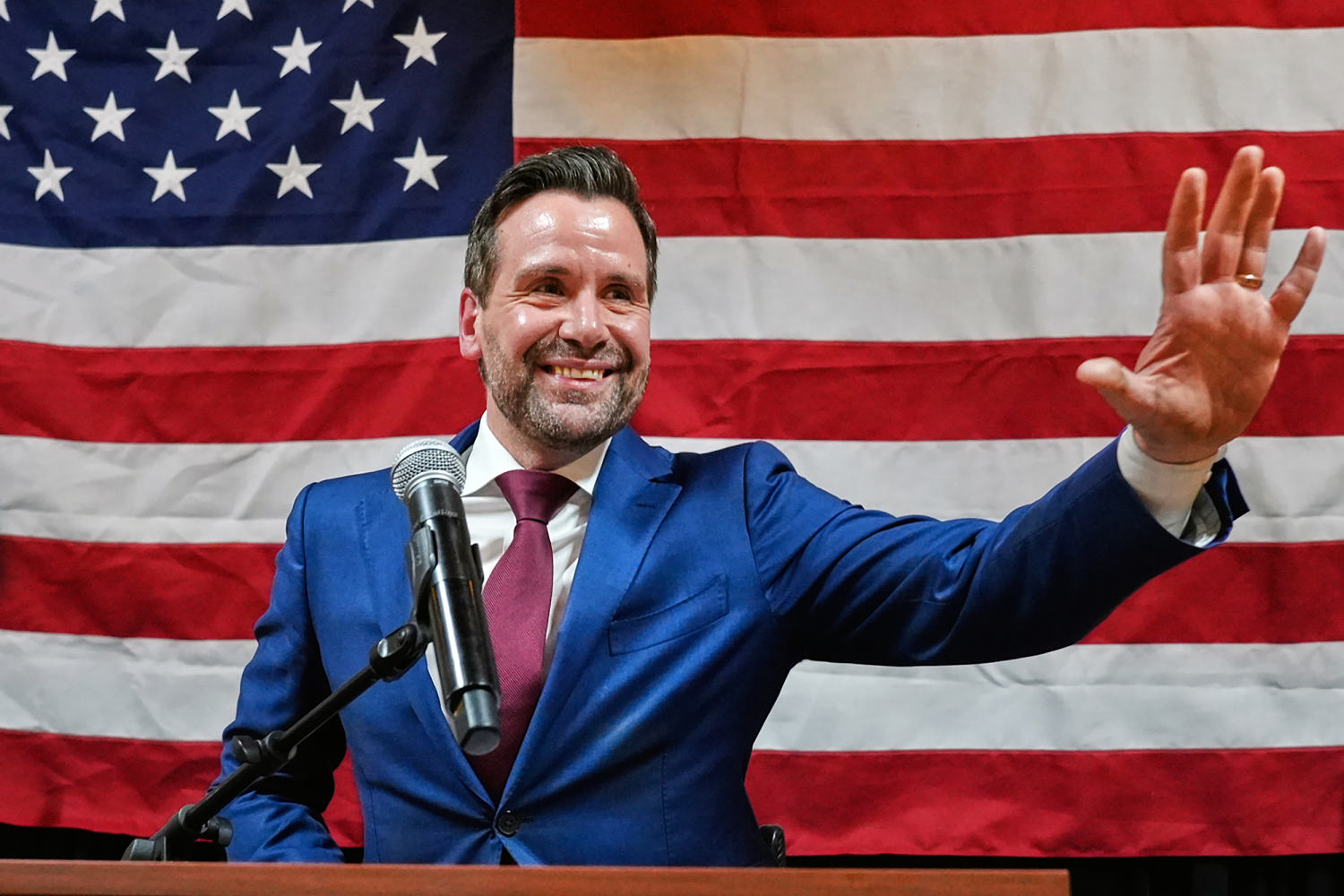
Political pundits love a simple math problem. Seat flips from red to blue. Blue column gains one point. Victory lap commences.
That lazy consensus is currently flooding every cable news chyron and beltway newsletter following Josh Turek’s win in Iowa. The narrative writes itself: a former Paralympic gold medalist pulls off an upset in a deeply red state, proving Democrats have cracked the code to winning back the heartland and securing a path to the Senate majority. For another view, read: this related article.
Stop buying the hype.
If Democratic strategists treat Turek’s victory as a replicable blueprint for taking back the Senate, they are walking straight into a buzzsaw. I have watched political committees burn hundreds of millions of dollars chasing "miracle" candidates in red states, mistaking hyper-local anomalies for national wave indicators. Turek’s win is an impressive personal achievement, a masterclass in constituent service, and a testament to his unique biography. What it is not is a structural realignment of the American electorate. Related coverage on this matter has been provided by USA Today.
The Seductive Lie of the "Blue Shift" in Red States
Every election cycle produces a handful of races that defy gravity. When a Democrat wins in a state that voted heavily for Donald Trump, national observers immediately declare the partisan fever broken. They point to Turek’s background—a wheelchair user, a two-time gold medalist in wheelchair basketball, a guy who built his political brand in the Iowa House by talking about disability rights, working-class kitchens, and local healthcare—and assume that messaging is the silver bullet.
Just run more athletes. Just talk more about kitchen-table issues. Just be authentic.
This advice is useless because it ignores the brutal mechanics of ticket-splitting erosion. Over the past twenty years, the correlation between how a state votes for president and how it votes for Senate has hardened into concrete. Political scientists like Gary Jacobson and Alan Abramowitz have documented this sorting extensively. Voters no longer view Senate races as local contests for regional advocates; they view them as national referendums on which party controls the gavel, the judges, and the regulatory state.
Turek succeeded because he managed to temporarily decouple his personal brand from the national Democratic apparatus. He ran against the national party's reputation as much as he ran against his Republican opponent. That is an extraction mission, not an invasion. You cannot scale an extraction mission across twenty battleground states.
Why Biography Cannot Beat Fundamentals
Let us look at the cold reality of candidate quality versus partisan lean.
Political science models—specifically those built on fundamentals-based forecasting—consistently show that candidate biography accounts for roughly 2 to 4 percentage points in a federal race. In a state that leans Republican by 8 to 10 points, a 4-point biography boost gets you a dignified concession speech, not a Senate seat.
For a candidate like Turek to clear that gap, three separate variables have to align simultaneously:
- An exceptionally flawed or complacent opponent who fails to nationalize the race early.
- A localized issue environment (such as property taxes, rural hospital closures, or agricultural trade disputes) that dominates media coverage over national cultural flashpoints.
- A distinct personal brand built over years of retail politics that immunizes the candidate against standard partisan attacks.
In Iowa, Turek had spent years building credibility in Council Bluffs and across the state legislature. Voters knew him before the national super PACs showed up with their glossy mailers. Try dropping a hand-picked, D.C.-vetted "moderate" into Ohio, Montana, or Texas six months before the filing deadline and telling them to "do what Josh Turek did." They will get eaten alive.
The Structural Math of the Senate Majority
The competitor narrative frames Turek’s win as a massive boost in the fight for the Senate majority. On a purely arithmetic level, yes, gaining a seat beats losing a seat. Every vote on the floor counts the same.
Strategically, however, celebrating this flip as a turning point misdiagnoses where the Senate majority is actually won and lost.
The United States Senate is structurally biased toward rural, less populous states. Every state gets two senators, whether it is Wyoming or California. Because the Democratic coalition has increasingly concentrated in urban centers and college-educated suburbs, the party enters every single election cycle playing defense on an uphill slope.
| Strategic Factor | The Pundit Myth | The Operational Reality |
|---|---|---|
| Driver of the Win | National Democratic messaging resonated with rural voters. | Hyper-local retail politics temporarily bypassed national party branding. |
| Replicability | Any charismatic veteran or athlete can replicate this model. | Authentic local roots take years to build and cannot be manufactured by consultants. |
| Resource Allocation | Pouring money into red states creates a wider map. | Chasing long-shot red seats starves vulnerable incumbents in swing states. |
| Majority Impact | Signals an impending national wave for the party. | Masks deeper structural bleeding among non-college-educated voters. |
When a party celebrates an outlier win in a red state, donors open their wallets for the wrong races. I have seen this exact movie play out before. In 2020, Democratic donors poured over $100 million into Jamie Harrison’s Senate campaign in South Carolina and another $90 million into Amy McGrath’s campaign in Kentucky. Both candidates ran disciplined, high-profile races. Both lost by double digits. Meanwhile, down-ballot races and genuinely competitive swing seats were starved of the marginal dollars that actually decide control of Congress.
The Opportunity Cost of Chasing Miracles
Imagine a scenario where the Democratic Senatorial Campaign Committee looks at Turek’s win and decides to expand the map into three other states with double-digit Republican leans. Every dollar spent on television ads in a state with a 12-point partisan deficit is a dollar not spent on voter registration in Pennsylvania, field organizers in Nevada, or persuasion ads in Michigan.
In modern campaigns, money experiences rapid diminishing marginal returns. Once a candidate has enough cash to saturate the local broadcast markets and fund a basic ground game, dumping another $20 million into the state mostly just enriches media buyers and consultants. The persuadable electorate shrinks to a sliver, and the extra cash yields fractions of a percent.
Turek’s victory creates a dangerous temptation: the illusion that the map is wider than it really is.
What Everyone Is Getting Wrong About the "Working-Class" Voter
If you read the standard post-mortem on Turek’s campaign, you will hear endless praise for his ability to connect with working-class voters. Commentators talk about the working class as if it is a monolithic tribe waiting for a Democrat to wear a flannel shirt and talk about manufacturing.
This is a fundamental misunderstanding of modern voter alignment.
The working class is no longer defined strictly by income; it is defined by educational attainment and cultural geography. Non-college-educated voters in rural counties have shifted right not simply because they dislike Democratic tax policy, but because they feel alienated by the cultural priorities of the coastal, urban institutions that dominate the Democratic brand.
Turek did not win those voters over by convincing them to love the national Democratic platform. He won them over by proving he was not one of them.
The Insider Trap of "Message Tweaking"
Consultants love to believe that voters are rational policy calculators who just haven't heard the right talking points yet. So, after a race like Iowa, they convene focus groups and rewrite the stump speeches. They tell candidates to stop using academic jargon and start talking about "kitchen-table economics."
Voters are not stupid. They can smell a focus-grouped pivot from a mile away.
When a candidate who spent five years marching in lockstep with progressive interest groups suddenly puts on a hard hat and talks about blue-collar dignity in September, voters see right through it. Turek’s appeal worked because his life story—fighting for healthcare access for people with disabilities, competing at the highest level of adaptive sports, knocking on thousands of doors in western Iowa—was undeniable. You cannot fake a gold medal, and you cannot fake decades of living in a community.
The Real Lesson: Stop Nationalizing Local Races
If there is an actual, actionable takeaway from Josh Turek’s Senate win, it is the exact opposite of what the national party operatives want to hear.
To win in red states, the national party needs to get out of the way.
Nationalizing a race is the death knell for any candidate running against the partisan grain of their state. The moment a local Senate race becomes a proxy war between the President and the Speaker of the House, the minority party candidate is finished. The partisan gravity is simply too strong.
Look at how Turek operated:
- He localized the stakes. He kept the conversation tethered to issues where the state and federal governments directly impact daily life in Iowa—Medicaid reimbursement rates, rural infrastructure, and agricultural stability.
- He avoided the national cable news circuit. Notice how rarely Turek appeared on national partisan talk shows compared to other high-profile Senate hopefuls. Every minute a red-state Democrat spends on national television giving soundbites to coastal anchors is ammunition for their opponent's next attack ad.
- He embraced ideological friction. He was willing to break with party orthodoxy when it clashed with the economic interests of his constituents.
The Downside of the Outlier Strategy
I will be entirely transparent about the flaw in my own argument: this strategy makes governing a nightmare.
If the Democratic Party actually manages to build a Senate majority on the backs of hyper-localized, independent-minded mavericks like Turek, that majority will be fractured from day one. A senator who wins by running away from the national party platform is not going to turn around and vote for sweeping, partisan legislation once they get sworn in. They will demand carve-outs, water down bills, and frequently side with the opposition to protect their seat back home.
You saw this exact dynamic play out with Joe Manchin in West Virginia and Kyrsten Sinema in Arizona. Party activists furious about their obstruction completely missed the point: you do not get a progressive rubber stamp from a state that voted for the opposing party by 30 points. You either accept a messy, defiant, frustratingly moderate senator who gives you the majority vote for judges and leadership, or you hand the seat to a hardline Republican for the next twenty years.
Answering the Questions Pundits Are Afraid to Ask
When voters and political junkies search for what Turek’s win means, they are usually asking the wrong questions. Let us dismantle the most common ones.
Does Josh Turek’s win mean Iowa is a swing state again?
No. Iowa is a firmly Republican state at the federal level. One Senate upset driven by unique candidate dynamics and localized discontent does not erase a decade of voter registration trends that heavily favor the GOP. Treating Iowa as a core battleground in a presidential cycle remains a massive misallocation of resources.
Can Democrats use the "Turek Playbook" to win in states like Texas or Florida?
Attempting to port a retail-heavy, small-state strategy into massive media markets like Texas or Florida is a recipe for bankruptcy. Iowa has roughly 3.2 million people and relatively inexpensive media markets where a candidate can genuinely shake hands with a meaningful percentage of the electorate. Texas has over 30 million people spread across twenty distinct media markets. You cannot "retail politics" your way across the Dallas-Fort Worth metroplex; those races are won and lost on macro-level demographic turnout and massive paid media wars.
What should campaigns actually do differently based on this race?
Stop recruiting candidates based on their ability to raise money from out-of-state ideological donors.
Right now, the primary filter for most Senate recruits is their Rolodex. Party committees look for candidates who can dial for dollars in New York, San Francisco, and Washington, D.C. Those candidates inevitably adopt the language and priorities of their coastal donors, which immediately alienates the voters they need to win back home.
Instead, parties need to recruit candidates with deep, pre-existing local roots—mayors, state legislators, local business owners, advocates—who already have an independent base of trust, and then let them run their own campaigns without D.C. consultants rewriting their speeches.
The Brutal Truth About the Road Ahead
Josh Turek earned his seat. He outworked his opponent, leveraged an extraordinary personal story, and kept his focus relentlessly local while the rest of the political world screamed about national culture wars.
But if the Democratic Party looks at his victory and sees a rising tide that will lift all boats, they are hallucinating. One swimmer crossing a freezing river does not mean the water is warm. It just means that specific swimmer was tough enough to survive the current.
Keep celebrating the outlier, keep ignoring the structural math, and watch what happens when the next election cycle hits the rocks.