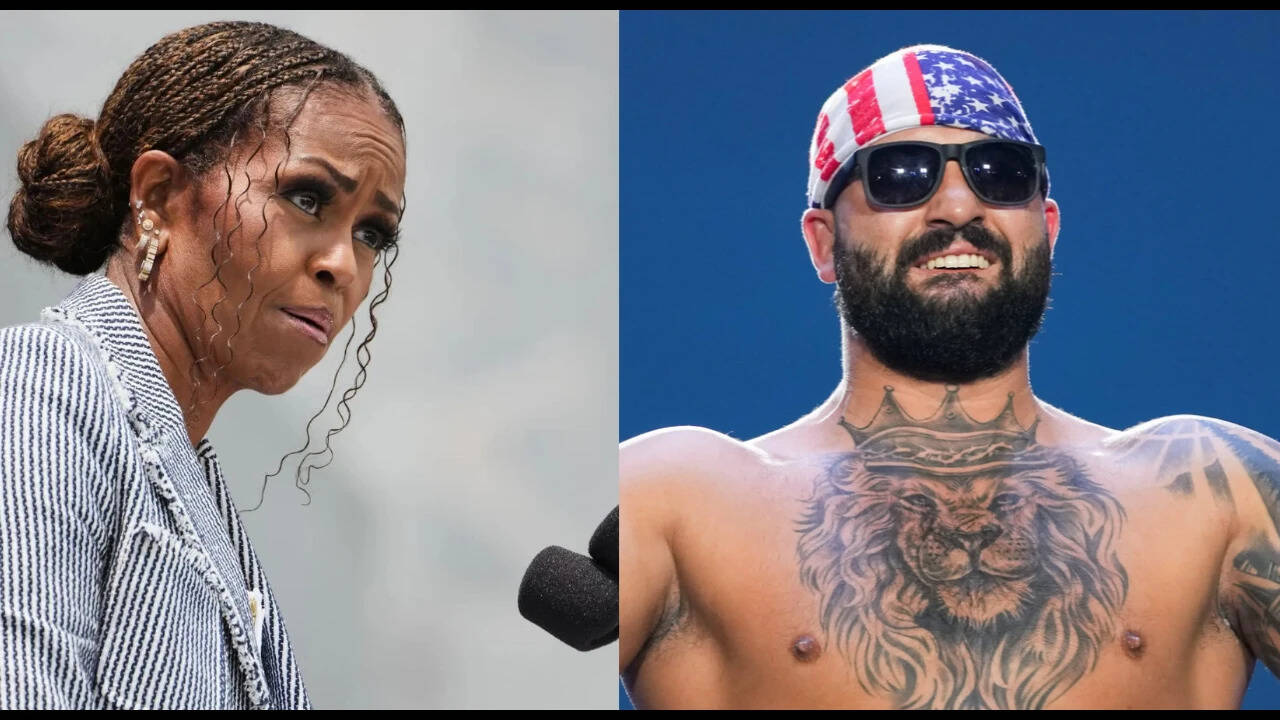
Josh Hokit does not regret calling former First Lady Michelle Obama a man on the South Lawn of the White House. Ahead of his heavyweight title bout against Ciryl Gane at UFC 334, the undefeated contender doubled down on the June 2026 outburst, claiming he was proud of the backlash because it put his name on President Donald Trump’s Truth Social feed and accelerated his rise to championship contention. His refusal to apologize lays bare a fundamental truth about modern mixed martial arts: inside the Octagon, shock value remains the fastest currency for bypassing traditional matchmaking.
The Mechanics of Manufactured Outrage
Hokit’s rise through the heavyweight ranks was never built on quiet professionalism. A former collegiate wrestler and NFL fullback, the 29-year-old entered the UFC with raw athletic pedigree. Yet in a division historically starved for charismatic stars, athletic competence rarely guarantees prime real estate on pay-per-view posters.
On June 14, 2026, Hokit seized an unexpected opening. He was not even supposed to be on the UFC Freedom 250 card—an unprecedented spectacle staged on the White House South Lawn to celebrate America’s 250th birthday and Trump’s 80th birthday. Hokit was pulled in as a late replacement to face veteran knockout artist Derrick Lewis after the president specifically requested Lewis for the event.
After securing a second-round technical knockout over Lewis, Hokit took the microphone from Joe Rogan wearing an American flag bandana. He used his victory speech to threaten light heavyweight star Alex Pereira before shouting an internet conspiracy theory into a live global broadcast: "Michelle Obama is a man. Am I right, America?"
The reaction was immediate and bipartisan in its disgust. Republican Senator Lindsey Graham publicly labeled Hokit an "idiot" for souring the celebratory atmosphere. Former NFL quarterback Robert Griffin III and several Democratic lawmakers condemned the cheap shot. Even UFC CEO Dana White, who has spent two decades defending fighters' right to say almost anything on a live microphone, broke ranks. Appearing on Ryan Clark’s The Pivot podcast weeks later, White called the remark "gross" and "inappropriate," expressing frustration that a single fighter had tarnished an event he had pitched as a unifying American showcase.
"When you hit this grand slam home run and have a perfect event in every way that it could be, you got a moronic..." — Dana White, UFC CEO, reflecting on the White House broadcast fallout
Yet when reporters pressed Hokit during UFC 334 media day in November 2026, expecting contrition or a rehearsed PR pivot, Hokit leaned straight into the fire. He argued that standing at the White House made his remarks an exercise in free speech rather than a breach of decorum. More tellingly, he pointed directly to the tangible rewards of the scandal.
Why the UFC Rewards What Its Boss Condemns
To understand why Hokit stood at Madison Square Garden fighting Ciryl Gane for heavyweight gold just five months after disgusting his own promoter, one has to separate corporate rhetoric from fight promotion economics.
Dana White claimed he intentionally fed Hokit difficult stylistic matchups to punish him for his mouth. In reality, giving an unbeaten heavyweight high-profile opponents is not a punishment—it is an audition. Every time Hokit stepped onto a stage, whether in April against Curtis Blaydes in Miami or in June against Lewis in Washington, D.C., he delivered action. When he paired those wins with a polarizing persona dubbed "The Incredible Hok," he solved the UFC’s biggest promotional headache: making casual audiences care about a heavyweight challenger.
Consider the alternative path in the UFC. Quiet, respectful contenders regularly win six or seven straight bouts on preliminary cards while waiting years for a title eliminator. By turning himself into a political lightning rod—and earning amplified visibility when Trump shared clips of him on Truth Social—Hokit bypassed the queue entirely.
The promotion operates on an attention economy where indifference is the only fatal sin. A fighter who draws millions of angry clicks generates the exact same pay-per-view curiosity as a fighter who draws millions of cheers. Fans tune in either to watch the villain get humbled or to watch him back up his arrogance. Hokit understood that calculus better than the pundits scolding him.
The Precedent of the Heel Turn
Hokit did not invent this playbook; he merely stripped away whatever subtlety remained. Mixed martial arts has long borrowed its promotional architecture from professional wrestling, where playing the heel is often more lucrative than playing the hero.
- Chael Sonnen turned a stagnant middleweight career into massive pay-per-view paydays in the early 2010s by unleashing scripted, xenophobic tirades against Brazilian fighters and Anderson Silva.
- Colby Covington rescued himself from being cut by the UFC—despite winning fights—by adopting a hyper-partisan persona in 2017, insulting entire nations and targeting opponents' families to secure multiple welterweight title shots.
- Conor McGregor redefined combat sports wealth by escalating trash talk from athletic critique to deeply personal attacks on religion, family, and heritage.
Each era pushes the boundary slightly further because audiences grow desensitized to yesterday's taboos. Sonnen insulted a country's infrastructure; Covington insulted fighters' wives and children; Hokit bypassed his opponent altogether to attack a former First Lady at a national monument. The escalation is structural. When the reward for crossing the line is a championship main event at Madison Square Garden, fighters will sprint across that line every single time.
The Reality Behind the Curtain
What makes Hokit’s media day defiance even more revealing is how abruptly the mask slips once the cage door closes. Following his November 14 title bout against Ciryl Gane—a grueling five-round war that Gane won via a razor-thin 48-47 unanimous decision—Hokit dropped the caricature entirely.
Speaking with former champion Michael Bisping after the fight, Hokit praised Gane as "such a nice guy," recounting how the two heavyweights sat together at the hospital until 5:00 a.m. getting stitched up while Gane encouraged him that he would become champion one day. The same man who spent fight week hurling insults at fellow athletes and boasting about offending half the country sounded indistinguishable from any college football teammate sharing a locker room.
That contrast exposes the cynicism at the heart of modern combat sports marketing. The vulgarity on the White House lawn was not an uncontrollable emotional spasm. It was a calculated brand investment made by an athlete who knew that polite humility would keep him buried on early prelims in Las Vegas, just as he was in January 2026 against Denzel Freeman.
The Cost of the Bargain
There are limits to how far outrage can carry a fighter, and Hokit found that ceiling against Gane. Promotional heat can get you into the building, force the matchmakers to book your name at the top of a marquee, and compel millions of viewers to watch. It cannot defend a jab, stuff a takedown, or sway three cageside judges when the rounds are close.
Moreover, relying on shock value carries long-term commercial penalties that an unbeaten prospect rarely calculates in the moment. Mainstream corporate sponsors—the blue-chip brands that provide steady, career-extending income outside of fight purses—routinely steer clear of athletes attached to political conspiracy theories and personal smears. By tying his public identity to a viral insult, Hokit traded broad commercial appeal for short-term notoriety.
Still, from a purely competitive standpoint, Hokit’s gamble paid off in full. He entered 2026 fighting on an early preliminary card and ended the year pushing a reigning heavyweight champion to a contested scorecard in New York City. Until the UFC’s matchmaking stops rewarding volume over virtue, fighters will keep grabbing the microphone and saying the quiet, ugly parts out loud.
For more details on how the initial controversy unfolded on the White House lawn, watch UFC Fighter Declares "Michelle Obama Is a Man" After Winning Match at White House. This video captures the exact post-fight interview with Joe Rogan that sparked the political backlash and set the stage for Hokit's title run.