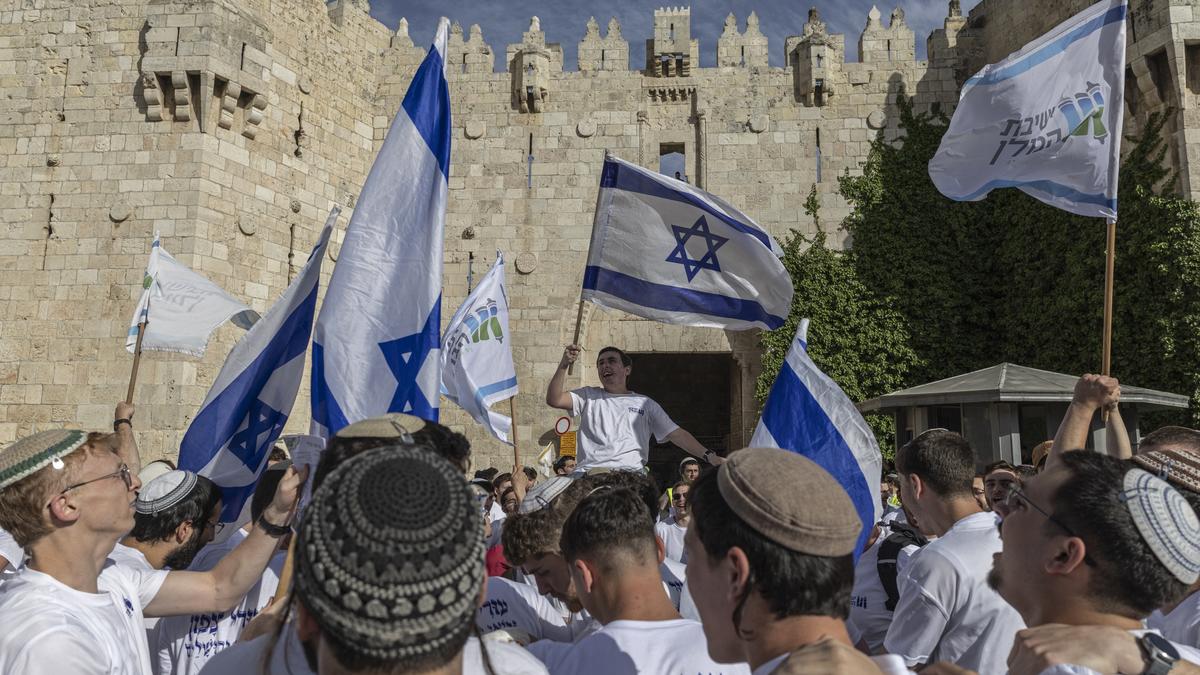
Tens of thousands of Israeli nationalists gather annually for the Jerusalem Day Flag March, an event that consistently pushes the city to a breaking point. Ostensibly a celebration of the city's unification after the 1967 Six-Day War, the parade features young, right-wing Israelis waving blue-and-white flags, dancing, and chanting through the heart of the Old City. But beneath the music and patriotism lies a deeply polarizing demonstration that frequently spirals into physical violence and racist vitriol. For the Palestinian residents of East Jerusalem, it isn't a holiday. It's an annual siege.
The central friction point centers on the route. Participants march through the Muslim Quarter, entering via Damascus Gate—a vital cultural and commercial hub for local Palestinians. Shops are forced to close, streets are locked down by thousands of police officers, and residents are effectively barricaded inside their own homes. The event exposes the deep, unresolved fractures of a city claimed by two peoples, serving as a microcosm of the broader Israeli-Palestinian conflict.
Inside the Muslim Quarter During the Flag March
Walking through Damascus Gate on Jerusalem Day offers a starkly different experience depending on who you are. For the marchers, it's a triumphant display of sovereignty. For the local population, it feels like a targeted provocation.
The atmosphere inside the narrow stone alleys of the Muslim Quarter quickly turns claustrophobic and hostile. In past years, crowds of nationalist youths have chanted inflammatory slogans, including "Death to Arabs" and "May your village burn." These aren't isolated incidents by a few outliers. The vitriol is loud, organized, and broadcast across social media.
Nationalist marchers routinely bang on the metal shutters of shuttered Palestinian shops, spit at local residents and journalists, and scuffle with anyone standing in their way. Security forces, deployed heavily to maintain order, often end up protecting the marchers while aggressively clearing Palestinians from public spaces to make way for the parade. The double standard is glaringly obvious to anyone watching on the ground.
The Geopolitical Stakes of Jerusalem Day
To understand why this single parade carries such explosive potential, you have to look at the underlying geopolitics. Israel views the entirety of Jerusalem as its eternal, undivided capital. This narrative took root after Israel captured East Jerusalem, the Old City, and the West Bank from Jordan in 1967, later annexing the eastern half of the city in a move unrecognized by most of the international community.
Palestinians see East Jerusalem as the capital of their future independent state. The Flag March serves as a blunt instrument to reassert Israeli dominance over the disputed territory. By marching thousands of nationalist Israelis through Palestinian neighborhoods, organizers send a clear message about who controls the city.
The provocations have led to catastrophic escalations before. In 2021, weeks of tension in Jerusalem, capped by the Flag March and clashes at the Al-Aqsa Mosque compound, triggered an 11-day war between Israel and Hamas in Gaza. Hamas fired rockets toward Jerusalem during the march, showing that events in the Old City can instantly ignite a broader regional conflict.
The Role of Far-Right Politicians
The political landscape in Israel has shifted drastically toward the right, directly impacting how the Flag March is conducted and policed. High-profile government ministers, including National Security Minister Itamar Ben-Gvir and Finance Minister Bezalel Smotrich, don't just support the march—they actively participate in it.
Ben-Gvir, a hardline nationalist who has faced past convictions for incitement to racism and supporting a terrorist group, now oversees the very police force tasked with managing the event. His presence at Damascus Gate reinforces the government's backing of the demonstration. When government ministers join in chanting and dancing through Palestinian sectors, it changes the event from a fringe nationalist rally into an official state-sanctioned display of dominance.
Security Tactics and the Impact on Daily Life
Managing an event this volatile requires a massive security apparatus. The Israeli police deploy thousands of officers, including border police and undercover units, to enforce a rigid security corridor.
The security strategy prioritizes total separation between the two groups. To achieve this, police implement measures that completely disrupt Palestinian life:
- Total closure of Palestinian businesses along the march route.
- Restricting Palestinian movement, preventing residents from returning to their homes for hours.
- Setting up physical barricades at major junctions within the Old City.
- Preemptive arrests of Palestinian activists to suppress potential counter-protests.
The economic toll on local shopkeepers is severe, but the psychological impact cuts deeper. Residents describe a feeling of humiliation as they watch outsiders parade through their neighborhoods under heavy police protection, while they are confined behind metal barricades.
The Myth of an Undivided City
The Flag March is meant to celebrate unity, but it ultimately exposes how divided Jerusalem actually is. The city remains segregated along ethnic and political lines. East Jerusalem Palestinians hold revocable residency status rather than full Israeli citizenship, meaning they pay taxes to the municipality but cannot vote in national elections and face systemic discrimination in housing, infrastructure, and public funding.
The parade doesn't bridge these gaps. It widens them. By treating the capture of East Jerusalem as a conquest to be celebrated over the local population, the event ensures that deep-seated resentment endures for another generation.
International observers and human rights organizations consistently condemn the racism and violence associated with the march. Yet, the Israeli government continues to authorize the traditional route through the Muslim Quarter, arguing that altering it would signal a weakness in Israel's claim to total sovereignty over the city.
Tracking the Consequences
The ramifications of the Flag March extend far beyond a single afternoon of unrest. The event serves as a reliable barometer for regional stability. Security analysts monitor the rhetoric leading up to the parade to gauge the likelihood of wider escalations in the West Bank and Gaza.
For those tracking the conflict, watching the specific flashpoints within the Old City—Damascus Gate, Hagai Street, and the entryways to the Al-Aqsa Mosque—provides critical data on current tensions. The event shows that Jerusalem remains a tinderbox, where a single provocative chant or police clash can alter the political situation overnight.