Island ecosystems operate under strict carrying capacities and compressed trophic dynamics. When non-native mammalian predators breach these isolated environments, the structural integrity of the local food web collapses. Recent interventions across six isolated islets within the Nukufetau and Funafuti atolls of Tuvalu demonstrate how targeted removal operations can reverse ecological decay. By systematically stripping away invasive rodents and suppressing secondary pest populations such as yellow crazy ants, the initiative provides a blueprint for biological asset recovery in low-lying maritime nations.
The Trophic Cascade of Rodent Invasion
Invasive rodents disrupt island environments through direct predation and resource competition. Native seabirds and land crabs, having evolved on isolated landmasses without mammalian predators, lack effective behavioral defenses. Consequently, rats target vulnerable eggs, hatchlings, and juvenile fauna, creating a severe bottleneck in recruitment rates across generations.
Beyond direct carnivory, rodents exert pressure on primary producers. By consuming seeds, stripping bark, and competing with native invertebrates like coconut crabs for fallen fruit and organic matter, rats suppress the regenerative capacity of coastal forests. This top-down pressure limits canopy renewal and degrades the structural habitats required by arboreal and ground-nesting species.
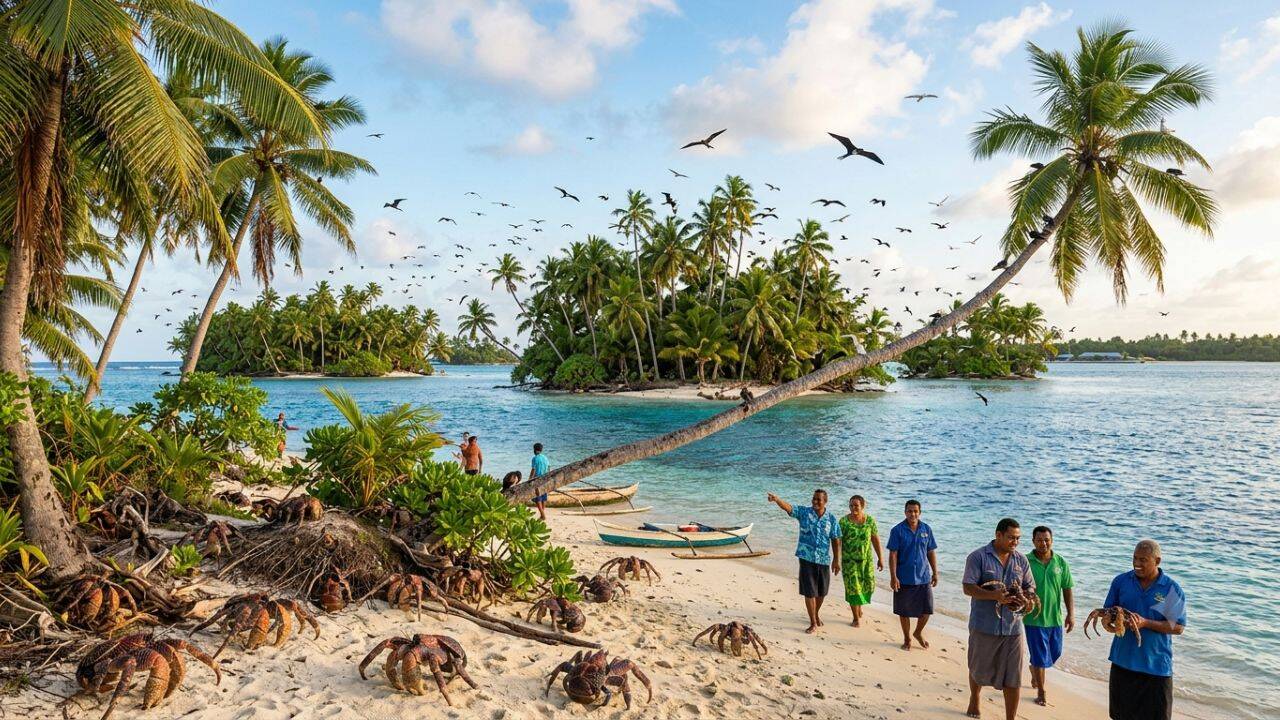
The mechanism of recovery observed across the cleared islets—specifically Sakalua, Motumua, Teafuone, and Teafuatule in Nukufetau, alongside targeted areas in Funafuti—relies on removing this suppression vector. Without rodents consuming ground-level biomass and preying on eggs, reproductive success rebounds immediately. Birds and coconut crabs reappear not through migration alone, but via the unblocking of native recruitment channels that were previously paralyzed by predation.
The Multi-Vector Pest Matrix
Conservation management in confined geographic zones cannot focus on a single species in isolation. Island environments often host interacting pest matrices where multiple invasive organisms create compound vulnerabilities. In Tuvalu, the operation addressed not only black rats but also localized surges of yellow crazy ants and mosquitoes.
Yellow crazy ants pose an alternative threat mechanism. Rather than functioning purely as seed predators or egg thieves, these ants form high-density supercolonies that physically overwhelm and chemically neutralize larger native fauna, including adult and juvenile coconut crabs. The simultaneous suppression of ants on islets like Tepuka and the eradication of rats establish a clean operational slate.
Targeting multiple vectors simultaneously prevents competitive release. When a dominant invasive species like the rat is removed, secondary pests can experience population explosions if left unchecked. By executing a coordinated multi-species suppression strategy led by the Tuvalu Department of Environment alongside the Secretariat of the Pacific Regional Environment Programme and technical partners like Island Conservation, the project mitigated the risk of ecological rebound by secondary invaders.
Community Integration and Operational Logistics
Executing eradications across scattered atolls requires navigating severe logistical constraints. Tuvalu comprises a fragmented land area distributed across 124 islands and islets, demanding high-precision execution where supply lines are long and local infrastructure is minimal.
The operational framework depended on a three-tier institutional structure:
- Strategic Funding and Design: Capital allocation and overarching architecture managed primarily through New Zealand's Ministry of Foreign Affairs and Trade and regional environmental frameworks.
- Technical Execution: Specialized field protocols, grid-based tracking, and bait application guidelines administered by experienced conservation NGOs.
- Local Implementation: Ground-level navigation, community participation, and ongoing surveillance driven by Tuvaluan departments and local residents.
Sustainability hinges on local capacity building. Residents of Nukufetau underwent targeted training in biosecurity protocols and invasive species identification. Because isolated atolls remain permanently vulnerable to reinvasion via maritime transport and drifting debris, the ultimate security of these six islets depends on continuous community-led surveillance functioning as an early warning mechanism.
Marine and Terrestrial Coupling
The ecological restoration of small islets has direct implications for surrounding marine assets. Nutrient exchange between land and sea forms the backbone of atoll survival. Healthy seabird populations nesting on land ingest marine resources and return substantial nutrient loads via guano deposition onto the soil and coastal waters.
When invasive rats decimate seabird colonies, this terrestrial-marine nutrient loop is severed. The reduction in guano inputs deprives inshore coral reefs of essential nitrogen and phosphorus. By reinstating seabird populations through predator removal, the restoration initiative reactivates this nutrient pump. Stronger nutrient flows enhance the resilience of adjacent coral reefs, which serve as physical barriers against rising sea levels and support local fisheries.
Food security in Tuvalu is tied directly to this coupling of land and ocean resources. Coconut agroforests and coastal marine zones provide the primary caloric and economic foundation for outer-atoll populations. Restoring the baseline productivity of the land directly strengthens the resilience of local food systems against external supply chain shocks.
Deploy surveillance grids across all uninfected maritime entry points to ensure zero tolerance for secondary introductions, while scaling the established multi-vector eradication model outward to the remaining islets of the archipelago.