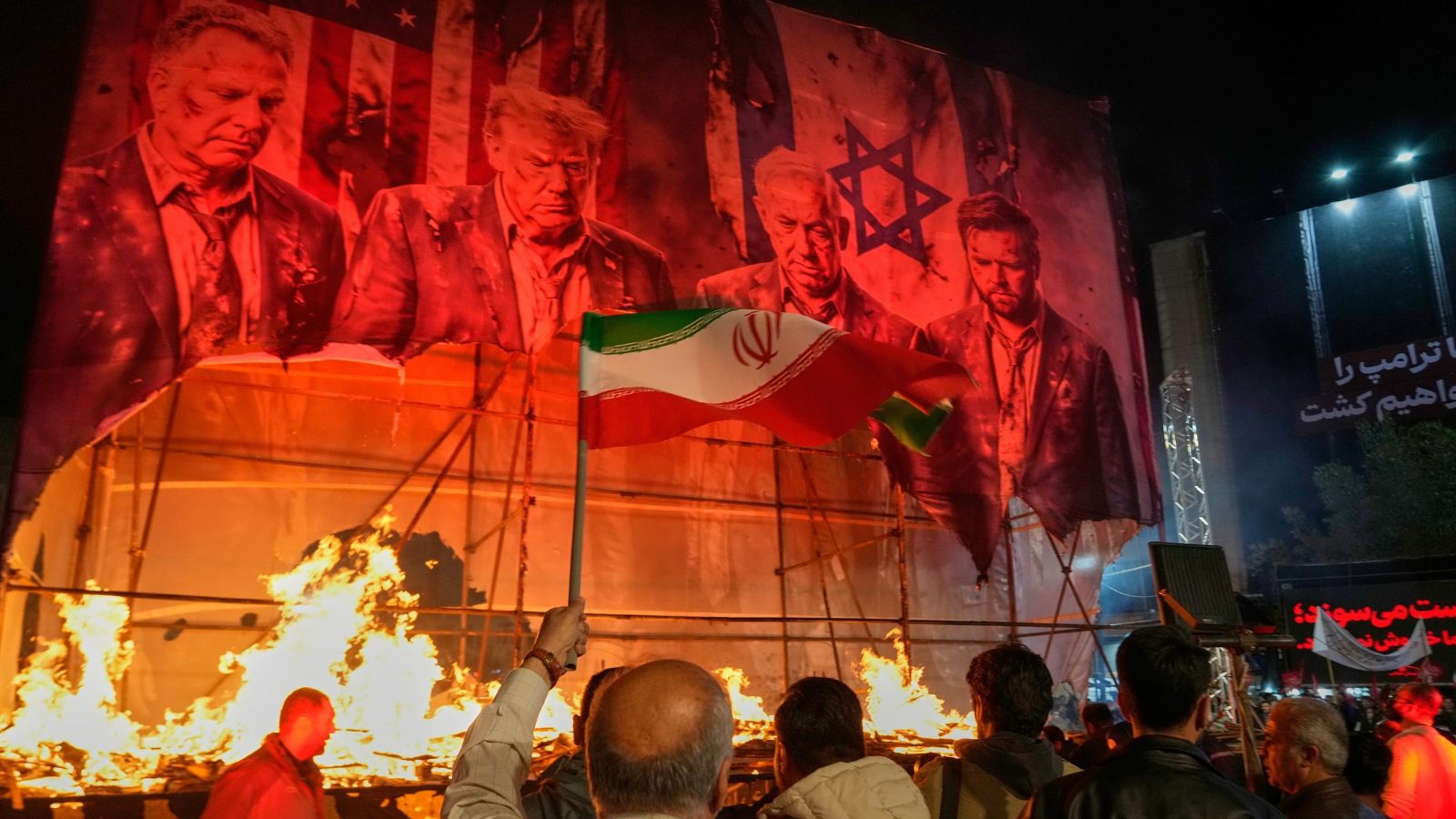
Tehran is popping metaphorical champagne over the November 3, 2026, U.S. midterm elections, and Washington’s pundit class is nodding right along. The prevailing wisdom is simple: Republicans lost both chambers of Congress because voters revolted against gas prices and the Iran war, leaving Donald Trump politically crippled and forcing him to beg for a diplomatic exit.
That narrative is dead wrong. Building on this topic, you can also read: What Most People Get Wrong About Blood in a Dinosaur Bone.
By treating a domestic American electoral correction as a strategic military victory, Mojtaba Khamenei and his hardline inner circle are walking straight into a geopolitical buzzsaw. Conventional foreign policy analysts love straight-line extrapolation. They see Vice President JD Vance admitting on social media that the war cost Republicans the Senate, they see Mohsen Rezaei boasting about a "strategic defeat" on the battlefield, and they conclude that Tehran holds all the cards.
They are misreading both American constitutional mechanics and the psychology of a cornered populist president. When you strip away the state-sponsored rallies in Enghelab Square and look at the actual incentives driving Washington and Tehran, a much darker reality emerges. Iran does not have the upper hand. It just lost its only real shield against total military escalation. Experts at Reuters have also weighed in on this matter.
The Lame-Duck Fallacy
I have spent two decades watching foreign ministries miscalculate American midterm cycles, and the mistake is always identical. Foreign leaders assume a president who loses Congress becomes weak. In domestic legislative battles over tax rates or judicial nominees, that is true. In foreign policy and kinetic warfare, the exact opposite happens.
When a second-term president loses the House and Senate, his domestic agenda dies on the spot. Every bill is dead on arrival. Every cabinet official—including Defense Secretary Pete Hegseth—faces endless subpoenas and impeachment threats. Deprived of legislative wins, a president turns to the one arena where the U.S. Constitution gives the executive branch near-total unilateral authority: commander-in-chief powers.
Iranian strategists are confusing electoral unpopularity with operational restraint.
Before November 3, Trump had a massive political incentive to hold back. He paused major bombing runs in July and explicitly held off on fresh strikes in October to keep crude oil prices from spiking right before Americans cast their ballots. The Strait of Hormuz blockade and energy inflation were Tehran’s primary weapons of political attrition.
Now, the election is over. There are no more ballots for Trump to win. Ever.
Imagine a scenario where a corporate CEO knows they can never be fired for the next two years, their board has blocked all domestic product launches, and their only remaining metric for legacy is crushing a rival competitor. Does that CEO become cautious, or do they go all-in? Trump does not have to face voters in 2028. By celebrating his midterm defeat, Tehran has removed the single biggest constraint that kept B-2 bombers grounded through the autumn.
Why Democratic Control Won't Save Tehran
One of the loudest assumptions circulating in diplomatic cables—and echoed in lazy op-eds—is that the incoming Democratic Congress in January 2027 will simply shut down the war.
Let’s dismantle that myth with basic legislative reality.
- The Veto Math: Even with majorities in both chambers, Democrats do not hold the two-thirds supermajority required to override a presidential veto on War Powers resolutions.
- The Appropriations Trap: Cutting off funding for active military operations sounds bold on cable news, yet no party in modern American history has successfully defunded troops in harm's way while missiles are actively flying at U.S. bases and regional allies.
- Bipartisan Hawkishness: Voting against a Republican president’s war strategy is vastly different from passing legislation that hands a victory to a regime chanting death slogans and threatening Gulf energy infrastructure.
Peiman Salehi and other sharp regional observers have rightly pointed out that Iranian leaders do not necessarily expect Democrats to be friendly; they simply believe Democratic oversight will tie Trump’s hands. That logic fails because congressional hearings do not stop carrier strike groups. Hearings move at the speed of subpoenas. Tomahawk cruise missiles move at 550 miles per hour. By the time a House committee convenes in February to debate war authorization, the physical reality on the ground in the Persian Gulf can be altered permanently.
What Hardliners Missed About Trump's Exit Math
To understand why Tehran’s new maximalist posture is suicidal, you have to look at what Trump actually needs to end this conflict.
Before the midterms, analysts like Arash Azizi noted that Trump faced a binary choice: extract a verifiable nuclear concession to declare victory, or launch a massive military strike to end the war from a position of strength.
Hardliners in Tehran, emboldened by Mojtaba Khamenei’s warnings against showing weakness, have slammed the door on option one. They have raised their price, demanding sanctions relief and regional concessions while refusing meaningful nuclear inspections. Why? Because they think Trump is desperate for a deal to salvage his presidency.
Look at the flaw in that equation:
| Strategic Factor | Tehran's Assumption | Washington's Actual Reality |
|---|---|---|
| Midterm Impact | Trump is weakened and must retreat. | Trump is freed from short-term election risk. |
| Oil Price Leverage | High gas prices force U.S. concessions. | Post-election oil drops reduce domestic pressure. |
| Congressional Flip | Democrats will block further escalation. | Executive war powers remain intact until 2029. |
| Negotiating Floor | U.S. will accept a face-saving compromise. | Trump cannot accept a deal worse than 2015 after losing Congress. |
A president who just suffered a bruising midterm defeat cannot walk up to a podium and sign a weak agreement that looks like capitulation. His own base—the remaining loyalists who didn't stay home—would eat him alive. If Tehran refuses to offer a clear, undeniable win on its nuclear stockpile, the diplomatic off-ramp disappears entirely.
When you close the diplomatic exit for a leader obsessed with projecting dominance, you do not get a surrender. You get escalation. Look at the spike in Iranian drone and missile launches in late November. Tehran is testing boundaries, convinced that Washington will blink first.
The Economic Attrition Illusion
Tehran’s broader war doctrine relies on asymmetric endurance. The theory goes like this: Iran absorbs punishment, keeps the Strait of Hormuz contested, drives global inflation, and waits for Western democracies to lose their political stomach.
In theory, democracies have shorter attention spans than authoritarian regimes. In practice, Iran is playing a game of economic chicken while driving a vehicle with no brakes.
Iran’s domestic economy is already lurching toward severe collapse. Inflation is entrenched, the rial is in freefall, and infrastructure battered during the 40-day conflict remains unrepaired. Meanwhile, global energy markets have begun pricing in the post-election reality, with crude prices dropping sharply since early November despite Tehran's threats to target Gulf oil and AI facilities.
You cannot wage a war of economic attrition when your own treasury is empty and your adversary prints the world's reserve currency.
More critically, Tehran is ignoring the internal rot that war accelerates. Outside the state-choreographed rallies in Enghelab Square, ordinary Iranians are exhausted by repression, economic misery, and the constant dread of renewed bombardment. Protests have been met with brutal crackdowns, leaving a massive chasm between the street and the state. Betting the survival of the Islamic Republic on the hope that American voters care about suburban gas prices more than the Pentagon cares about regional deterrence is a catastrophic gamble.
How Strategic Analysts Should Actually Read This Crisis
If you are advising a multinational corporation, managing sovereign risk, or tracking geopolitical volatility, stop reading headlines about partisan blame games in Washington. Track the operational indicators that actually dictate whether the Persian Gulf catches fire before January 20.
- Watch Kharg Island and Energy Infrastructure, Not Congressional Speeches: Ignore what House members say on Sunday talk shows. Watch naval deployments and rhetoric surrounding Iran's primary oil export terminals. If Washington decides a deal is dead, targeting revenue choke points is the fastest way to break Tehran's financial spine without putting boots on the ground.
- Monitor the "Good Cop, Bad Cop" Collapse: For months, figures like Ali Larijani and Mohsen Rezaei have balanced hardline threats with quiet back-channel signals. When those back channels go silent and Mojtaba Khamenei’s Khatam al-Anbiya command publicly expands target lists, diplomatic optionality has hit zero.
- Price in the January 2027 Transition Window: Trump has roughly two months before the new Democratic Congress is sworn in and begins investigative warfare. If he intends to execute a "one big shot" military campaign to reset the board, the window between late November and mid-January is the highest-risk period on the calendar.
The Blind Spot in My Own Thesis
To be completely candid, betting on rational escalation math with this White House carries a massive caveat. My argument assumes Trump views a decisive military strike as the logical antidote to his midterm humiliation.
There is a real chance he does the exact opposite. Trump’s instincts are deeply transactional and notoriously averse to protracted quagmires. He campaigned on ending foreign wars, and his own inner circle—including Vance—is acutely aware that an endless Middle Eastern conflict is electoral poison for the GOP heading into 2028. If Trump decides that the Iran war is a sunk cost dragging down his legacy, he could abruptly declare "mission accomplished," claim the missile defenses already defeated Iran's latest barrages, and walk away regardless of what Tehran does next.
That is the single variable that could validate Tehran's gamble. Not Iranian strength. Not Democratic subpoenas. Pure, unilateral American disengagement.
The Reality Tehran Refuses to Face
Even if Trump chooses to walk away, Iran still loses. A frozen conflict with crippling sanctions, a shattered economy, a restless population, and an Israeli military looking for an excuse to finish the job is nobody's definition of an "upper hand."
History is littered with regimes that misread American domestic turmoil as terminal decline. Saddam Hussein watched the Vietnam syndrome and thought Washington wouldn't fight for Kuwait. Imperial Japan looked at American isolationism in the 1930s and thought a sharp blow at Pearl Harbor would force a negotiated settlement.
Tehran is making the exact same mistake in 2026. They saw Republicans lose a midterm election and convinced themselves the superpower across the ocean had surrendered. They forgot that in Washington, a president with nothing left to lose at the ballot box is the most dangerous adversary on earth.
Stop watching the vote tallies from November 3. Start watching the flight paths over the Arabian Sea.