Silence.
In a city of seven million people, true silence is a rare and fragile currency, usually spent only in the dead hours between two and four in the morning when the highway arteries of King Fahd Road finally stop throbbing with taillights.
Consider a hypothetical scenario, grounded in the recurring reality of life across the Arabian Peninsula over the past decade. Picture Tariq, a thirty-four-year-old structural engineer living in a high-rise apartment in Riyadh’s Olaya district. It is just past midnight. His apartment smells faintly of cardamom coffee and the dry, mineral dust that blows in from the surrounding Najd plateau. Outside his double-paned windows, the Kingdom Centre tower glows like a giant sapphire needle stitched into the black velvet of the desert sky. Tariq is checking his phone one last time before sleep, scrolling past photos of his daughter’s school play, when the air pressure in his living room seems to drop.
Then comes the sound. Not a crack, not a gunshot, not thunder. It is a deep, concussive thud that vibrates in the fillings of your teeth and rattles the glass of water on the nightstand before your ears even register the noise. A second thud follows. Seconds later, three sharper, higher-pitched detonations ripple across the upper atmosphere, miles above the sleeping neighborhoods.
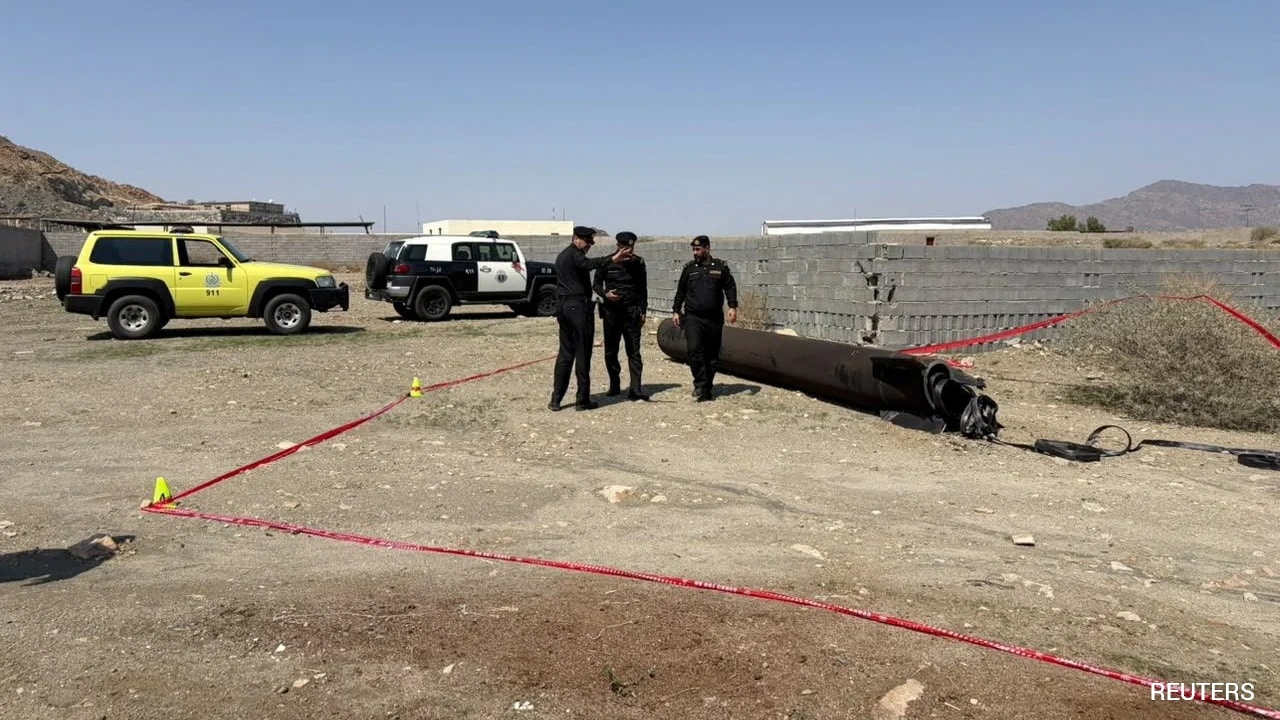
By morning, the event will be compressed into a sterile, fourteen-word wire headline: Saudi Alliance Intercepts 2 Houthi Missiles, 3 Drones Targeting Riyadh.
To anyone reading that headline over breakfast in London, New York, or Tokyo, it reads like a routine box score from a distant, intractable conflict. Two missiles. Three drones. Zero casualties. A clean sheet for the defense. The reader swipes to the sports section or the stock ticker, registering the news as a non-event because nothing on the ground burned.
That reaction misses the entire point. When a ballistic missile traveling at several times the speed of sound is shattered in the upper atmosphere by a kinetic interceptor, the absence of a crater is not a non-event—it is an engineering miracle purchased at staggering financial, psychological, and strategic cost.
The Anatomy of a Ten-Minute War
To understand what happened in the dark sky over Riyadh, you have to strip away the military jargon and look at the brutal physics of the exchange.
When Houthi forces in northern Yemen launch a ballistic missile toward the Saudi capital, they are bridging a distance of roughly six hundred miles—about the distance from Chicago to Washington, D.C. Unlike an artillery shell, which arcs predictably like a thrown baseball, a long-range ballistic missile punches out of the lower atmosphere, climbs into the freezing vacuum of near-space, and then plummets downward toward its target, pulled by gravity at speeds exceeding Mach 5.
From the moment the launch plumes bloom on infrared satellite sensors to the moment the warhead reaches Riyadh, the defenders have roughly eight to twelve minutes.
Think about what you can accomplish in ten minutes. You can brew a pot of tea. You can walk a dog around the block. In a hardened command bunker outside Riyadh, radar operators and battery commanders must execute a sequence of decisions where a thirty-second hesitation turns a skyscraper into rubble.
First, long-range phased-array radars—massive, flat-faced electronic eyes that sweep the horizon thousands of times per second without moving a single mechanical part—must distinguish the incoming threat from commercial airliners, weather balloons, and atmospheric clutter. Once the track is locked, computers calculate the trajectory, predicting the exact neighborhood in Riyadh where the warhead will strike.
Then comes the asymmetric nightmare of modern warfare: the layered attack.
Why Drones and Missiles Travel Together
Notice the specific combination in the military report: two ballistic missiles and three armed drones. That pairing is neither accidental nor redundant. It is a calculated tactical trap designed to overwhelm the human mind and the silicon brain of an air defense network simultaneously.
If you want to understand how a combined drone-and-missile strike works, imagine a pickpocket operating in a crowded train station. One accomplice bumps into your left shoulder, spilling hot coffee on your coat and demanding all your visual attention; while your eyes are locked on the stain, the second accomplice slips your wallet out of your right pocket.
In the skies over Saudi Arabia, the drones are the spilled coffee.
Unmanned aerial vehicles—often delta-winged, propeller-driven craft built from lightweight composites and powered by engines no more sophisticated than those found in a large lawnmower—fly low and slow. They hug the terrain, skimming ridges and valleys to hide beneath the curvature of the earth from long-range radar horizons. They take hours to cover the distance a ballistic missile crosses in minutes.
Their job is to arrive at the exact same moment as the ballistic missiles, forcing the air defense grid to look in two directions at once. High and fast for the ballistic warheads; low and slow for the drones. If the defenders commit all their radar bandwidth and interceptor launchers to the high-altitude threat, a drone slips underneath and slams into an electrical substation, an airport terminal, or an oil processing facility. If they focus too heavily on swatting the low-flying drones, the ballistic missile drops straight down through the roof of the sky.
Stopping two missiles and three drones in a single coordinated wave means the Saudi-led coalition’s integrated air defense network—relying largely on American-made Patriot PAC-3 batteries and layered point-defense systems—had to solve five separate, fast-moving geometry problems in the dark, simultaneously, with zero margin for error.
The Crushing Math of Asymmetry
Anyone who has lived under the umbrella of an active air defense network knows that the relief of an interception is always shadowed by a quiet, gnawing anxiety about the scoreboard. Not the casualty scoreboard, which thankfully read zero, but the economic one.
Let us look at the ledger, because the numbers tell a story that press releases never mention.
A single Houthi-assembled explosive drone—often based on Iranian Shahed or Qasef designs—can be built in a workshop for anywhere between $15,000 and $30,000. Even a modified ballistic missile, pieced together from smuggled components and locally fabricated airframes, represents a fraction of the budget of a conventional army.
Now look at the other side of the ledger. A single Patriot interceptor missile costs roughly $3 million to $4 million. And standard military doctrine rarely fires just one interceptor at an incoming ballistic warhead; to guarantee a hit-to-kill destruction, batteries routinely fire two interceptors per target.
Do the arithmetic on that quiet Tuesday night in Riyadh. To stop five incoming projectiles whose combined manufacturing cost might not buy a suburban house in Texas, the defenders likely expended tens of millions of dollars in precision-guided hardware in less than sixty seconds.
This is the central dilemma of twenty-first-century conflict, a truth that military planners from Riyadh to Tel Aviv to Kyiv wake up sweating about every morning. You cannot afford to let a $20,000 drone hit a billion-dollar refinery or a residential apartment block. So you fire the $3 million missile. Every single time. And the adversary knows you have to fire it. Even when the attacker misses—even when every single missile and drone is reduced to harmless metallic confetti seven miles above the desert—the attacker still imposes an enormous financial tax on the defender.
Living With Debris
There is another reality that dry military communiqués smooth over with tidy verbs like intercepted and destroyed.
Nothing in physics ever truly vanishes. Conservation of mass is an unforgiving law.
When a Patriot missile—which does not even carry a traditional explosive warhead, relying instead on sheer kinetic energy, slamming into the incoming target like a bullet hitting another bullet at a closing speed of nearly ten times the speed of sound—pulverizes a ballistic missile over a major metropolis, tons of twisted aluminum, unburned rocket fuel, titanium casings, and guidance circuitry still have to obey gravity.
They fall.
For residents on the ground, the interception itself is only half the ordeal. Once the shockwaves fade, neighborhoods wait in tense silence to hear if flaming shrapnel will punch through a roof, crush a parked sedan, or spark a fire in a courtyard. Over the years of this conflict, the true danger to civilians in Riyadh has frequently come not from intact warheads reaching their targets, but from the jagged, white-hot rain of successful interceptions.
Why Riyadh Remains the Prize
To grasp why these launches keep happening—even amid diplomatic backchannels, temporary truces, and shifting regional alliances—you have to understand what Riyadh represents.
For decades, the Saudi capital was viewed by the outside world primarily as an administrative hub sitting atop an ocean of crude oil. Today, it is the centerpiece of an audacious economic gamble. Under Saudi Arabia’s Vision 2030 transformation, the kingdom is pouring hundreds of billions of dollars into reinventing Riyadh as a global financial capital, a tourism magnet, and a logistics hub meant to rival Dubai and Singapore. Foreign executives are being courted to move their regional headquarters there; megaprojects are rising out of the limestone desert at breakneck speed.
Capital, however, is famously cowardly. Corporate boards and international investors do not mind high temperatures, strict regulations, or steep real estate prices. What they cannot tolerate is the sound of air-raid sirens while they are unpacking their suitcases.
When Houthi forces launch two missiles and three drones toward Riyadh, their military objective is almost secondary to their psychological one. They know the Saudi air defense shield is among the most battle-tested and densely layered on earth. They know the odds of a warhead slipping through are slim.
They fire anyway because the launch itself is the message. Every time the sky over Riyadh lights up with interceptor trails, it sends a tremor through boardrooms from Frankfurt to Singapore. It reminds every expatriate worker, every airline scheduling a flight into King Khalid International Airport, and every sovereign wealth fund manager that the war across the southern border is not a museum piece. It is live, it is unfinished, and it can reach the capital’s doorstep in ten minutes flat.
The Exhaustion of Vigilance
Step back into Tariq’s apartment in Olaya, twenty minutes after the last sonic boom has rolled away toward the eastern dunes.
The sirens have stopped. His daughter, who slept miraculously through the first thud, stirred at the sharper cracks of the drone interceptions, and Tariq spent ten minutes sitting on the edge of her bed, his hand resting on her back until her breathing slowed back into the deep, rhythmic cadence of childhood sleep.
On his phone, the official statement from the coalition spokesperson finally appears, confirming that all five targets were destroyed before reaching populated areas. No injuries. No structural damage. Life in the capital will resume at dawn. Traffic will clog King Fahd Road by seven-thirty. Baristas will pull espresso shots in glass-walled cafes; construction cranes will swing steel beams into place against the morning sun.
On paper, nothing happened.
Yet Tariq stands by the living room window for a long time before going back to bed, watching the distant, blinking red warning lights atop the city’s skyscrapers. He knows that miles away, in dimly lit radar vans and concrete bunkers ringing the city, young men and women in uniform are already reloading empty launch canisters, resetting radar sweeps, and staring at green phosphor screens, waiting for the next faint blip to rise over the southern horizon—knowing they have to be right every single night, while the people firing at them only have to get lucky once.