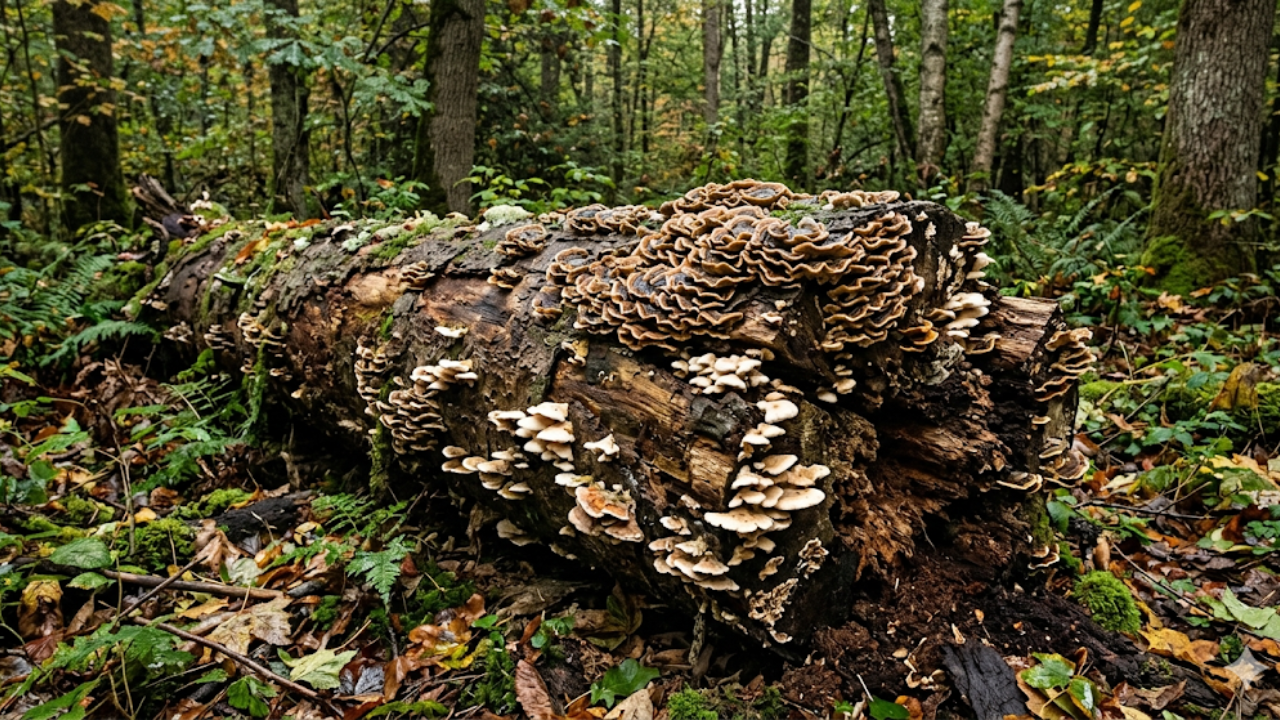
You walk through a forest and see a massive oak. It looks sturdy. It looks eternal. But inside that trunk, a silent war is being waged by organisms you can't even see. Hidden fungi are rotting trees from the inside and it’s becoming a massive problem for the planet’s carbon math. If you think climate change is just about melting ice caps or rising seas, you're missing a huge part of the story happening right under the bark of your local woods.
For decades, we’ve treated forests like giant sponges that just soak up carbon dioxide. It’s a nice, simple image. We plant a tree, it grows, it eats carbon, everyone wins. But new research suggests we’ve been ignoring the "leak" in the system. As temperatures climb, these internal fungal networks are working faster than ever. They’re turning solid wood into mush and releasing stored carbon back into the atmosphere long before the tree actually falls over.
The Stealthy Predators Living in Every Trunk
Heart rot isn’t new. Fungi have been breaking down wood since the first forests appeared on Earth. Usually, this is a good thing. It’s the circle of life. But what’s happening now is different. Fungi like Ganoderma or Phellinus are essentially "waking up" earlier and staying active longer because of shorter, warmer winters.
These aren't your typical mushrooms growing on the forest floor. These are endophytic fungi—organisms that live inside the plant tissue without causing immediate harm. Or at least, that’s the theory. When the tree gets stressed by drought or extreme heat, these fungi flip a switch. They stop being roommates and start being parasites. They eat the lignin and cellulose that give a tree its strength.
I’ve seen this firsthand in managed woodlots. A tree looks perfectly healthy from the outside. No holes, no weird growths. Then a storm hits—not even a particularly bad one—and the tree snaps like a dry twig. When you look at the break, the center is hollow or filled with a crumbly, wet powder. The tree was a shell of itself. It was a ghost long before it hit the ground.
Why Fungal Rot Is a Climate Change Warning Sign
The relationship between temperature and fungal metabolism is pretty straightforward. Heat them up, and they eat faster. A study led by researchers at the University of Arizona highlighted that we might be severely underestimating how much CO2 is escaping from "healthy" looking forests.
Think of it this way. A forest is a bank account for carbon. We’ve been counting the deposits (growth) but ignoring the hidden service fees (internal rot). If the rot accelerates, the bank account drains faster than we can fill it.
- Carbon release: When fungi digest wood, they breathe out CO2.
- Tree mortality: Weakened trees die younger, meaning they store less carbon over their lifetime.
- Methane risks: In some wet, rot-filled trunks, bacteria join the party and produce methane, a greenhouse gas far more potent than CO2.
This isn't just a "nature is changing" vibe. It's a fundamental shift in how the Earth’s carbon cycle functions. We are seeing a feedback loop. Higher temps lead to more rot, which leads to more CO2, which leads to even higher temps. It’s a nasty cycle that doesn't care about our net-zero targets.
The Myth of the Healthy Forest
We have this romanticized idea that a "natural" forest is a static thing. It isn't. But humans have messed with the balance. By suppressing natural fires and over-managing certain species, we've created dense stands of trees that are all the same age. When a fungal outbreak hits these crowded areas, it spreads like a cold in a kindergarten classroom.
Drought is the biggest trigger. When a tree doesn't have enough water, its immune system—yes, trees have those—basically shuts down. It can't produce the resins and chemical compounds it usually uses to wall off fungal infections. The fungi "sense" this weakness. They move from the heartwood into the sapwood, the living part of the tree. Once they hit the sapwood, the clock starts ticking.
Real-world impact by the numbers
Research from the Global Change Biology journal suggests that wood decay rates could increase by 10% to 20% for every degree of warming. That sounds small until you multiply it by the billions of trees in the Siberian Taiga or the Amazon. We are talking about gigatons of carbon that could potentially bypass our climate models.
Spotting the Signs Before the Crash
If you own land or just care about your backyard maples, you need to know what to look for. Waiting for a "conk"—those shelf-like mushrooms on the bark—is often too late. By the time the fungus produces a fruiting body on the outside, the inside is likely already gone.
- Crown Dieback: If the very top of the tree starts losing leaves or looking thin while the rest is green, the tree is struggling to move nutrients. Internal rot is often the culprit.
- Cavities and Seepage: Look for "weeping" spots or dark stains on the trunk. This is the tree trying to flush out an infection.
- Bulges and Swellings: Unusual lumps in the trunk often indicate where the tree is trying to grow "reaction wood" to reinforce a spot that's rotting from within.
Don't just assume a big tree is a safe tree. In fact, the bigger the tree, the more "old wood" it has in its center for fungi to feast on.
What Needs to Change in Forest Management
The old way of doing things—planting rows of the same tree and hoping for the best—is dead. We need to stop treating forests like timber factories and start treating them like complex, biological systems that are currently under fever.
Diversification is the only real defense. A forest with a mix of species and ages is more resilient. Some trees will resist certain fungi better than others. We also need to get comfortable with "disturbed" landscapes. Sometimes, thinning out a forest is the only way to save the remaining trees from the stress that triggers fungal takeovers.
Most importantly, we need to update our carbon models. We can't keep claiming carbon credits for forests that are secretly rotting away. It’s bad science and even worse policy. We need real-time monitoring of forest health that looks beyond just "greenness" from a satellite and starts measuring the actual structural integrity of the wood.
How You Can Act Right Now
If you have trees on your property, get an arborist out there—not just a guy with a chainsaw, but a certified professional who understands pathology. Ask them about "resistograph" testing. This tool uses a tiny needle to measure the density of the wood inside the trunk. It’s like an X-ray for a tree. It can tell you if your favorite oak is a solid pillar or a hollow pipe before the next big wind event.
Support local conservation groups that focus on "old-growth" characteristics rather than just "number of trees planted." A hundred saplings don't provide the same ecosystem services as one ancient, healthy giant. We have to protect the giants we have left by managing the water and soil around them to keep their stress levels low.
The fungi aren't the villains here. They're just doing what they've always done. They are the cleanup crew of the planet. The problem is that we’ve turned up the heat and given the cleanup crew an all-you-can-eat buffet of stressed-out trees. It’s time to stop looking at the leaves and start paying attention to what's happening deep inside the wood. If the trees are rotting from the inside, our climate strategies might be doing the same.
Go check your trees. Look for the bulges. Watch the crowns. The warning signs are there if you're willing to see them.