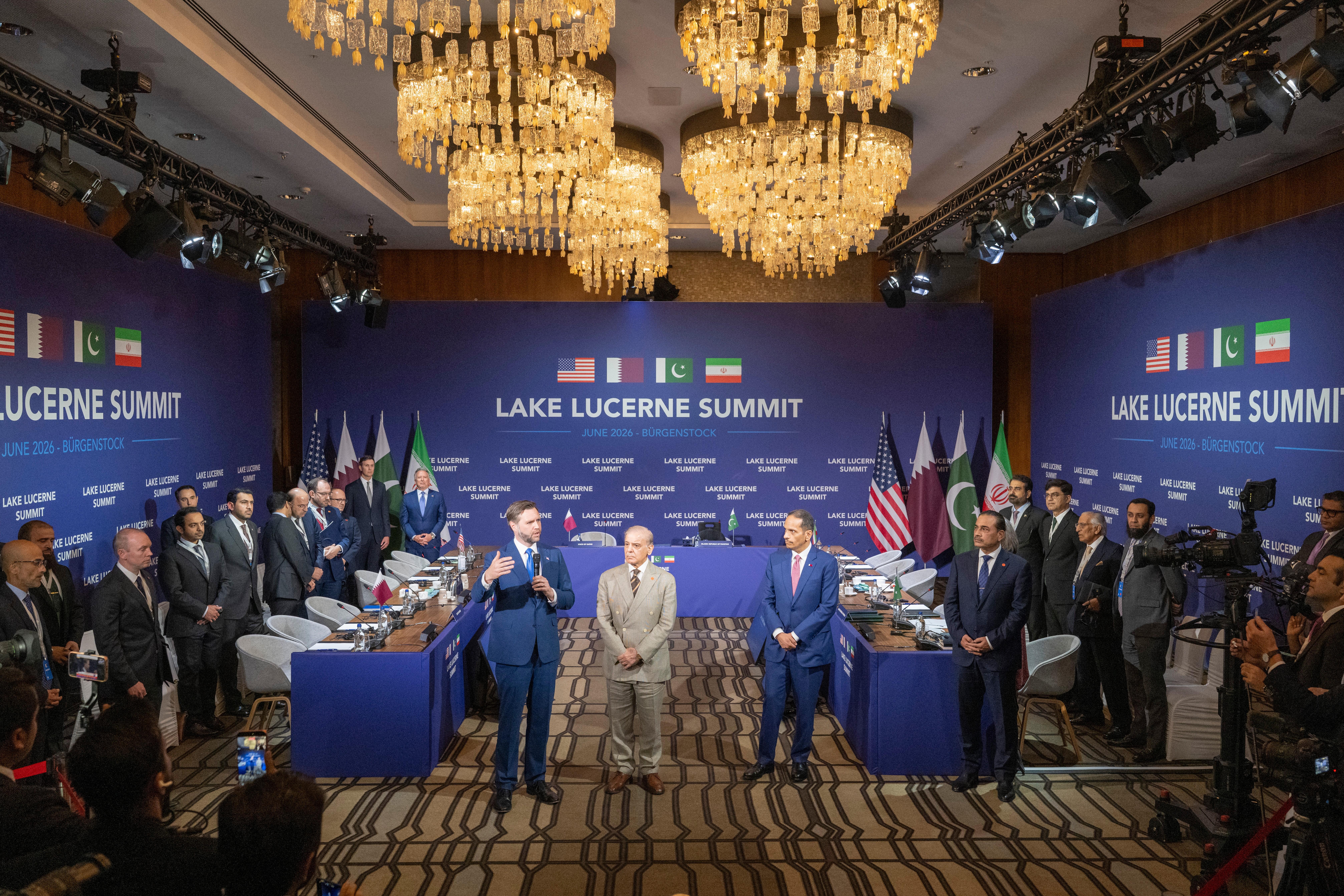
Social media feeds erupted over a five-second clip from the high-stakes US-Iran talks at the Bürgenstock resort in Switzerland. X users went wild claiming that Qatari Prime Minister Sheikh Mohammed bin Abdulrahman Al Thani deliberately humiliated US Vice President JD Vance. In the video, the Qatari leader walks into the room and warmly embraces Pakistani Prime Minister Shehbaz Sharif while completely bypassing Vance, who stands awkwardly toward the back.
The internet called it an instant diplomatic disaster. But if you look at how international diplomacy actually works behind closed doors, the reality is far less dramatic.
This summit overlooking Lake Lucerne wasn't a staged photo op. It was an grueling, high-pressure quadrilateral negotiation involving the US, Iran, Pakistan, and Qatar, all trying to hammer out a framework to stop a massive Middle East escalation. When you look at the actual timeline of events and the statements from the people in that room, the narrative of a deliberate snub completely falls apart.
The Viral Video and the Internet Freakout
The footage that sparked the online frenzy looks bad at first glance. Sheikh Mohammed enters the frame, greets Sharif with a warm hug, and appears to ignore Vance entirely. Moments later, Iranian Foreign Minister Abbas Araghchi does almost the exact same thing, hugging Sharif while keeping his distance from the American Vice President.
Commentators quickly jumped on the optics. Critics claimed Qatar and Iran were openly disrespecting the Trump administration on the world stage. The fact that the delegations didn't arrange a joint photo session fueled the rumors that the talks were collapsing.
But context changes everything. A senior US official later cleared up the confusion, calling the online outrage complete nonsense. The American delegation had already spent hours in intense meetings with the Qataris before that video was filmed. In the real world, diplomats don't constantly re-greet each other with formal handshakes every time they walk into a room after a bathroom break. The joint press statements were put together at the last minute, which is why the interaction looked unstructured and awkward on camera.
Real Diplomacy Happens in the Dark
While social media was busy analyzing body language, the actual negotiators were pulling a grueling ten-hour session that stretched long into the night. Qatar's Prime Minister even posted a photo on X showing himself working directly with Vance and Jared Kushner in Lucerne, completely shutting down the idea of a breakdown in communication.
Diplomats weren't focused on handshakes because they were trying to prevent a wider regional war. Tensions have been boiling over since the US enforced a naval blockade on Iranian maritime traffic in the Strait of Hormuz following military strikes earlier this year. The stakes in Switzerland couldn't have been higher.
Instead of a diplomatic failure, the summit actually produced a major breakthrough.
- A 60-Day Roadmap: The US and Iran agreed to a formal timeline to negotiate a broader political settlement covering Tehran’s nuclear program and regional security.
- Strait of Hormuz Hotline: The sides established a direct communication line to ensure safe passage for commercial vessels and prevent accidental military clashes in the strategic waterway.
- Lebanon De-confliction: Mediators locked in a mechanism to backstop the fragile ceasefire in Lebanon and rein in regional proxy forces.
The Trump Administration Strategy
The talks took place under a cloud of heavy public rhetoric. Just before the sessions got underway, President Donald Trump threw a wrench into the gears by threatening on Truth Social to hit Iran harder than ever if they didn't control their proxies. Iranian negotiators even walked out briefly on Sunday in protest before being coaxed back to the table by Qatari and Pakistani mediators.
Vance’s role in Switzerland wasn't to look pretty for the cameras. He was there to deliver a specific message: Trump is willing to turn over a new leaf with Tehran, but only if they comply with the strict terms of this new framework. It is a classic good-cop, bad-cop routine. Trump threatens total destruction from Washington, while Vance negotiates the fine print in Switzerland.
Qatar and Pakistan have spent months keeping these channels open. Sheikh Mohammed even visited Vance at the White House back in May to lay the groundwork for this exact summit. The relationship between these two leaders is highly strategic, despite what a selectively edited internet video might make you think.
Stop Reading the Diplomatic Tea Leaves
If you want to understand where global conflicts are heading, stop analyzing five-second clips on social media. Viral videos love conflict, but real international agreements are built on boring, late-night text editing and transactional security guarantees.
The Bürgenstock summit wasn't a failure or an embarrassment for the US delegation. It was a messy, high-stakes success that kept a fragile truce alive.
To get a real sense of where the US-Iran relationship goes next, ignore the handshake drama and watch these two indicators over the next few weeks:
- Shipping Volume in the Strait of Hormuz: Watch whether commercial oil tankers can pass through the strait without paying the arbitrary fees Tehran has threatened to impose. Real freedom of navigation is the ultimate proof that the communication line is working.
- The 60-Day Technical Talks: Keep track of whether low-level American and Iranian teams actually meet for the scheduled technical sessions. If those meetings happen, the roadmap is real, no matter how cold the room looked in Switzerland.