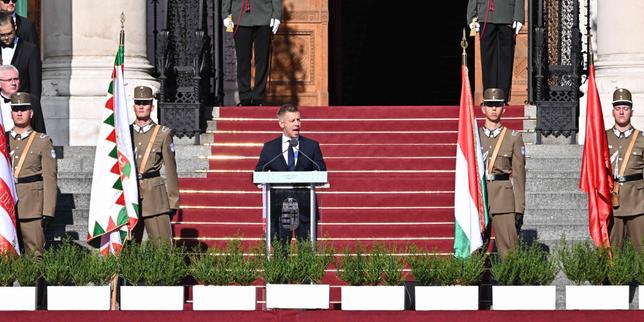
The recent resumption of news broadcasts on Hungary’s state-owned television, following a 44-day hiatus initiated by Prime Minister Péter Magyar, marks the implementation phase of a systemic political de-alignment. This operation was not a mere scheduling adjustment; it functioned as an administrative vacuum designed to decouple public broadcasting infrastructure from the partisan mechanisms of the preceding sixteen-year Fidesz administration. By suspending the output, the new government effectively neutralized the institutional inertia of a news apparatus that had operated as a government communication arm.
The Mechanics of Institutional Capture and De-Capture
The Hungarian media landscape under Viktor Orbán relied on a concentrated control model. The state media umbrella, MTVA, functioned as a centralized hub for narrative production, ensuring alignment between legislative intent and public-facing propaganda. When Magyar secured a mandate in April, he inherited a state media structure that was functionally incapable of impartial reporting due to the deep integration of party loyalists within the editorial decision-making hierarchy. For another look, consider: this related article.
The suspension of news programs on July 7, 2026, served three operational purposes:
- Information Throttling: By cutting the primary broadcast output, the government halted the flow of state-aligned content, preventing the internal resistance or sabotage of the new reform agenda through established communication channels.
- Resource Reallocation and Auditing: The period provided the interim leadership, overseen by delegated ministerial authorities, the operational space to conduct audits of legacy processes and staffing without the distraction of daily production pressures.
- Symbolic Reset: The black screen, replaced by an explicit public apology for years of state-sponsored misinformation, functioned as a signaling device to both the domestic public and international institutional observers, validating the break from the previous administration's communication protocols.
The Cost of Personnel Continuity
The challenge facing the current transition is the friction between the need for structural change and the reality of the existing labor pool. While the resumption of news on the national holiday—August 20—sought to provide a sense of legitimacy to the new era, the composition of the editorial staff remains a variable of concern. Further reporting on this matter has been shared by BBC News.
Reports indicate that while specific high-profile anchors and editors were purged, the broader editorial base remains largely intact. This creates an operational bottleneck: institutional memory and technical execution are currently managed by the same individuals who facilitated the prior administration’s information strategy. The efficacy of the reform, therefore, depends on the strength of the new oversight mechanisms and the ability of the interim leadership to enforce professional norms that supersede previous internal mandates.
The Structural Risk of Political Control
The criticism leveled by Orbán—labeling the move as "despotic"—relies on the argument that the current government is merely swapping one form of centralized influence for another. This highlights the vulnerability of the Hungarian public media model: its design is intrinsically tied to executive power.
For the reform to achieve its stated goal of long-term independence, the state must move beyond the current interim oversight and establish a firewall between the executive office and the daily management of MTVA. The current model—where the government directly oversees the "transition"—is a temporary necessity but represents a structural vulnerability. If the institutional rules governing media funding, appointment processes, and editorial oversight are not codified to prevent future executive interference, the current reform risk repeating the cycle of capture.
Implementation Trajectory
The path forward for the Hungarian state media hinges on two indicators:
- Editorial Pluralism: The recent 25-minute broadcast featuring balanced coverage suggests a tactical change in production standards. However, the true test will be the consistent inclusion of critical perspectives during periods of significant political conflict, not just during the "honeymoon" phase of a new administration.
- Appointment Transparency: Future leadership appointments at MTVA will demonstrate whether the new government intends to foster an independent institution or if it will simply establish a new internal consensus. If the board and leadership roles remain subject to direct government appointment without rigorous, independent verification processes, the risk of reversion to a state-mouthpiece model remains high.
The immediate strategic play for the current government is to transition from an interim, audit-based management style to an autonomous governance structure. They must surrender the direct levers of control they are currently utilizing to perform the reset. If they retain these levers, the reform will be exposed as a mere personnel swap rather than a genuine shift in state communication policy. Success will be measured not by the absence of past propaganda, but by the ability of the institution to withstand pressure from its own creators.