On June 24, 2026, two massive earthquakes measuring magnitude 7.2 and 7.5 hit north-central Venezuela in a brutal 39-second doublet sequence, leveling high-rise buildings in Caracas, shattering the main international airport, and leaving thousands feared dead or trapped under concrete rubble. While official government reports initially downplayed the numbers, the structural collapse across the capital and the coastal disaster zone of La Guaira reveals a far deeper crisis. This is not just a story of tectonic movement along the Boconó fault system. It is an investigation into decades of severe infrastructure neglect, unenforced seismic building codes, and an ongoing political and economic collapse that has left the nation completely defenseless against natural disasters.
The earth broke open on a national holiday, the anniversary of the Battle of Carabobo, meaning thousands of families were gathered inside their apartments rather than at office buildings or schools when the twin tremors struck. The first shock hit near Yumare at a depth of roughly 12 miles, followed immediately by a shallower, far more destructive 7.5 magnitude rupture. What followed was a cascade of structural failures that structural engineers and seismologists have warned about for a generation.
The Anatomy of a Predicted Catastrophe
For decades, experts at the Venezuelan Foundation for Seismological Research warned that Caracas was a ticking time bomb. The city sits inside a high-seismic hazard zone, boxed in by active strike-slip faults. Yet, walking through the hardest-hit neighborhoods of Altamira and Los Palos Grandes reveals that the destruction was entirely man-made.
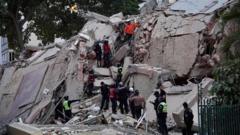
A 22-story residential tower in Altamira did not just sustain damage; it Pancaked completely, floor collapsing onto floor in a dense sandwich of pulverized concrete and rebar. This specific type of collapse points directly to structural deficiencies. In mid-twentieth-century concrete architecture, columns were often built without enough lateral steel ties to keep them from bursting under horizontal seismic forces. While the country technically updated its building codes in 2001 to mandate strict seismic reinforcement, enforcement completely evaporated over the last fifteen years due to hyperinflation, institutional flight, and systemic corruption.
In the informal settlements or barrios that cling to the mountainsides surrounding Caracas, like Catia and Petare, the situation is even grimmer. Millions live in self-built, unengineered brick-and-mortar homes stacked precariously on top of each other. The tremors triggered widespread landslides, sweeping entire blocks of these fragile homes down the steep slopes. There are no building records for these neighborhoods. No inspections were ever carried out. The state simply ignored their growth, leaving millions to rely on luck.
A Systemic Blackout and the Illusion of Control
Immediately following the disaster, Acting President Delcy Rodríguez declared a state of emergency but focused heavily on projecting an image of calm and total state control. The government restricted independent media access to the worst-affected sites, and state telecommunication networks experienced widespread blackouts, blinding the population to the true scale of the casualties.
Behind the official press conferences lies an ugly reality. The nation's emergency response network is fundamentally broken. Fire departments and civil protection units lack functioning vehicles, specialized concrete-cutting saws, heavy lifting equipment, and even basic medical supplies. In the hours after the 7.5 magnitude mainshock, neighborhood volunteers used their bare hands and crowbars to pull neighbors from the concrete ruins of collapsed apartments.
The closure of Simón Bolívar International Airport in La Guaira further paralyzed the country. The facility suffered catastrophic structural damage to its terminals and runways, rendering it useless just when international search-and-rescue teams needed a staging ground. La Guaira itself was declared a disaster zone, cut off from Caracas by landslides that blocked the main highway through the Avila mountain range.
The Collapse of the Healthcare Safety Net
Decades of economic isolation and underfunding have turned Venezuelan hospitals into hollow shells, a fact made tragically clear as hundreds of severely injured patients flooded emergency rooms. Hospitals lacked stable electricity, forcing doctors to perform triage and emergency amputations using the flashlights on their smartphones.
Even before the June 2026 disaster, major medical centers faced chronic shortages of basic antibiotics, sterile bandages, anesthetics, and blood for transfusions. The sudden influx of over 700 severely injured patients in the first few hours shattered what little capacity remained. Municipal authorities begged medical professionals nationwide to report to duty, but many had already fled the country during the long-standing economic crisis, leaving a severe shortage of specialized trauma surgeons and orthopedic experts.
Water systems also failed across north-central Venezuela, as old pipelines ruptured under the shifting earth. Without running water, hospitals cannot maintain sterile environments, raising the immediate threat of secondary health crises like waterborne diseases in temporary shelters and crowded triage zones.
The Geopolitical Standoff Over Humanitarian Aid
Natural disasters usually transcend geopolitics, but in Venezuela, the political landscape dictates who lives and dies. While international figures like chef José Andrés immediately pledged financial and logistical backing through non-profit networks, formal state-level aid faces massive diplomatic hurdles.
The government has historically been deeply suspicious of Western humanitarian intervention, viewing it as a Trojan horse for political destabilization. Consequently, international search-and-rescue teams from neighboring nations remained stranded on tarmacs in Colombia and Panama, waiting for formal entry clearances that were delayed by bureaucratic paranoia. Meanwhile, the clock ran out for survivors trapped deep within the voids of collapsed high-rises.
The structural vulnerability of the country is inextricably linked to its financial decay. Building safe, earthquake-resistant cities requires massive capital investment, transparent regulatory oversight, and a stable economy where contractors cannot bribe their way out of safety codes. Venezuela has none of these. Concrete manufacturing and steel production, both nationalized industries, have suffered from years of mismanagement, leading to substandard building materials flooding the local market.
A Legacy of Unheeded Warnings
The 2026 doublet is the largest seismic event to hit the country since 1900, but it is not unprecedented. Caracas was heavily damaged by a magnitude 6.6 earthquake in 1967, which killed over 200 people and collapsed several modern buildings. The lessons from 1967 were documented, studied, and ultimately filed away in government cabinets to gather dust.
The physical reconstruction of Caracas, La Guaira, and the surrounding states will take years and billions of dollars that the state simply does not possess. But the structural reconstruction of the nation's safety infrastructure is an even steeper hill to climb. Without a complete overhaul of building inspections, a massive reinvestment in emergency response equipment, and an end to the political weaponization of international aid, the country will remain perfectly exposed to the next inevitable shift of the Caribbean and South American tectonic plates.
The dust over Caracas will eventually settle, and the official state media will stop broadcasting images of rescue workers. But under the rubble, the true cost of systemic institutional decay remains buried, completely hidden from the rest of the world.