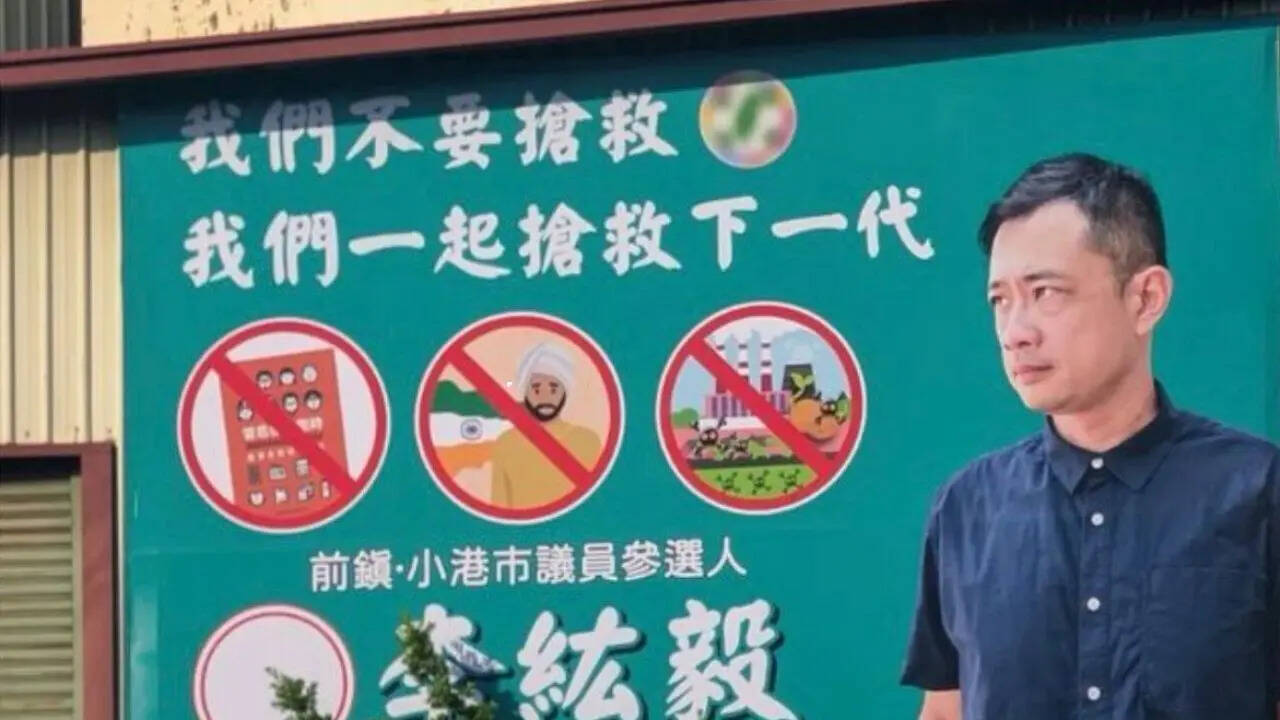
A single campaign billboard in southern Taiwan has exposed a fracture line in the island’s tech-driven economy. In Kaohsiung City’s Siaogang district, an independent local council candidate recently erected a massive hoarding featuring a "no entry" sign superimposed over the Indian national flag and the image of a turbaned man. The message was unmistakable, xenophobic, and timed perfectly to exploit shifting political dynamics ahead of the November municipal elections.
This is not an isolated incident of local political theater. It is the visible surface of a deeper structural crisis that threatens Taiwan’s industrial supply chains, its critical semiconductor expansion, and its delicate geopolitical alignment against Chinese pressure. Taiwan urgently needs labor, India has an abundance of it, but domestic political weaponization and digital disinformation are threatening to derail a critical economic alliance before it even starts.
The Math Behind the Labor Crisis
Taiwan is facing a demographic brick wall. The island is transitioning into a "super-aged" society, with a fertility rate well below the replacement level needed to sustain a modern economy. For decades, factories and tech assembly lines relied on blue-collar migrant workers from four primary Southeast Asian nations: Vietnam, Indonesia, the Philippines, and Thailand.
That supply is drying up. Economic growth within those nations means fewer workers are willing to move abroad for low-wage factory jobs. Meanwhile, Taiwan's domestic tech expansion—fueled by global AI demand and the relentless growth of firms like TSMC and Foxconn—requires an ever-larger base of manufacturing and support staff.
To solve this, Taipei signed a Memorandum of Understanding (MOU) with New Delhi to open up recruitment pathways for Indian workers. The initial pilot program targets a modest 1,000 arrivals by the end of the year, focusing on manufacturing, agriculture, and caregiving. Yet, opposition politicians quickly weaponized the policy, spreading claims that Taiwan would soon be flooded by 100,000 unregulated workers.
Weaponizing Statistics for Political Gain
The opposition Kuomintang (KMT) party seized on the agreement to score points against the ruling Democratic Progressive Party (DPP). Lawmakers cited aggregate crime data from India to stoke public anxiety, pointing to high absolute numbers of offenses against women without adjusting for India's population of 1.45 billion people.
This selective use of data successfully manufactured a fear psychosis among segments of the electorate. An online petition calling for a complete halt to the Indian labor program quickly gathered over 34,000 signatures. The narrative implies that migrant workers cannot be vetted effectively, ignoring the reality that any incoming worker must pass rigorous criminal background checks, health screenings, and document verification protocols before a visa is granted.
The strategy works because the general Taiwanese public has historically had minimal direct contact with Indian culture. There are currently just over 7,000 Indian nationals living in Taiwan, the vast majority of whom are highly educated engineers, researchers, and tech professionals working at major firms like Realtek and Foxconn. The campaign rhetoric deliberately conflates these distinct demographics to present a unified foreign threat.
The Digital Disinformation Engine
The anxiety surrounding the labor pact did not emerge organically. National security agencies in Taipei tracked coordinated, modular messaging campaigns across social media platforms like TikTok and Threads. These digital operations amplified racist tropes and exaggerated the terms of the bilateral agreement.
Analysts point to external actors, specifically Chinese influence operations, seeking to disrupt the growing alignment between New Delhi and Taipei. India has quietly deepened its unofficial relationship with Taiwan, expanding bilateral trade from 1.19 billion USD in 2001 to 12.5 billion USD. New Delhi has also omitted explicit mentions of Beijing's "One China" policy in joint statements, signaling a strategic shift that irritates the Chinese leadership. By poisoning the well of public opinion in Taiwan, hostile digital campaigns hit two targets at once: they stall Taiwan’s economic modernization and damage its diplomatic ties with a major Indo-Pacific power.
The ruling DPP’s response to the backlash occasionally worsened the issue. In an attempt to soothe public anxieties, officials previously suggested that Taiwan would prioritize hiring from northeastern India, claiming those populations would integrate better due to physical characteristics and religious alignment. This attempt to rationalize immigration criteria along ethnic lines drew sharp criticism from labor advocates and international observers, exposing a deep-seated discomfort with multiculturalism within the political establishment.
Supply Chains Versus Social Conservatism
Taiwan's industrial sector cannot afford a political stalemate over immigration. Local manufacturers are caught between the reality of empty factory floors and the caution of politicians eyeing the upcoming local elections. If the pilot program for Indian workers fails due to domestic political resistance, Taiwan risks falling behind in the global technology race.
The private broker system complicates the integration of foreign labor. Under current regulations, private brokers manage the recruitment and placement of foreign workers, often charging exorbitant fees that trap laborers in debt cycles before they set foot on the island. When workers abscond from their assigned factories to escape these financial burdens, they enter an underground economy, providing ammunition for political factions who claim that migrant labor creates a national security risk.
The Ministry of Labor is attempting to move forward cautiously, emphasizing that future recruitment will scale strictly according to industry demand and the success of the initial pilot. But the Kaohsiung billboard demonstrates that the technical merits of a policy matter little once an issue is successfully racialized for electoral leverage.
The Geopolitical Cost of Domestic Friction
The fallout from the campaign billboard extended far beyond local ward politics. Senior national security officials, including National Security Council Secretary-General Joseph Wu, issued public condemnations of the campaign materials, labeling the behavior despicable. Taiwan's representative office in New Delhi issued a public apology to distance the state from the discriminatory rhetoric, recognizing the damage such incidents cause to broader strategic ambitions.
Taiwan wants to be viewed as a progressive, democratic beacon in East Asia. Incidents of blatant racial discrimination erode that soft-power narrative, particularly in the eyes of Global South partners that Taipei is trying to court.
The issue remains unresolved as the November elections approach. For Taiwan's high-tech economy, the choice is no longer just about managing immigration numbers. It is a fundamental question of whether a society built on global trade can overcome insular domestic politics to secure the human capital its survival depends on.