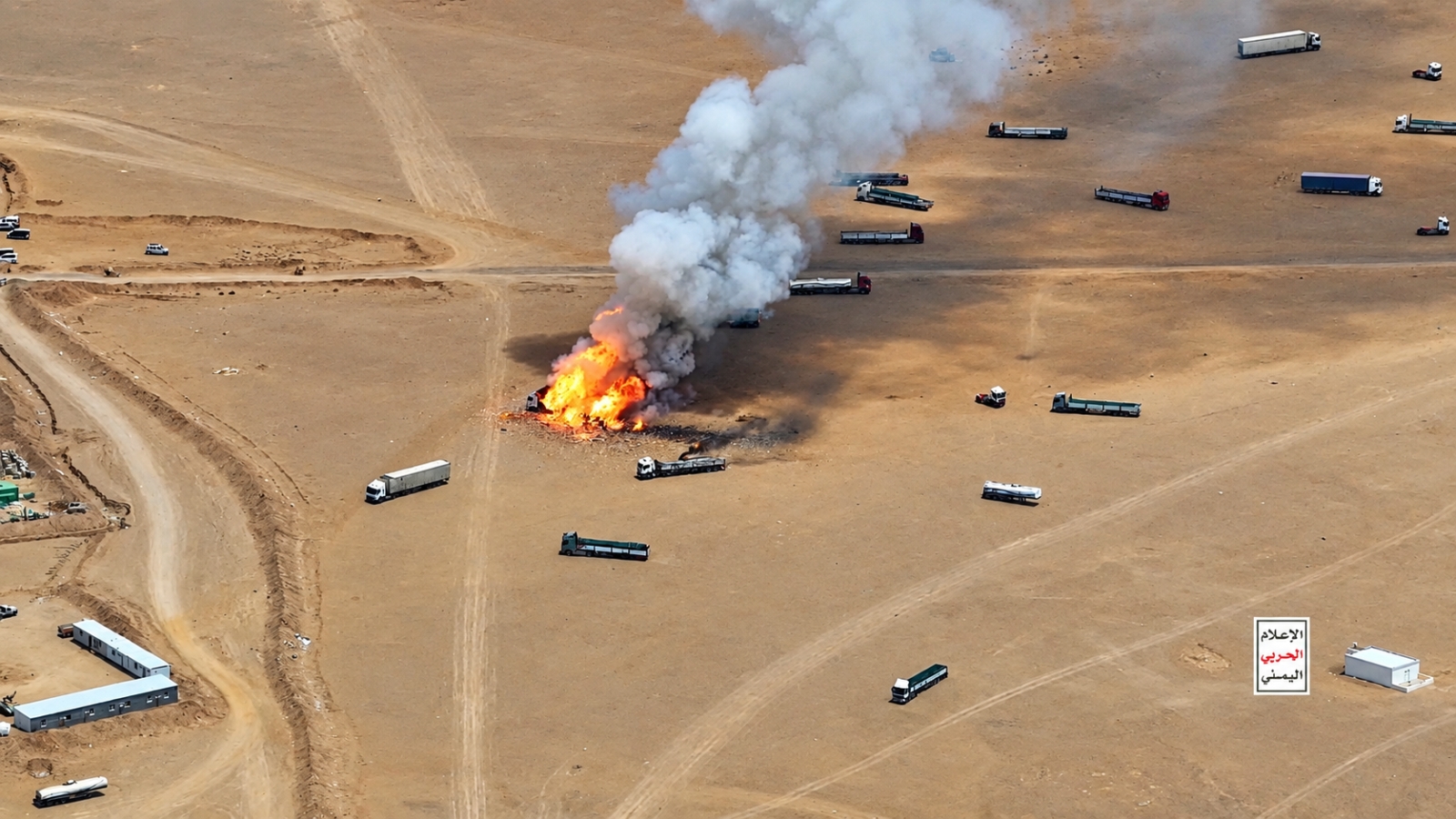
Yemen's Houthi movement struck multiple southern Saudi energy nodes, including critical Saudi Aramco installations in Jazan, Abha, and Najran, using coordinated salvos of ballistic missiles and explosive drones. The Tuesday morning barrage injured 73 civilians, triggered fierce industrial fires, and forced the Saudi Energy Ministry to temporarily suspend operations at several vital facilities.
This was not a random act of border violence. It represents a calculated escalation designed to exploit the physical vulnerabilities of the global petroleum apparatus at its most fragile choke point.
For years, military analysts treated the Houthi arsenal as a collection of rudimentary backyard modifications. That patronizing miscalculation has expired. The trajectory of recent strikes reveals an adversary that has mastered long-range guidance systems, telemetry, and low-altitude flight paths capable of bypassing multi-billion-dollar Western-built air defense batteries. When seventy-three people are wounded across multiple distinct municipal zones simultaneously, the operational choreography points to sophisticated targeting intelligence.
The immediate catalyst for this offensive traces back to a breakdown of local deterrence and a broader regional theater. Following the collapse of the 2022 truce, ground clashes in Yemen intensified rapidly, compounded by a direct confrontation over aviation access at Sanaa International Airport. When a humanitarian or political challenge to the long-standing Saudi-led blockade was met with kinetic runway strikes, the retaliatory vector turned outward. Riyadh became the primary canvas for a regime seeking to rewrite the cost of regional containment.
The Choke Point Calculus
To understand why these specific infrastructure targets matter, look at a map of global energy geography. The Strait of Hormuz has faced severe operational constriction due to concurrent regional conflicts involving Iran. Consequently, the maritime corridor through the Bab al-Mandab Strait and the Red Sea assumed an existential role for Saudi petroleum exports.
By launching persistent campaigns against Red Sea shipping and coupling them with direct kinetic strikes on southern refineries like Jazan—a facility capable of processing four hundred thousand barrels per day—the Houthis are targeting the alternative pathways.
Consider the logistical reality. If Hormuz is choked and Red Sea transport lanes face persistent maritime drone threats, downstream processing facilities inside southern Saudi Arabia form the vital hinge of continuity. Disrupters do not need to sink every tanker if they can cripple the domestic stabilization and refining network that feeds them. The Jazan complex, perched precariously near the Yemeni frontier, sits within comfortable range of mobile tactical ballistic systems.
The Limits of Air Defense
Western defense contractors have spent decades selling an infallible narrative of layered missile defense. Patriot and intermediate interceptor batteries line the perimeter of the kingdom's key economic assets. Yet, economics favor the attacker. A sophisticated loitering munition or a massed salvo of liquid-fueled rockets costs a fraction of the defensive interceptors launched to neutralize them.
When structural fires erupted at utilities and oil terminals across Abha, Khamis Mushait, Jazan, and Najran, specialized field teams found themselves playing a reactive game of containment. Passive defense can absorb blows, but it cannot stop the rhythm of an entrenched insurgent force manufacturing components locally or receiving modular shipments via sophisticated supply chains.
The Saudi-led coalition has promised severe military retribution, initiating counter-strikes across Houthi-held governorates in Yemen such as Taiz and Marib. Yet, historical precedent suggests that aerial bombardment alone rarely compels a non-state actor with decentralized cells to capitulate. The structural asymmetry of this conflict means that a prolonged campaign inside Yemen yields diminishing returns for Riyadh, while each successful drone strike on an oil installation sends tremors through international crude markets.
Global energy infrastructure was built for an era of conventional state-on-state warfare, not for asymmetrical attrition by non-state factions wielding precision-guided munitions. As repair crews work under the shadow of sirens to secure damaged pipelines and storage tanks, the structural vulnerability of the global energy grid remains laid bare on the Red Sea coast.


