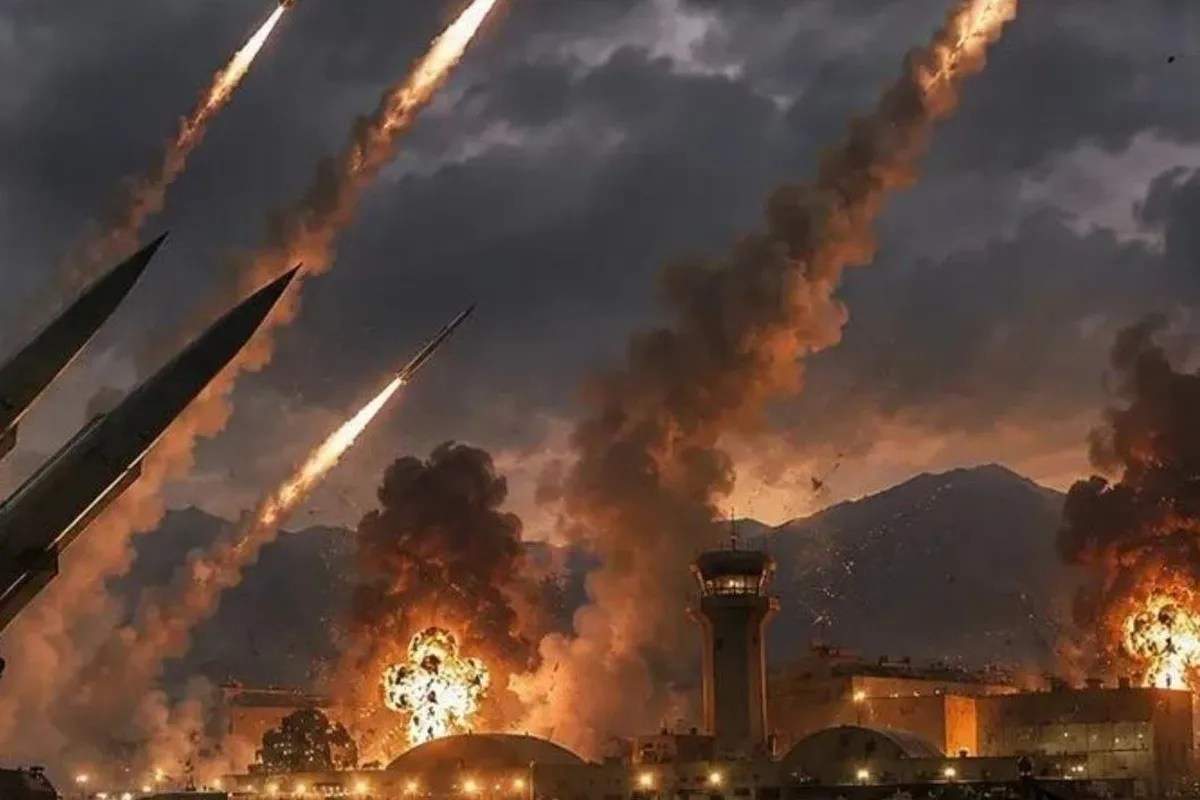
The fragile quiet that held the Persian Gulf in suspense for a month evaporated in a matter of hours. Iranian ballistic missiles slammed toward regional outposts following an American strike on Larak Island, abruptly ending a brief period of diplomatic maneuvering and plunging Washington and Tehran back into open military confrontation.
This sudden escalation exposes the structural fragility of the ongoing conflict. For weeks, the White House signaled a pivot toward economic pressure, hoping that financial isolation under campaigns like Operation Economic Outcast would force Tehran to bend. That strategy underestimated the immediate tactical imperatives governing the Islamic Revolutionary Guard Corps. When United States Central Command forces identified and destroyed two Iranian rocket launchers preparing to deploy naval mines into the Strait of Hormuz, the calculus shifted instantaneously from ledgers back to launch codes. Learn more on a connected subject: this related article.
The Anatomy of the Larak Island Strike
The trigger for the missile exchange occurred on the shores of Larak Island, a heavily fortified position overlooking the narrow shipping lanes of the Persian Gulf. Intelligence assets tracked IRGC units positioning mobile launchers designed to seed the international waterway with sea mines.
The Strait of Hormuz remains the jugular vein of global energy transport, carrying roughly one-fifth of the world's petroleum supply. Allowing Tehran to re-mine a corridor that the US Navy had spent weeks clearing would have handed the regime a permanent chokehold on international commerce. Additional reporting by NBC News delves into similar views on this issue.
Precision airstrikes obliterated the launchers. Yet, military planners in Washington understood the inherent risk of breaking the month-long operational pause. Striking sovereign Iranian territory crosses a political boundary that demands a kinetic reply from a regime whose domestic legitimacy relies on projecting unyielding defiance.
The Retaliatory Arc to Jordan
Within hours of the Larak Island operation, Iranian state media confirmed the launch of ballistic missiles targeting regional installations. The primary targets identified by the IRGC were the King Hussein and Al Azraq air bases in Jordan, facilities utilized by coalition forces supporting regional security.
Jordanian air defenses proved active and capable. Armed forces reported intercepting eight incoming missiles that breached national airspace, blunting the impact of the salvo. Initial assessments from American defense sources confirmed that multi-layered interception systems successfully neutralized the threat before widespread structural damage or casualties materialized at the targeted installations.
Despite the high interception rate, the choice of target carries profound diplomatic weight. Jordan walks a precarious geopolitical tightrope, hosting Western military infrastructure while managing a domestic populace deeply sensitive to regional flare-ups. Dragging Amman further into the crossfire serves Tehran's broader objective of raising the diplomatic and security costs for any regional government cooperating with Washington.
The Illusion of Containment
The latest cycle of violence demonstrates the failure of containment theories that separate economic warfare from kinetic engagement. Financial sanctions and naval blockades—which have successfully redirected dozens of commercial vessels and choked off regime revenue—do not exist in a vacuum. They provoke counter-measures at the physical margins of the conflict.
Tehran retains a deep inventory of asymmetric assets, including ballistic missiles, loitering munitions, and anti-ship capabilities distributed across rugged coastal terrain. Even as senior officials in Washington emphasize financial deterrence, the physical reality on the water dictates that every move to enforce a blockade meets an equal and opposite reaction.
Oil markets reacted instantly to the explosions over the Gulf and the desert, with benchmark crude prices ticking upward as traders priced in the renewed risk of structural supply disruptions. This sensitivity underscores a permanent vulnerability. No amount of diplomatic optimism can decouple the global economy from the narrow waters separating the Iranian coast from the Arabian Peninsula.
The illusion that this conflict can be managed through intermittent pauses has vanished. Every attempt to lock down the shipping lanes forces the IRGC to test the perimeter, and every defensive strike guarantees a response aimed at American footprint across the Middle East. The threshold for total escalation grows thinner with every salvo, leaving the entire corridor tethered to a hair-trigger balance where a single miscalculation can render localized skirmishes obsolete.