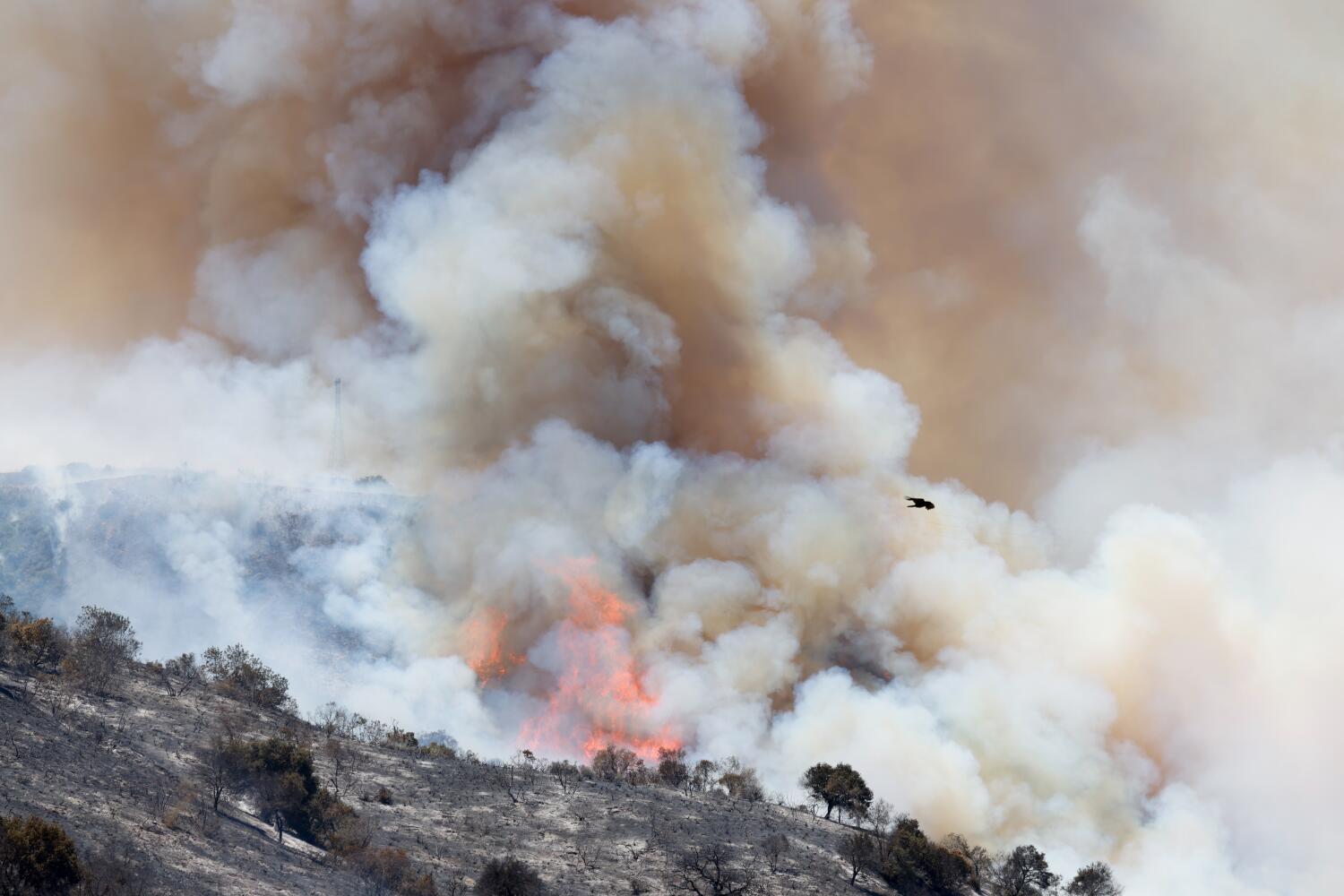
Multiple wildfires burning simultaneously across Southern California have triggered an extended, region-wide unhealthy air quality alert, forcing millions of residents from Ventura down to the Imperial Valley to seal their windows or retreat to public shelters. The South Coast Air Quality Management District and the National Weather Service expanded emergency smoke advisories as a toxic combination of fine particulate matter ($PM_{2.5}$) and high-heat ozone pollution pushed regional air quality index (AQI) readings into dangerous territory.
While official government bulletins urge people to stay indoors and run air conditioners on recirculation mode, these boilerplate public safety warnings mask a much more severe infrastructure and public health failure. The conventional narrative treats these spring blazes—including the fast-moving Sandy Fire near the Santa Susana Mountains and the massive 16,000-acre Santa Rosa Island fire pumping smoke from the ocean back onshore—as an unfortunate, localized weather event.
The reality is far more dangerous. Southern California is trapped in a structural pollution funnel where shifting topography, a warming climate, and modern home construction are failing to protect the public from an increasingly year-round wildfire season.
The Toxic Micro-Particle Trap
Most media coverage focuses on the visible, dramatic walls of orange smoke or the heavy smell of ash blanketing coastal communities like Santa Monica and Pacific Palisades. But the real threat to human biology is entirely invisible.
Wildfire smoke is a chaotic, ultra-fine chemical soup. The primary driver of the current health alert is $PM_{2.5}$, particulate matter smaller than 2.5 micrometers in diameter. To put that in perspective, one of these particles is roughly thirty times smaller than the width of a single human hair.
Standard nasal passages and upper respiratory tracts are entirely defenseless against particles of this size. When inhaled, $PM_{2.5}$ bypasses the lungs' natural filtration mechanisms entirely, embedding deep within the alveoli. From there, the microscopic soot crosses the blood-air barrier, entering the human bloodstream directly.
Medical data shows that this direct entry triggers immediate systemic inflammation. The body treats the foreign carbon and chemical particles as an invasive trauma, causing blood vessels to constrict and blood pressure to spike. For healthy individuals, this manifests as scratchy throats, severe headaches, or acute fatigue. For vulnerable populations—including children, pregnant individuals, and the elderly—the introduction of $PM_{2.5}$ into the cardiovascular system drastically increases the immediate, short-term risk of myocardial infarction and ischemic stroke.
The Double-Whammy of Ground-Level Ozone
What makes the current atmospheric crisis in Southern California uniquely perilous is that the region is not just battling wildfire smoke. It is simultaneously suffocating under a massive spike in ground-level ozone, colloquially known as urban smog.
This is not the protective ozone layer high up in the stratosphere. Ground-level ozone is created when nitrogen oxides and volatile organic compounds—emissions pumped out by millions of vehicles idling on Southern California freeways and heavy industry at the ports—chemically react under intense sunlight and high temperatures.
When wildfire smoke mixes with this existing urban pollution basin, the chemical reaction accelerates. The smoke acts as a massive catalyst, supercharging the formation of ozone just as afternoon temperatures peak.
The geographical basin of Southern California acts as a literal cage. Mountain ranges trap this highly reactive air mass, holding it close to the ground where millions of people breathe. While the Sandy Fire poisons the western edges of Los Angeles County, this ozone accumulation has driven air quality to hazardous levels further inland, completely choking out communities in the Imperial Valley like El Centro and Calexico.
The Myth of Safe Indoor Air
Public health agencies consistently issue a singular piece of advice during these crises: stay indoors. Yet, this directive relies on a flawed assumption that the average American home is an airtight bunker capable of repelling microscopic atmospheric contaminants.
It is not. The vast majority of residential housing stock in Southern California relies on structural designs that naturally exchange indoor and outdoor air multiple times per hour through a process known as ambient infiltration. Microscopic particles migrate through microscopic gaps in window seals, under door frames, and through standard attic ventilation.
If you can smell the distinct scent of a wildfire while sitting inside your living room, your indoor air quality is likely nearly identical to the toxic air on your driveway.
Furthermore, standard residential central air conditioning systems do not inherently purify the air. Most homes are equipped with basic fiberglass filters designed purely to keep large dust bunnies from damaging the mechanical blower motor. These low-tier filters have a Minimum Efficiency Reporting Value (MERV) rating of 4 or lower. They are completely useless against a particle measuring 2.5 micrometers.
To actually scrub wildfire smoke from an indoor environment, an HVAC system requires a MERV 13 filter or higher, alongside a system capable of handling the high static pressure resistance these dense filters create. Without this specific hardware, running a standard air conditioner simply recirculates existing indoor toxins while pulling in additional fine particulate matter from the outside.
Socioeconomic Air Inequality
The advice to simply switch on an advanced, recirculating air conditioning system or purchase high-end HEPA filtration units highlights a glaring socioeconomic divide that public safety alerts completely ignore.
Clean air has become a luxury commodity in California. Low-income families living in older, poorly insulated rental units or historic housing stock often lack central HVAC entirely. During high-heat events that coincide with wildfire smoke advisories, these residents face a brutal, impossible choice:
- Keep windows and doors tightly shut to keep out the toxic smoke, risking severe heat exhaustion inside a stagnant, boiling apartment.
- Open the windows to catch a breeze, flooding their living space with carcinogenic particulates and ozone.
While county officials point to public libraries and commercial shopping centers as designated "cooling and clean air zones," these stopgaps fail to account for the realities of hourly wage workers, those lacking reliable transportation, or individuals with mobility constraints who cannot easily relocate for days at a time while a wildfire burns.
The Operational Failure of Atmospheric Forecasting
Predicting the movement of wildfire smoke remains one of the most notoriously unreliable fields in modern meteorology. Air quality models regularly fail to anticipate how localized terrain features alter smoke paths.
The Santa Rosa Island fire provides a textbook example of this forecasting failure. Initial models suggested the massive smoke plume would stay safely out over the Pacific Ocean, dispersing harmlessly over open water. Instead, a shifting, low-level marine layer inversion flipped the script overnight. The heavy smoke mass was pushed directly back onshore, blindsiding coastal communities with a sudden drop into the "Unhealthy" AQI category before local agencies could update their public digital dashboards.
Relying solely on delayed government monitors can be dangerous. Because regional monitoring stations are often placed miles apart, they frequently miss localized "smoke pockets" trapped in specific canyons or valley floors.
Immediate Tactical Self-Defense
Waiting for a wildfire to be fully contained is a losing strategy. Residents must take proactive, mechanical control of their immediate breathing environments using accessible, proven tactics rather than relying on abstract environmental policy.
| Mitigation Tool | Action Strategy | Primary Benefit |
|---|---|---|
| HVAC Recirculation | Set thermostat fan to "On" and "Recirculate." Never use fresh-air intake settings during active smoke advisories. | Prevents drawing high-concentration outdoor smoke directly into the home infrastructure. |
| MERV 13 Upgrades | Replace standard 1-inch filters with rated MERV 13 variants if the system compressor allows. | Mechanically traps a significant percentage of microscopic $PM_{2.5}$ particles. |
| Corsi-Rosenthal Box | Construct a DIY purifier using a 20-inch box fan, four MERV 13 filters, and duct tape. | Provides cheap, high-volume clean air delivery rates that match or exceed expensive commercial purifiers. |
| Respirator Discipline | Deploy tightly fitted NIOSH-certified N95 or P100 respirators for any mandatory outdoor exposure. | Creating a physical, sealed facial gasket is the only way to filter particles when outside. |
Standard cloth face masks, surgical masks, and bandanas do absolutely nothing to protect against wildfire smoke. They are designed to catch large liquid droplets, not microscopic airborne soot. Slipping on a loose surgical mask before walking into an active smoke plume provides nothing more than a false sense of security while your lungs absorb the damage.


