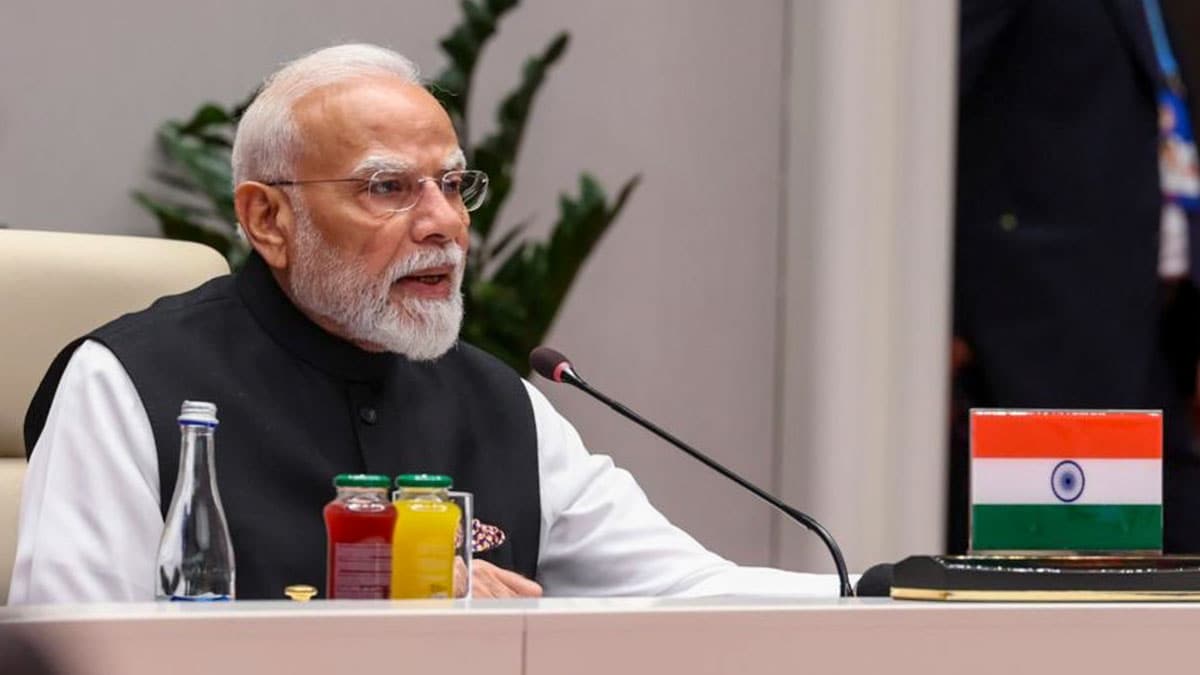
Prime Minister Narendra Modi used the 26th Shanghai Cooperation Organisation (SCO) summit in Bishkek to deliver an uncompromising geopolitical indictment against Pakistan and China, directly targeting state-sponsored militancy and Beijing's contentious cross-border infrastructure projects. Standing alongside regional adversaries under the institutional roof of an organisation dominated by Beijing and Moscow, New Delhi opted for institutional warfare over polite diplomatic platitudes. The messaging was razor-sharp. Modi targeted the financial arteries of regional violence and challenged the fundamental legality of connectivity corridors infringing on national sovereignty.
Diplomatic gatherings often rely on carefully sanitized communiques. Bishkek offered no such comfort.
Dismantling the Terror Matrix
Modi attacked the concept of militancy as an instrument of state policy. With Pakistan Prime Minister Shehbaz Sharif seated feet away, the critique cut straight to the bone of Islamabad's security architecture.
"We must speak in one voice that there can be no place for double standards in dealing with terrorism," Modi stated during the plenary session.
The language broke away from standard diplomatic convention. Instead of condemning generic acts of violence, the speech demanded the complete dismantling of terrorist financing, recruitment pipelines, and geographic safe havens. Decades of cross-border infiltration have forced New Delhi to abandon defensive rhetoric. By declaring that terror cannot function as a strategic asset, India sought to delegitimize the policy vectors historically utilized by its western neighbor.
This hardline posture creates friction within a bloc designed to project Eurasian unity. Moscow balances multiple regional dependencies, while Beijing shields Islamabad through diplomatic vetoes and economic lifelines. Inserting a blunt counter-terrorism mandate into this forum forces member states to navigate public positions on security accountability that they would prefer to obscure behind closed doors.
Sovereignty and the Corridor Conflict
While Islamabad absorbed the security warnings, Beijing faced a direct challenge regarding territorial integrity and regional transit initiatives. Modi addressed the sensitive architecture of connectivity by tying physical integration directly to the preservation of sovereign borders.
"India supports all efforts that connect markets, facilitate trade and open new avenues for development," Modi noted. "However, respect for the sovereignty and territorial integrity of all countries is essential in these efforts."
The statement served as a calculated rebuke of the China-Pakistan Economic Corridor (CPEC). Traversing Pakistan-administered Kashmir, the infrastructure project represents a direct violation of Indian sovereignty claims. Beijing routinely attempts to normalize CPEC as a commercial venture under the Belt and Road Initiative. By embedding sovereignty prerequisites into the official SCO record, New Delhi established a legal and political counter-weight. It signals to Central Asian republics that economic integration cannot come at the expense of international law or territorial boundaries.
The Geopolitical Balancing Act
Operating inside a Beijing-led security architecture requires deliberate maneuvering. New Delhi treats the SCO as a necessary venue to project influence across Central Asia, a resource-rich region historically tied to Russian and Chinese spheres of authority. Abandoning the platform would surrender regional optics. Remaining inside allows India to challenge rival narratives directly.
The Bishkek summit laid bare the structural fault lines within the bloc. The organization attempts to brand itself as an alternative to Western-dominated multilateral institutions. Yet, internal contradictions render unified action nearly impossible. When member states actively harbor or finance militant networks, security cooperation remains an illusion. When major economic initiatives ignore foundational legal principles, regional integration transforms into an instrument of hegemony.
New Delhi chose to expose these contradictions on an international stage. The diplomatic fallout from Bishkek extends far beyond the conference halls, resetting the terms of engagement across Eurasia as India refuses to dilute its core security interests for the sake of institutional harmony.