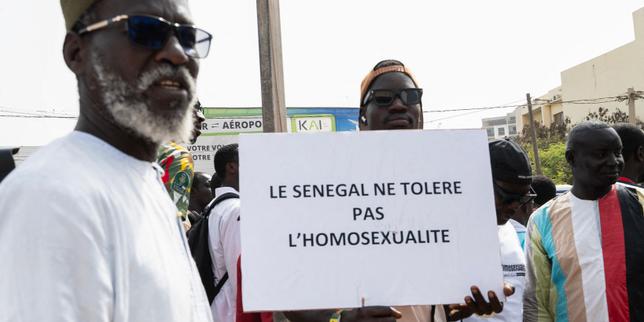
The immediate danger for sexual minorities in Senegal is no longer just the local police force. It is their neighbors, their families, and the state-sanctioned digital networks tracking their movements. President Bassirou Diomaye Faye signed Law No. 2026-08 into effect, modifying Article 319 of the Penal Code to double the maximum prison sentence for consensual same-sex acts to ten years. The law introduces a staggering ten-million CFA franc fine and penalizes the amorphous offense of glorifying or financing unnatural acts. This legislative shift has fundamentally altered the survival mechanisms for the country's underground queer population, turning a long-standing social taboo into an active internal displacement crisis.
For decades, Senegal maintained a fragile, unwritten compromise. While Article 319 had criminalized improper or unnatural acts since 1965, prosecutions were historically sporadic, typically triggered only when activities occurred in public spaces or clashed overtly with religious sensibilities. The 2026 amendment effectively ends that era of quiet containment. By criminalizing the vague concept of promotion, the state has targeted the entire support infrastructure, including civil society organizations, human rights defenders, and medical providers offering essential HIV testing and treatment. Meanwhile, you can explore other developments here: The Reality of Gaza Police Casualties Under Israeli Airstrikes.
The Economics of Exclusion
The legislative crackdown has triggered an immediate collapse of safe spaces, leaving vulnerable populations completely exposed. In urban centers like Dakar and Thiès, landlords are preemptively evicting tenants suspected of being non-conforming to avoid complicity charges under the new financing and support clauses. This has created a class of internally displaced citizens who cannot access formal housing, secure employment, or seek police protection.
- Evictions: Immediate termination of rental agreements based on neighborhood rumors.
- Employment Termination: Immediate dismissal without recourse, as the national constitution offers no protections against discrimination based on sexual orientation or gender identity.
- Healthcare Collapse: A sharp decline in clinic visits for sexual health, driven by the fear that possession of condoms or water-based lubricants will be used by authorities as circumstantial evidence of illegal acts.
The state apparatus is actively supported by influential conservative groups. The local organization Jamra recently announced it possesses a comprehensive list containing hundreds of names of individuals alleged to be homosexual, explicitly intending to use this data to force the government to dismantle sixteen separate non-governmental organizations. This systematic targeting means that fleeing the country is frequently the only viable survival strategy, yet the avenues for legal exit are rapidly closing. To understand the full picture, check out the detailed article by Reuters.
Extortion and the Digital Bounty Economy
The true gravity of the current crisis lies in how the legal framework empowers vigilantes. The new law contains a clause penalizing malicious false reporting with up to ten years in prison, intended on paper to prevent arbitrary accusations. In practice, however, this has done little to curb a booming underground extortion market.
Blackmarket operators and criminal syndicates routinely use dating apps and social media platforms to catfish individuals, lure them to private residences, and hold them captive. Victims face a brutal choice: pay an exorbitant ransom or face exposure to local mobs and subsequent police arrest. Because the statutory minimum penalty for natural acts has risen to five years, victims almost never report these extortions to the police. The state has essentially outsourced its surveillance to the public, creating an environment where suspicion alone is enough to destroy a life.
[Target Selection via Social Media]
              │
              ▼
    [Catfishing / Luring]
              │
              ▼
   [Physical Confinement] ───► Paid Ransom ───► Financial Ruin
              │
              ▼
       Refused Payment
              │
              ▼
[Public Exposure / Police Arrest]
The political context behind this escalation is deeply rooted in domestic electoral dynamics. Prime Minister Ousmane Sonko championed this legislative hardening during his time in the opposition, turning anti-LGBTQ sentiment into a powerful tool for populist mobilization. By fulfilling this campaign promise early in the current administration's mandate, the ruling party successfully consolidated support among influential religious leaders and conservative voting blocs, effectively using a marginalized population as political currency.
The Closed Borders of West Africa
Escaping Senegal has become immensely difficult. Neighboring countries offer no refuge; the regional landscape is increasingly hostile. Gambia retains severe anti-homosexuality laws, Mauritania applies strict Islamic legal codes where same-sex acts can theoretically carry the death penalty, and Mali and Burkina Faso are moving rapidly toward their own regressive legislative frameworks under military juntas.
This geographical isolation traps individuals in a permanent state of flight within their own borders. Those who attempt to reach Europe or North America face insurmountable visa barriers, forcing many onto dangerous irregular migration routes across the Atlantic to the Canary Islands or through the Sahara toward the Mediterranean. The international community has issued sharp condemnations, with UN Human Rights Chief Volker Türk noting that the law violates binding obligations under the African Charter on Human and Peoples' Rights. However, these statements have generated zero policy changes on the ground in Dakar.
The strategy for survival has therefore shifted from community organizing to absolute invisibility. Safehouses operate under total secrecy, changing locations every few weeks to avoid neighborhood suspicion. Activists who previously managed public health campaigns have burned their archives, deleted digital registries, and cut communication channels to protect their clients from the threat of the Jamra list. The Senegalese state has made it clear that non-conformity will be met with the full force of the law, leaving thousands of its own citizens to navigate a subterranean existence where a single indiscretion carries a ten-year prison sentence.