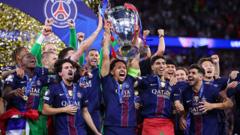
Paris Saint-Germain spent years chasing an identity, throwing money at superstars until the fabric of the club nearly tore itself apart. Then came the shift. Luis Enrique stripped away the ego-driven circus, built a ruthless collective machine, and captured an unprecedented sextuple. The capital club swept Ligue 1, the Coupe de France, the Trophée des Champions, the UEFA Champions League, the UEFA Super Cup, and the FIFA Intercontinental Cup in a historic run.
Yet, as the confetti swept off the pitch at the Parc des Princes, a far more brutal question emerged from the shadows of success. Can Paris Saint-Germain sustain this absolute peak, secure a consecutive Ligue 1 three-peat, and manage the crushing physical toll of a six-trophy defense? The answer requires looking past the glossy club propaganda and examining the structural strains of modern football hegemony.
The Exhaustion Equation
Winning everything is a physical trap. When a squad plays deep into every domestic and international competition, the calendar ceases to offer recovery windows. Luis Enrique demands high-intensity gegenpressing, positional fluidity, and relentless athletic output. That style works brilliantly when legs are fresh in April and May. It turns to lead when matches pile up every three days across a grueling ten-month campaign.
Sports science data shows that clubs coming off a historic treble or sextuple face a stark statistical drop in high-speed running metrics by the second half of the following season. The human body has absolute physiological limits. PSG managed the load masterfully during their historic run, aided by smart squad rotation and tactical adaptations. Replicating that delicate balance while opponents study every tactical nuance of Enrique’s playbook multiplies the difficulty exponentially.
The Target on the Back
For years, domestic rivals treated matches against Paris as polite exercises in damage control. That psychological safety net is gone. Every mid-table Ligue 1 side now views taking points off the European champions as the ultimate scalp of their season. Low blocks become denser, defensive lines drop deeper, and physical intimidation rises.
When you sit at the summit, tactical innovation becomes a defensive necessity because the rest of the league adopts your principles or designs specific antidotes to them. Enrique faces the ultimate managerial chess match. He must reinvent elements of his buildup play without losing the foundational discipline that brought them the Champions League. If PSG grows even five percent complacent in their domestic application, the points gap vanishes overnight.
The Roster Math and Succession Planning
Dynasties fail when they stand still. Maintaining a six-trophy standard demands continuous, aggressive squad evolution. You cannot rely on the same starting eleven to carry the exact same competitive fire year after year. Hunger wanes once the ultimate mountain is climbed. Players want new challenges, higher wages, or guaranteed minutes elsewhere.
Sporting director Luis Campos faces a narrower margin for error than ever before. Every incoming transfer must hit the ground running without an adjustment period. A single miscalculated summer window leaves glaring vulnerabilities when injuries mount during the winter fixture congestion. The financial muscle remains unmatched in France, but Financial Fair Play constraints and elite market inflation mean PSG must scout smarter, not just richer.
The Psychological Burden of Perfection
Fans and club executives suffer from the worst affliction in sports: the normalization of excellence. Once supporters witness their side lift every available piece of silverware, a standard is permanently locked in. A season ending with "only" a domestic league title and a domestic cup suddenly registers as a failure.
That expectation creates an invisible, suffocating weight inside the locker room. Pressure alters decision-making under the floodlights. Players begin playing not to lose rather than playing to destroy their opponents. Managing that mental fatigue requires a rare brand of psychological leadership from the technical staff.
Paris Saint-Germain conquered the football world by shedding their historical fragility. Staying there means staring down the barrel of physical burnout, tactical hunting parties, and the quiet poison of internal satisfaction. The trophies are safely locked in the museum cabinet, but the hardest part of a dynasty is never reaching the top. It is surviving the gravity that tries to pull you back down.