Artificial nests are giving Australia’s endangered palm cockatoos a rare lifeline, culminating in a milestone first chick fledging from a man-made cavity in what conservationists describe as a world-first achievement. Yet behind the celebratory headlines lies a much harder truth about why these birds are running out of homes in the first place. A single fledged chick does not reverse decades of slow-motion habitat attrition for one of the planet’s most specialized and slow-breeding parrots.
I have covered conservation stories long enough to know that artificial nests rarely fix broken ecosystems on their own. They buy time. Sometimes they buy crucial time. When an animal takes decades to mature and raises barely one young every couple of years, every extra chick matters, especially when natural breeding hollows are vanishing faster than ancient trees can grow to replace them.
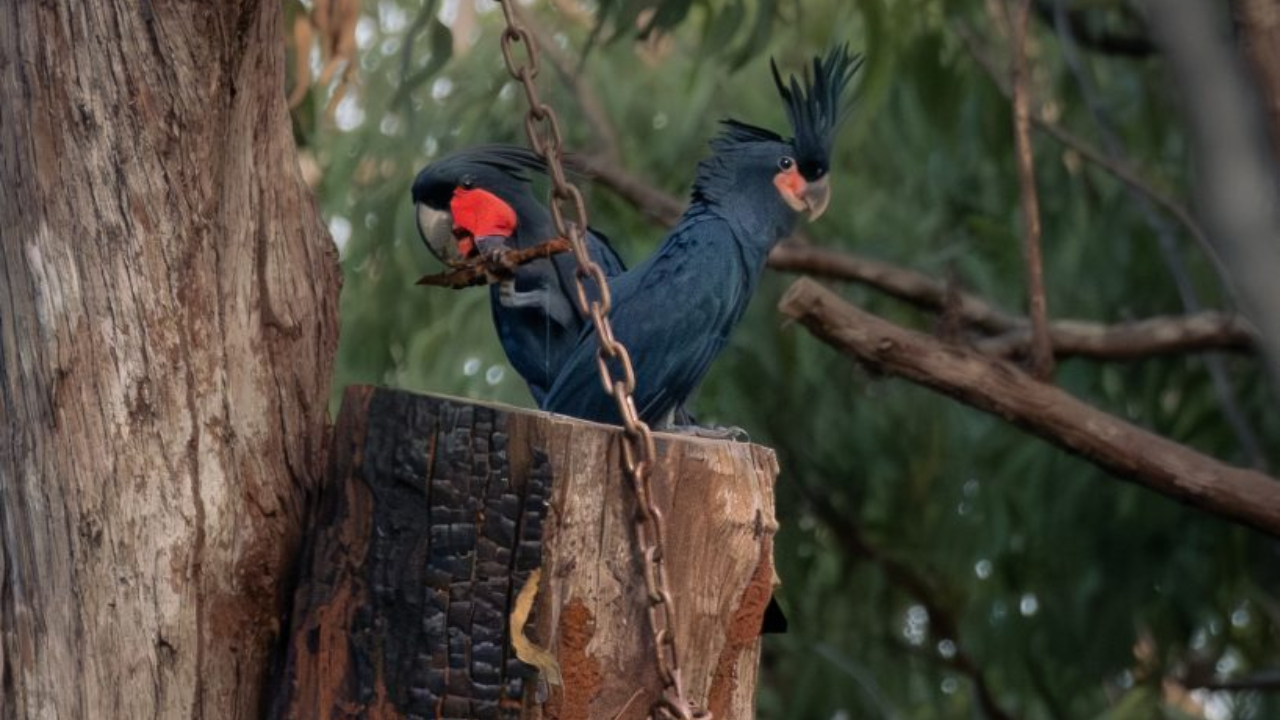
To understand why a man-made box matters so much for palm cockatoos, you have to look at how picky they are. These large, smoky-black birds of Cape York Peninsula and parts of New Guinea are not casual squatters in the canopy. They depend on deep, dry, well-drained hollows inside mature eucalyptus and other large trees, often lining the base with a thick mat of sticks to keep eggs and chicks elevated above dampness and predators.
Why Natural Hollows Are Disappearing
Trees do not wake up one morning with a ready-made nesting chamber. A suitable hollow often takes a century or more to form through a slow sequence of wind damage, termite activity, fungal decay, and fire. Once a giant tree falls or burns in an intense blaze, that irreplaceable piece of real estate disappears in an instant.
Cape York’s savanna woodlands face compounding pressures that make hollow replacement an uphill battle. Frequent, high-intensity fires scorch mature timber and kill saplings before they ever reach hollow-bearing age. Cyclones snap limbs and topple aging giants. Cattle grazing and altered land management shift grass fuel loads and soil moisture, changing how fire moves through the bush.
Even when trees survive, competition is fierce. Parrots, owls, possums, and other cavity-nesters all hunt for secure spaces in a shrinking pool of old-growth timber. If a hollow leaks rainwater, rots through at the bottom, or sits too close to the ground where monitors or pythons can easily reach, breeding success drops.
Think of it like a housing shortage where new apartments take a hundred years to build. You cannot speed up biology by wishing for older trees. Conservation teams turned to artificial nests because waiting for nature to catch up on its own timetable is a gamble with a population that already has very little margin for error.
Engineering a Cavity That Mimics a Century of Decay
Building a convincing nest for a palm cockatoo is far more demanding than nailing a wooden box onto a fence post. A palm cockatoo has a massive bill capable of cracking hard seeds and stripping bark, along with sharp claws and enough strength to wreck poorly built structures. If a nest is flimsy, too small, or poorly ventilated, the birds will ignore it or tear it apart.
Field biologists have had to think like structural engineers and microclimate specialists. A viable artificial hollow needs thick walls to buffer against tropical heat and sudden temperature swings. If temperatures inside a cavity spike during the hot months before the wet season arrives, a developing chick faces serious heat stress.
Drainage and airflow are equally unforgiving. Water pooling inside a nest can ruin a clutch or create damp conditions that invite rot and disease. Meanwhile, the entrance has to be sized and positioned so adults can enter and defend the space while keeping out larger predators where possible.
A successful artificial nest does not just hold a bird. It has to replicate the thermal stability, structural durability, and acoustic character of a hollow carved out over generations.
Acoustics and placement matter too. Palm cockatoos are famous for drumming with sticks or seed pods against branches to advertise territories and bond with mates. Where a nest sits in the canopy, how it is anchored to a live or dead trunk, and how surrounding vegetation shapes flight paths all influence whether a pair ever inspects it.
A First Chick Fledges, But the Math Remains Brutal
A chick successfully fledging from an artificial nest is a genuine breakthrough. Getting an egg laid is one hurdle; keeping a slow-growing nestling alive through weeks of vulnerability and getting it out into the world on its own wings is another. For researchers who have spent years testing designs, monitoring cameras, and troubleshooting failures, seeing a young bird leave the nest is proof of concept.
Still, conservation math is unforgiving. Palm cockatoos have notoriously low reproductive rates. Pairs typically lay just one egg at a time, and breeding intervals stretch across years rather than seasons. Even under ideal conditions, population recovery for a species like this moves at a crawl.
One fledged chick is a triumph of persistence, not a cure-all. If ten artificial nests go up and one produces a fledgling after years of effort, that is encouraging data, not a finished job. Scaling a bespoke, labor-intensive intervention across vast, remote landscapes like Cape York presents massive logistical hurdles.
Remote field work means hauling heavy materials along rough tracks or into rugged bush, battling heat, humidity, storms, and distance. Every nest requires inspection, maintenance, and long-term monitoring to see whether it stays safe, weatherproof, and predator-resistant over time. Without ongoing upkeep, even a clever design can degrade into a trap or a dud.
What Artificial Nests Get Right—and Where They Fall Short
There is a temptation in conservation news to treat clever technology as a silver bullet. Artificial nests deserve credit for solving an immediate bottleneck when natural hollows are scarce. They give breeding pairs an option right now, in places where waiting another eighty years for a tree to mature is not an option.
Yet relying too heavily on human-made cavities carries real risks if it distracts from underlying drivers. A box bolted to a tree does not fix altered fire regimes. It does not restore landscape connectivity or protect the remaining old-growth trees that anchor the wider woodland community.
| Approach | Primary Strength | Key Limitation | Role in Recovery |
|---|---|---|---|
| Artificial Nests | Provides immediate nesting options where hollows are scarce | High labor, maintenance cost, and limited landscape scale | Short-term bridge to keep pairs breeding |
| Old-Growth Tree Protection | Preserves proven, long-lasting hollows and wider habitat | Cannot create new hollows overnight | Essential foundation that cannot be replaced |
| Fire and Land Management | Reduces catastrophic canopy loss and supports regeneration | Requires sustained coordination across vast areas | Long-term safeguard for future generations |
Consider a hypothetical example to see how the numbers play out. Suppose a conservation group installs thirty artificial nests across a patch of degraded woodland where natural hollows have dropped by half. Over five years, eight pairs use the boxes and four chicks fledge, while two boxes fail due to storm damage or moisture buildup. Those four fledglings are real gains for a threatened population, yet if fires continue killing mature trees across the surrounding ten thousand hectares, the overall habitat ledger still leans negative.
That gray area is where honest analysis belongs. Artificial nests work best as a bridge, not a destination. They buy breathing room while land managers tackle slower, messier work like smarter fire management, protecting remaining big trees, and understanding how climate shifts are altering northern Australia’s woodlands.
The Bigger Picture Beyond a Single Fledgling
Wildlife milestones often arrive with tidy story arcs, even when the underlying science is messy and open-ended. A chick leaving a man-made hollow gives people a concrete reason to care about a bird many have never seen in the wild. Palm cockatoos are charismatic, unmistakable creatures, and stories of innovation help keep funding and public attention focused on threatened species.
The real test starts after the applause fades. Researchers have to figure out which nest designs hold up best over a decade, which sites attract consistent breeding rather than one-off attempts, and how artificial cavities affect chick survival compared with natural hollows. Predation pressures, parasite loads, and adult survival rates all shape whether early fledglings go on to become breeding adults themselves.
There is also the question of scale. Cape York covers a massive footprint, and conservation budgets are always tight. Every dollar spent fabricating, transporting, and monitoring artificial nests is a dollar not spent on fire management, invasive species control, or long-term ecological surveys.
Good conservation is rarely about choosing one tool and ignoring the rest. It is about matching the right intervention to the right bottleneck while staying clear-eyed about what that tool can and cannot do.
Keep building better nests, keep tracking every fledgling, and never mistake a clever workaround for a healed forest.