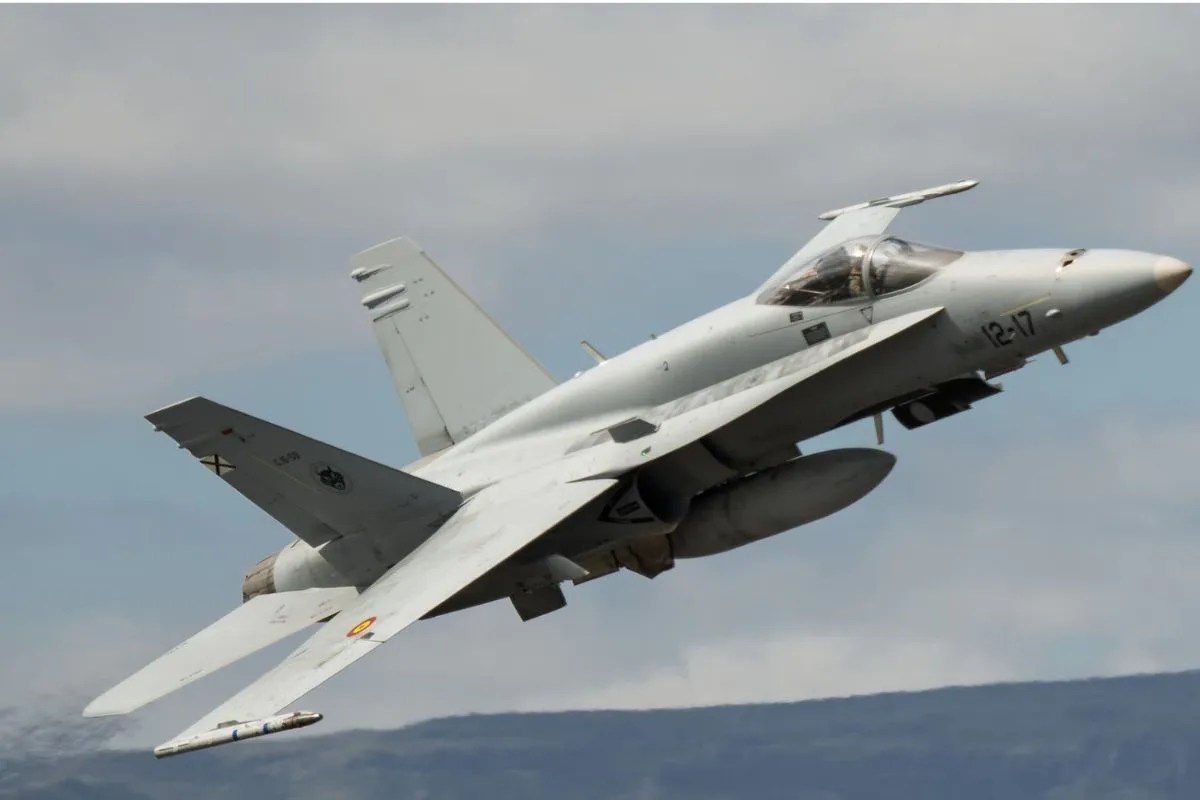
At precisely 4:44 in the morning, the radar screens at the Mihail Kogălniceanu Air Base in southeastern Romania lit up with an unwelcome signature. An unauthorized aerial target had crossed the border from the Republic of Moldova, tracking roughly 24 kilometers north of the city of Galați. Seventeen minutes later, a Spanish Air and Space Forces F-18 Hornet, flying an active NATO Air Policing mission, squeezed its trigger and neutralized the intrusion.
The wreckage plummeted into an unpopulated tract of land between Băleni and Cudalbi, sparing civilian lives. Yet this fourth successful shootdown of the year by allied forces over Romanian territory is far from a routine operational success. It represents a worrying escalation in the systematic erosion of allied airspace integrity along the alliance's eastern flank.
The Fragile Physics of Low-Altitude Interceptions
Modern air defense architectures are brilliant at tracking high-altitude ballistic missiles and supersonic bombers, but they suffer from severe blind spots when facing cheap, low-flying unmanned aerial vehicles. These drones hum along at tree-top levels, deliberately hugging the contours of the terrain to exploit the curvature of the earth against ground-based radar horizons.
When an aerial vehicle cruises beneath standard radar detection thresholds, it turns into a ghost until it crosses directly overhead. In this specific incident, the target drifted out of the chaotic airspace over neighboring Ukraine, ghosted through Moldovan airspace, and slipped across the Romanian border before military sensors finally acquired a hard track.
The math behind intercepting such a target with a multi-million-dollar fighter jet is brutally unforgiving. An F-18 Hornet optimized for dogfighting and medium-altitude missile delivery has a high stall speed. Slowing down a heavy tactical jet to safely trail a small, erratic drone requires immense pilot discipline and precise sensor fusion.
[Ground Radar Blind Spot] ---> [Terrain Masking] ---> [Sudden Border Breach] ---> [Scramble & Intercept]
Why Allied Air Policing is Straining Under the Weight
Deploying Spanish F-18s and ground crews to the Black Sea theater is a visible demonstration of alliance solidarity, but it is also a band-aid on a structural vulnerability. NATO's eastern perimeter stretches thousands of kilometers, and member states like Romania share extensive borders with active war zones.
Electronic warfare is warping the battlefield. Analysts point out that electronic jamming and GPS spoofing—widespread across the Ukrainian theater—routinely knock unmanned platforms off course. A drone launched miles away can lose its navigational lock, drift across international boundaries, and exhaust its fuel supply over neutral or allied territory.
When this happens repeatedly, the operational burden shifts entirely to allied aircrews. Pilots are pulled from routine training rotations to fly endless combat air patrols over silent fields, burning through expensive airframes and specialized ordnance to stop flying lawnmowers strapped with explosives.
The Dangerous Normalization of Border Violations
Every time an unidentified drone crosses into sovereign allied territory without triggering immediate kinetic aversions, deterrence degrades a fraction of a degree. Moscow and other actors observe the response threshold closely. They test reaction times, evaluate radar coverage gaps, and measure political hesitation within command structures.
While Western capitals issue standard diplomatic condemnations regarding reckless behavior, the frequency of these incursions threatens to normalize violations that would have triggered severe military crises a decade ago. Romania has shifted from passive monitoring to active engagement—evidenced by recent F-16 and F-18 strikes—yet the sheer volume of stray munitions suggests that airspace management near active conflict zones remains profoundly broken.
Until electronic countermeasures and short-range kinetic interceptors are densely integrated directly along vulnerable border corridors, allied fighter jets will remain forced to play an expensive, high-stakes game of aerial target practice over European farmland.