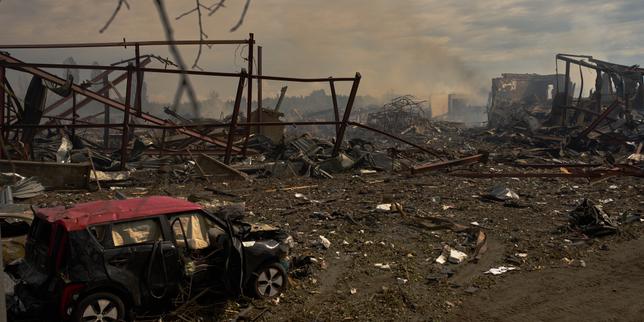
Thirty-eight people died in the village of Myla because military logistics were crammed into the backyard of a civilian nursing home. When a Russian drone struck the western outskirts of Kyiv on a Friday night, it did not merely hit a storage facility; it ignited a catastrophic chain reaction of secondary detonations involving artillery shells, mines, and drones stored just feet away from civilian residences. Thirty-four of the dead were residents of the Dobryi Dim care home for the elderly and disabled, individuals who never stood a chance against the shockwaves that leveled fifty surrounding homes.
This disaster is not an isolated malfunction of war. It is the bloody manifestation of systemic negligence that leadership in Kyiv is only now scrambling to address.
The Anatomy of a Preventable Disaster
Military doctrine is written in blood, and one of its oldest maxims dictates the strict separation of ordnance from civilian populations. Yet, nearly five years into a full-scale invasion, convenience and administrative sloth overrode basic survival protocols. The facility in Myla, situated roughly five kilometers west of the capital along the Kyiv-Chop highway, functioned as an unauthorized holding point for defense force supplies.
When the initial projectile struck, it triggered hours of continuous secondary explosions. Residents described hearing deafening blasts every few minutes, rendering firefighting efforts impossible until the cache had completely burned itself out. First responders, including local community leader Taras Didych, rushed into the chaos only to become casualties themselves.
The architecture of this failure traces back to an administrative blind spot. Decentralized logistics networks, hastily expanded to keep pace with drone warfare and frontline supply demands, frequently bypass formal military engineering oversight. Warehouses are leased in industrial parks or commercial zones without factoring in blast radiuses or the presence of vulnerable populations nearby.
A Repeat of Past Impunity
The tragedy in Myla follows a nearly identical blueprint to an incident in Vyshneve just weeks prior, where an ammunition depot explosion linked to a state-owned defense enterprise killed dozens and devastated neighboring blocks. Following that earlier blast, promises were made, audits were threatened, and statements were issued regarding the strict enforcement of safety regulations.
Those promises evaporated before the smoke cleared.
By allowing hazardous storage sites to proliferate near population centers, supply officers created stationary targets that doubled as weapons of mass destruction against their own citizens. President Volodymyr Zelenskyy acknowledged the criminal negligence behind the deployment, ordering an immediate, nationwide audit of all defense storage facilities. But an audit ordered after thirty-eight bodies are pulled from the rubble is a diagnostic performed on a corpse.
The Broader Logistical Strain
The underlying pressure driving these dangerous storage choices stems from a desperate shortage of secure, purpose-built infrastructure. With standard military installations targeted relentlessly by precision Russian strikes, supply chains have fractured. Planners have been forced to disperse components, propellants, and drones into smaller, commercial-grade warehouses across central and western regions.
These commercial sites lack the earth-mounded revetments, blast walls, and underground bunkers of traditional military magazines. They are metal-and-drywall sheds sitting adjacent to veterinary clinics, grocery distribution points, and residential care facilities. When a strike hits a proper military base, the energy is absorbed or directed upward. When a strike hits an ad-hoc warehouse in a populated district, the energy projects outward into living rooms and hospital wards.
The friction between operational necessity and civilian safety has reached a breaking point. As long as accountability remains deferred through bureaucratic committees and delayed investigations, the rear-area supply network will remain as hazardous to Ukrainians as the frontlines. The state prosecutor's office has opened criminal proceedings for official negligence, yet legal filings cannot restore a neighborhood turned into a minefield.
Search teams are still combing through the toxic debris in Myla for the missing, while pyrotechnic units neutralize unexploded ordnance scattered across gardens and streets. The true measure of this war's cost is found not just in the trenches of the east, but in the preventable ash of the suburbs behind them.