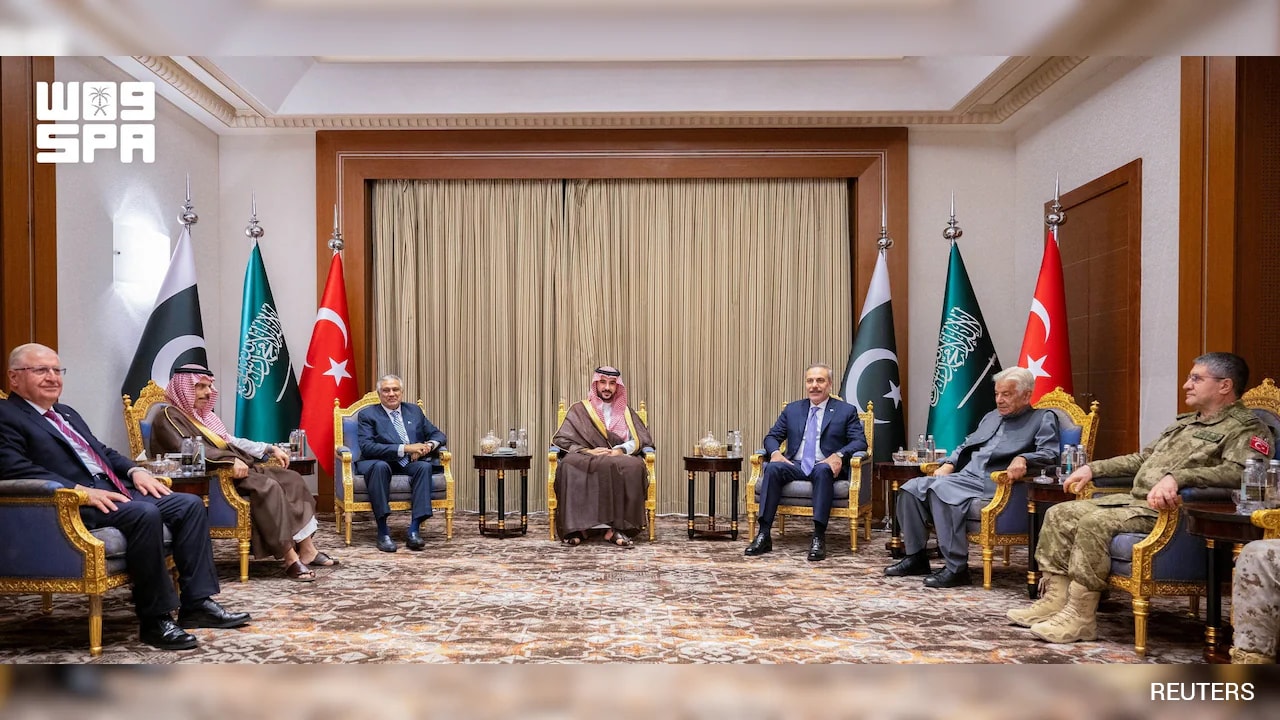
Turkey, Pakistan, and Saudi Arabia will make the Mecca Joint Defence Agreement work only if they stop treating a treaty signed under fire as a substitute for a real military command. Signed in Mecca on August 7, 2026 amid the 2026 Iran war, and officially entering into force on November 14, 2026 after the final ratification step, the pact promises mutual protection and collective deterrence. Yet signatures on parchment do not stop incoming drones or reopen shipping lanes. Turning an emergency diplomatic bargain into working security requires resolving sharp disagreements over who the real enemy is, building actual operational machinery, and pricing every bullet before the next crisis hits.
I have watched enough middle-power security pacts over the past thirty years to know the difference between summit theater and combat readiness. Leaders love invoking an Article 5-style pledge when missiles are flying and old security assumptions are cracking. Real military alliances, by contrast, live or die in dull staff meetings, ammunition stockpiles, overflight clearances, and hard arguments over who pays when things go wrong.
Why Three Capitals Signed in Mecca
Panic concentrates minds faster than decades of diplomatic seminars. When the 2026 Iran war erupted and Gulf infrastructure faced heavy missile and drone barrages alongside threats to Strait of Hormuz shipping, Riyadh confronted a painful reality. Outside guarantees felt unreliable under pressure, and regional escalation left little room for diplomatic hesitation.
The Mecca text did not appear out of thin air. It built directly on the September 17, 2025 bilateral Strategic Mutual Defence Agreement between Saudi Arabia and Pakistan, folding Turkey into a formal trilateral framework. Under Article 2, an external armed attack against one member is treated as an attack against all three, paired with commitments on defense-industrial cooperation, intelligence sharing, logistics, and mutual assistance consistent with Article 51 of the UN Charter.
Each capital brought a distinct calculation to the table. Saudi Arabia brought deep pockets, energy weight, and urgent exposure to regional strikes and renewed Houthi friction. Pakistan brought seasoned military manpower—including roughly 8,000 troops and air defense assets already tied to Saudi security—plus a strategic need for financial lifelines and energy ties. Turkey brought a large, battle-tested defense industry, drone and naval capabilities, and regional diplomatic reach.
A mutual defense clause on paper is an intent to show up; a working alliance is the agreement on which runway your jets use and who authorizes the strike at 3 a.m.
Threat Mismatches Under the Hood
Here is the uncomfortable truth that celebratory press releases skip over. The three signatories do not share the same threat hierarchy.
Ankara increasingly treats friction with Israel as its primary regional security problem, especially around Syria and the broader eastern Mediterranean. Riyadh has spent years calibrating its security calculus around Iran and Gulf stability, while still maintaining competition with Ankara in places like Syria and Lebanon. Meanwhile, Islamabad faces persistent pressure along its own borders with India and Afghanistan.
An alliance built on divergent threat maps faces a built-in stress test. If low-level drones hit Saudi energy sites, does that automatically pull Turkish forces into a wider Gulf exchange? Conversely, if Ankara faces a sharp clash with Israel over Syrian fault lines, is Riyadh prepared to underwrite or backstop that confrontation?
Nuclear Rumors and Real Limits
Whenever Pakistan signs a defense deal with a Gulf state, speculation about a nuclear umbrella follows within hours. Observers have asked whether the Mecca pact creates a backdoor path toward Saudi nuclear ambitions.
There is no public indication that Pakistan has extended a nuclear umbrella under the agreement, and Saudi officials have stated the pact is not tied to nuclear weapons ambitions. Treating a conventional collective security treaty as a nuclear shortcut misreads both the text and the severe diplomatic fallout any such move would trigger. Conventional air defense, counter-drone systems, naval protection, and munitions production are far more realistic pillars than nuclear signaling.
The Diplomacy Paradox
Even as the three governments rushed to ratify the pact in October and November 2026 and held an emergency October meeting in Riyadh, senior officials from Saudi Arabia, Pakistan, and Turkey also met with Iranian leaders in Tehran in late October to push de-escalation. Iranian officials offered mixed reactions—ranging from Foreign Minister Abbas Araghchi's rhetorical nod to regional self-reliance to sharper pushback from hardliners and state media.
That dual track makes sense in statecraft. Deterrence without a diplomatic off-ramp invites endless attrition. Still, talking to Tehran while building a mutual defense pact aimed at deterring external aggression requires tight coordination so Ankara, Riyadh, and Islamabad do not undercut one another's credibility in the same week.
Making the Machinery Actually Work
Appointing retired Pakistani Lt. Gen. Nauman Mahmood as the alliance's first secretary-general for a three-year term at the October 5, 2026 Riyadh meeting was a necessary first bureaucratic step. A secretariat gives the pact an address and a focal point. It does not by itself create an integrated joint command.
To move past paper solidarity, defense planners in Riyadh, Ankara, and Islamabad have to tackle five practical bottlenecks:
- Command and rules of engagement: Define clear thresholds between routine harassment, drone or missile strikes, and full-scale armed attack so assistance does not stall in committee debates.
- Air and missile defense integration: Link radar data, early-warning sensors, and interceptor stocks rather than operating disconnected national batteries side by side.
- Logistics and basing: Lock in pre-negotiated transit rights, fuel and spare-parts hubs, and rapid deployment corridors before a crisis closes airspace or ports.
- Defense-industrial co-production: Pair Saudi capital with Turkish and Pakistani engineering to build local capacity for drones, air defense components, and munitions instead of relying solely on slow foreign resupply.
- Cost and burden-sharing rules: Settle upfront who pays for forward deployments, joint exercises, and emergency logistics so financial strain does not breed resentment later.
Consider a hypothetical example to see where friction can hide. Suppose a swarm of long-range drones strikes a coastal facility in the Gulf while a border flare-up demands air defense units elsewhere. Without pre-agreed rules on air tasking, spare parts, and legal authority, allied aircraft or air defense batteries could lose precious hours waiting for political sign-off from three separate capitals.
Who Joins Next and Why It Matters
Talk of expanding the Mecca pact has moved fast since August. Turkish President Recep Tayyip Erdoğan has described the door as open to brotherly states, and Foreign Minister Hakan Fidan has pointed to Egypt once technical hurdles are sorted out. Reports and official statements have also surfaced around Syria, Bangladesh, and Indonesia exploring or eyeing membership.
Expansion is tempting because larger numbers look impressive on a communique. In practice, every new member changes the math of Article 2. Egypt carries its own security commitments with Greece and Cyprus and has long been cautious about open-ended obligations to fight other states' wars, while Riyadh has questioned how much military weight Cairo would realistically commit. Bringing in countries with unresolved border disputes or distant geographies—such as Indonesia in Southeast Asia—could dilute focus if the core three have not yet built a working operational staff.
| Factor | Core Strength | Major Friction Point | What Must Happen Next |
|---|---|---|---|
| Threat Priorities | Broad geographic reach across the Gulf, Levant, and South Asia | Ankara prioritizes Israel while Riyadh focuses on Gulf and Iran risks | Agree on explicit scenarios that trigger collective action |
| Military Capability | Saudi funding, Pakistani troops, Turkish defense industry | Lack of integrated command and joint response mechanisms | Stand up joint planning cells, logistics hubs, and combined drills |
| Diplomacy | Channels to both regional rivals and major powers | Mixed signals during parallel talks with Tehran | Coordinate messaging so talks do not weaken deterrence |
| Membership Growth | Potential to widen political and industrial backing | Conflicting bilateral treaties and uneven military readiness | Finish core institutional rules before admitting new members |
The real test of the Mecca Joint Defence Agreement will not arrive at another signing ceremony or diplomatic summit. It will arrive the first time a real missile, naval blockade, or border shock tests whether three capitals with different histories and competing instincts can actually fight or deter as one.