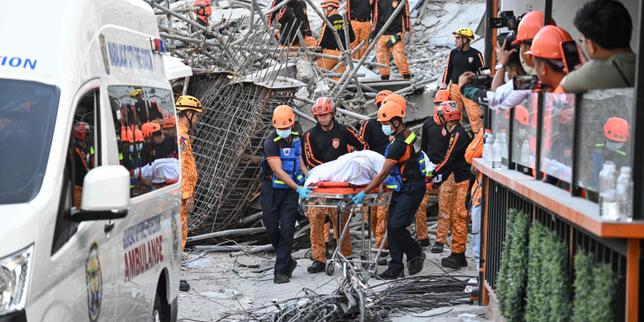
The faint rhythmic thudding detected beneath the twisted rebar and pancaked concrete of the collapsed Manila commercial complex offered a fragile sliver of hope. Rescuers, working past the 40-hour mark, scrambled through the night to locate 17 workers trapped in the subterranean void. Four of their colleagues are already confirmed dead. While the immediate focus remains a desperate race against time to pull survivors from the rubble, the disaster exposes a systemic, deep-seated crisis within the rapidly expanding urban infrastructure sector of the Philippines. This was not an unavoidable tragedy. It was the predictable consequence of regulatory failure, aggressive cost-cutting, and institutional blindness.
The narrative surrounding urban development disasters in metropolitan centers follows a tragic, repetitive script. First comes the sudden structural failure. Then, the frantic search for survivors, followed closely by corporate expressions of sympathy and government promises of a sweeping investigation.
To understand how a multi-story commercial project can suddenly disintegrate during a standard concrete pour, one must look beyond the immediate physical failure to the economic and regulatory mechanisms that govern local real estate development.
The Illusion of Structural Oversight
The physical catalyst for a building collapse during construction almost always traces back to premature shoring removal or substandard material ratios. When developers race to meet tight completion deadlines, the temptation to strip supporting formwork before the concrete achieves its full compressive strength increases exponentially.
In highly regulated markets, independent structural inspectors must sign off on every major phase of a build. In the rapid densification of regional urban hubs, that oversight is frequently outsourced, underfunded, or bypassed entirely.
The relationship between local government units and private developers creates an inherent conflict of interest. Municipalities are eager to boost property tax revenues and signal economic growth, which often results in building permits being issued with minimal scrutiny of the structural calculations or the track records of the sub-contractors involved.
The oversight process is largely a paper exercise. Field inspections are rare, and when they do occur, they are often performed by under-equipped municipal engineers who lack the specialized training to spot sophisticated structural shortcuts.
The Subcontracting Cascade and the Loss of Accountability
The structural integrity of a building diminishes with every layer of subcontracting. On paper, a major, reputable developer anchors the project. In reality, the actual labor and day-to-day engineering decisions are outsourced to a cascading chain of secondary and tertiary firms.
- The Primary Developer: Secures financing, acquires land, manages marketing, and distances themselves from physical liability.
- The General Contractor: Bids low to win the contract, then aggressively cuts internal costs to maintain profit margins.
- The Subcontractors: Hire casual laborers, manage individual trades, and frequently substitute specified materials with cheaper, off-brand alternatives.
By the time a worker steps onto a high-rise scaffolding rig, the entity paying their daily wage is three or four steps removed from the firm whose logo sits on the perimeter fence. This fragmentation dilutes accountability to the point of erasure.
When a failure occurs, the primary developer points to the general contractor, the general contractor blames a rogue subcontractor, and the subcontractor declares bankruptcy, leaving victims and their families with no legal recourse and no financial compensation.
The Human Cost of Casualized Labor
The 17 workers trapped beneath the Manila rubble are symptomatic of a broader labor crisis within the regional building sector. The vast majority of construction laborers are hired on an informal, project-by-project basis. They receive no formal safety training, possess no health insurance, and are paid well below the legal minimum wage.
[Typical Project Hierarchy]
Primary Developer (Brand Owner)
       │
       ▼
General Contractor (Operations Management)
       │
       ▼
Subcontractors (Material Procurement & Logistics)
       │
       ▼
Labor Brokers (Casual Workers & Site Enforcement)
This lack of job security creates a culture of silence. A worker who notices that a support beam is buckling or that a concrete mix is excessively watery is highly unlikely to report it. To speak up is to risk immediate termination without recourse.
The enforcement of occupational safety standards by the Department of Labor and Employment is reactive rather than preventative. Fines for safety violations are so negligible that developers treat them as a minor cost of doing business rather than a deterrent.
Reforming a Broken Development Model
Halting this cycle of construction disasters requires a fundamental restructuring of liability. Civil and criminal penalties must be legally bound to the primary developer and the principal architects, regardless of how many subcontractors are wedged between them and the job site. If a building collapses due to negligence, the executive leadership of the parent company should face immediate prosecution.
Furthermore, building inspection departments must be insulated from local political influence. Transitioning to a system of mandatory third-party structural insurance—where private insurers assess risk and conduct rigorous inspections before a building can be occupied or financed—would introduce a commercial incentive for safety that the current bureaucratic framework completely lacks.
Until the financial cost of a structural failure outweighs the profit generated by cutting corners, the sound of rescue teams listening for signs of life in collapsed concrete will remain a permanent fixture of the urban landscape. The survival of the 17 individuals trapped in Manila depends on the skill of the rescue crews; the survival of future workers depends on dismantling the system that put them there.