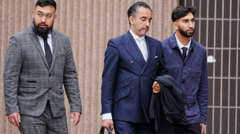
The second attempt to secure a conviction against the brothers at the center of the viral Manchester Airport terminal melee has collapsed. After nearly 20 hours of deliberations at Liverpool Crown Court, the jury failed to reach a verdict regarding the alleged assault of PC Zachary Marsden. Judge Neil Flewitt KC discharged the eight women and four men, leaving the Crown Prosecution Service until May 29 to decide whether to pursue an exceptionally rare third trial.
This outcome stalls a legal saga that began on July 23, 2024, when a mobile phone video showing a firearms officer kicking a man in the head at Terminal 2 sparked national protests.
What the public saw on social media was a flashpoint. What the jury had to untangle over five weeks of testimony was a complex legal knot of preemptive force, split-second self-defense claims, and the chaotic breakdown of public order in a high-security environment. The inability of two separate juries to reach a consensus on the final charges reveals the deep gray areas built into English self-defense laws when civilians and armed police collide.
The Anarchy in Terminal Two
To understand why the jury gridlocked, one must look beyond the infamous social media footage at the sequence of events that afternoon. The incident began not with the police, but with a family dispute that turned physical inside a Terminal 2 Starbucks.
Mohammed Fahir Amaaz, 21, had approached Abdulkareem Ismaeil following an alleged disagreement involving Amaaz’s mother on a flight from Pakistan. Amaaz headbutted Ismaeil. He was convicted of this assault at a previous trial, alongside convictions for assaulting two other police officers, PC Lydia Ward and PC Ellie Cook.
When firearms officers intercepted Amaaz and his brother, Muhammad Amaad, 26, at the car park pay station, the situation escalated instantly. The prosecution characterized the brothers' actions as a "high level of violence." PC Ward suffered a broken nose from an Amaaz punch, and PC Cook was felled by a succession of elbows and blows.
Then came the flashpoint involving PC Marsden. The prosecution alleged that both brothers focused their aggression on Marsden, causing actual bodily harm.
The defense strategy turned the prosecution's narrative on its head. The brothers claimed they did not initiate a fight but rather came "under attack" by officers whose initial approach was overly aggressive. Amaaz testified that everything happened so quickly that he could not process fine details, claiming he didn’t even realize PC Ward and PC Cook were female officers when the blows were struck.
The High Stakes of the Holster
The core of the legal deadlock sits squarely on what happened when PC Marsden was struck. In a heavily secured zone like an international airport, an altercation with an armed officer carries lethal stakes.
During testimony, PC Marsden stated that while he was absorbing blows, he felt his service weapon being shifted from its position on his thigh holster. That single sensation altered the risk profile of the entire encounter.
"My initial fear was that someone was trying to get my gun," Marsden told the court. "If that had happened, there was an immediate lethal threat to anyone in the vicinity."
This statement highlights the defense’s primary challenge and the jury’s primary dilemma. Under English law, a person may use reasonable force to defend themselves or another. If the defendants genuinely believed they were being unlawfully assaulted by police, their legal right to self-defense was triggered.
Conversely, if an armed officer reasonably believes an individual is attempting to disarm them, the threshold for acceptable police force rises dramatically. The jurors were forced to evaluate the subjective mindsets of both the officers and the defendants simultaneously during a brawl that lasted mere seconds.
The physical reality of the fight further muddied the waters. PC Marsden described receiving the hardest blows of his career from multiple directions, explaining that his subsequent actions were not born out of anger or retaliation, but a desperate attempt to dissuade the brothers from continuing their assault. The jury’s gridlock suggests that matching the timeline of the CCTV footage to these internal calculations proved impossible to do beyond a reasonable doubt.
The Breakdown of Objective Reality
This trial serves as a textbook example of how viral video clips distort public and legal perceptions. The initial 2024 internet outcry focused exclusively on a snippet of footage showing an officer kicking a grounded suspect. That footage led to an independent investigation by the Independent Office for Police Conduct and the suspension of an officer.
In the courtroom, however, that video was just one frame of a much larger, darker mosaic. Jurors had to watch comprehensive CCTV footage detailing the minutes leading up to the intervention. They saw the Starbucks assault. They saw the sudden, explosive resistance at the pay station.
The defense effectively leveraged this chaos. By painting the scene as an uncontrolled, terrifying scrum where commands were obscured by shouting and physical pain, they created enough reasonable doubt to prevent a unanimous or majority verdict.
When a trial is reduced to a frame-by-frame dissection of a melee, clarity is often the first casualty. A movement that looks like an attempt to grab a firearm on a low-resolution security camera can be argued as an involuntary flail by a defense barrister.
The Crown Prosecution Service Dilemma
The Crown Prosecution Service now faces an institutional crossroads. Securing convictions on three counts in the first trial proved that juries acknowledge the violence used against the public and the initial responding officers.
Yet, the specific charge involving PC Marsden remains an unresolved legal quagmire. Pursuing a third trial is incredibly rare in the English justice system, usually reserved for high-profile homicide cases or matters of fundamental public safety where new evidence comes to light.
A third trial would require assembling another jury, restarting a five-week process, and asking victims and witnesses to recount the events of July 2024 for a third time. The financial cost to the taxpayer is substantial, but the institutional cost of walking away without a resolution on the Marsden charge is also heavy. It risks signaling that under sufficiently chaotic conditions, the accountability for assaulting an armed officer can be entirely obscured by the fog of war.
The case stands adjourned until May 29. The decision made on that day will dictate whether this airport incident remains an open wound for Greater Manchester Police and the Rochdale community, or if the state will make one final attempt to force a definitive legal conclusion.