When a magnitude 7.1 earthquake violently tore through Kumamoto Prefecture on Japan's southern island of Kyushu, shallow underground fault lines ruptured with a terrifying peak intensity of 7 on the local Shindo scale. This disaster left at least five people dead, hundreds injured, and triggered a brief tsunami advisory. Yet the immediate media rush focused almost entirely on the surface-level panic, missing the deeper structural vulnerabilities plaguing Japan's disaster response architecture. Beneath the flashing broadcast screens lies a sobering reality regarding aging infrastructure, commercial building resilience, and the psychological fatigue of communities trapped in perpetual seismic recurrence.
Decades of engineering triumphs have conditioned the global public to view Japan as an impenetrable fortress of earthquake-resistant design. Concrete flexes, skyscrapers roll with seismic waves, and strict building codes supposedly keep citizens safe. Tuesday afternoon’s tremor tore holes in that comforting narrative.
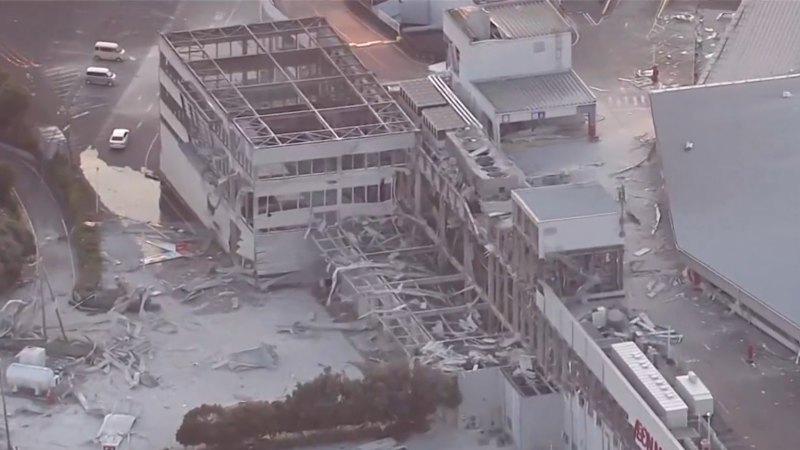
The most brutal damage unfolded not in old wooden shacks, but in modern commercial spaces. In Kashima, a massive shopping center suffered a catastrophic second-floor structural collapse alongside a secondary explosion that trapped panicked shoppers. Meanwhile, a heavy industrial smokestack at a local paper mill snapped in half, killing workers instantly. These failures highlight a troubling blind spot in structural maintenance cycles. Engineers often focus heavily on primary structural frames while underestimating secondary hazards like internal gas lines, commercial atrium spans, and industrial appendices that fail under multi-directional shear stress.
Ground zero of this latest tragedy sits directly along the active Hinagu Fault zone, a geological fracture that also triggered devastation ten years prior. The psychological toll on local residents is immeasurable. People who spent a decade rebuilding homes, businesses, and historical landmarks—such as the iconic stone walls of Kumamoto Castle—watched their hard-won progress crumble in a matter of fifteen seconds.
Emergency responders faced immediate logistical nightmares. Power grids failed instantly, plunging tens of thousands of households into darkness. Mobile network towers went dark due to primary power loss and transmission line disruptions, turning coordination into a chaotic guessing game for regional authorities. Bullet train networks ground to a sudden halt, stranding thousands of commuters and breaking the vital supply lines required to move heavy rescue equipment into isolated pockets.
Government officials, led by Prime Minister Sanae Takaichi, rapidly mobilized military units to manage search and recovery operations. But state-level readiness runs into hard physical limits when multiple systems fail simultaneously. When a regional hospital receives fifty trauma patients in an hour, and neighboring towns are simultaneously cut off by fractured bridges and landslides, the margin for error shrinks to zero.
Japan remains the global gold standard for earthquake preparedness. Sirens wail, automated systems cut bullet train power before shockwaves arrive, and citizens participate in rigorous drills from childhood. However, structural perfection remains an illusion. As underground fault systems continue shifting beneath densely populated valleys, the true measure of survival depends less on concrete durability and more on anticipating where commercial shortcuts, aging industrial sites, and communication bottlenecks will intersect when the earth next splits open.