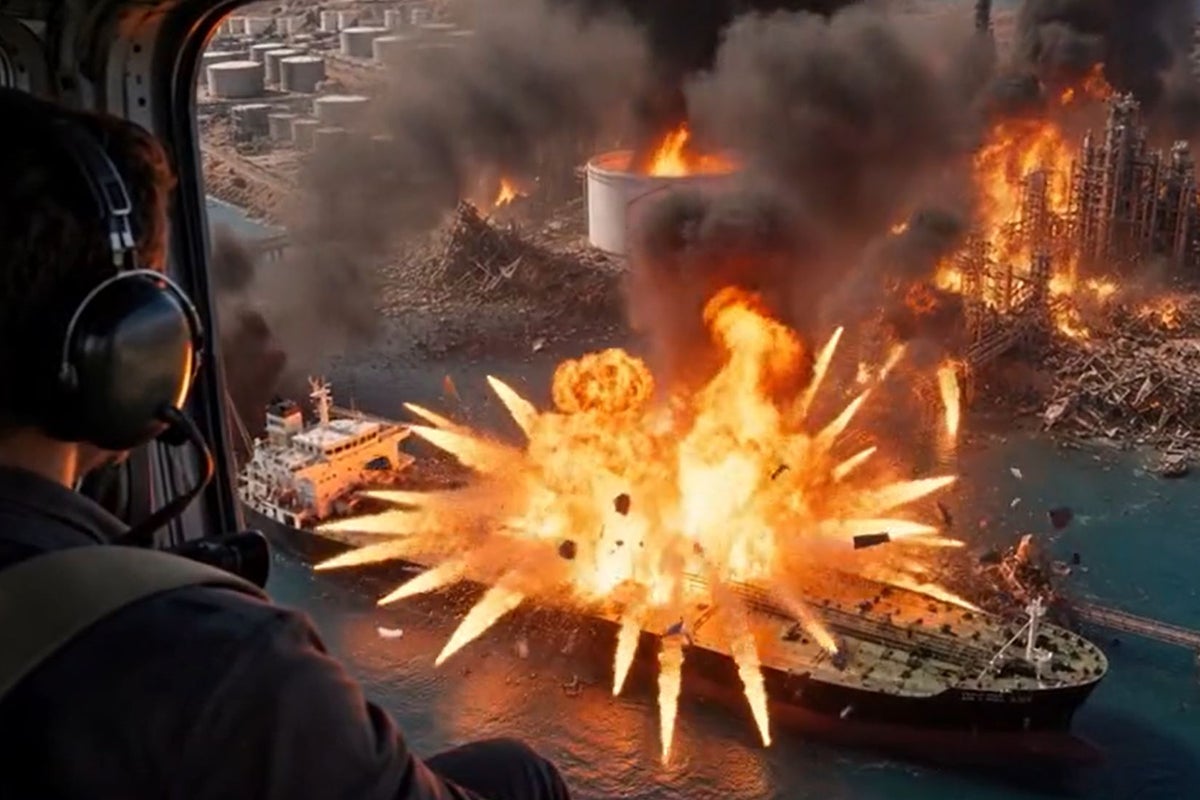
When the President of the United States uses a social media platform to broadcast an artificial intelligence-generated video of an active war zone under non-existent bombardment, the machinery of national defense does not merely stumble—it fractures. Donald Trump’s decision to publish a synthetic clip depicting Iran’s primary oil terminal, Kharg Island, "blown to smithereens" transformed a routine Sunday evening into a high-stakes operational emergency for Pentagon spokespeople and Central Command analysts. Hours after American forces launched actual, limited kinetic strikes against rocket launchers on Larak Island, the commander-in-chief opted for digital theater, uploading a low-quality, helicopter-perspective animation of petroleum tanks erupting in synthetic flames.
The immediate fallout exposed a profound structural vulnerability in modern statecraft. When the official communications channel of the executive branch indistinguishably mixes real military action with algorithmically generated fantasy, foreign adversaries no longer need sophisticated espionage to decode American intentions. They simply watch the feed, laugh at the transparently fake media, and use the confusion to discredit actual diplomatic and military deterrence.
The Mechanics of Manufactured Chaos
Military doctrine relies on the ironclad predictability of command authority. Down the chain of command, from the Secretary of Defense to the combatant commanders stationed at CENTCOM, every operational movement is calibrated to convey a precise signal to hostile capitals. A strike on Larak Island meant to neutralize immediate minelaying threats in the Strait of Hormuz requires precise calibration. Introducing a synthetic video of an entirely different, unhit strategic asset like Kharg Island short-circuits that signaling entirely.
Senior defense officials spent Monday morning managing urgent inquiries from international allies, maritime shipping associations, and foreign intelligence desks attempting to verify whether an unannounced strategic escalation had occurred. No such attack had taken place. The National Iranian Oil Company promptly released footage showing calm conditions on the island, turning what was meant to be a display of psychological dominance into a public relations gift to Tehran. Iranian officials easily dismissed the post as laughable, stripping American deterrence of its gravity through the simple expedient of pointing out that the president had posted an internet novelty.
This incident highlights a dangerous blurring of lines between digital political messaging and national security policy. Decades ago, executive statements carried the institutional weight of the entire federal bureaucracy. Today, the institutional weight has been subordinated to the impulsive distribution of synthetic media designed for domestic political consumption.
The Strategic Cost of Trolling as Doctrine
For months, the administration’s strategy regarding Iran’s critical energy infrastructure has swung wildly between economic strangulation and erratic musings about seizing territory outright. Kharg Island handles the vast majority of Iranian crude exports, making it one of the most sensitive economic pressure points in the Middle East. Threatening its destruction through real military planning is a grave geopolitical maneuver. Threatening it with an AI-generated clip that looks suspiciously like mobile game advertisements reduces state power to the level of internet provocation.
The friction between the Pentagon and the White House on this matter is not merely about embarrassment; it is about operational integrity. When reporters asked defense leadership to clarify whether the synthetic video foreshadowed upcoming kinetic objectives, officials were placed in the untenable position of either contradicting the commander-in-chief or taking responsibility for a strategic fiction. Publicly, administration surrogates attempted the usual defensive gymnastics, claiming the post was merely intended to send a generalized message of consequence. Privately, career military planners expressed exhaustion at having to untangle national defense policy from social media vanity metrics.
Adversaries study these fractures closely. In an era where deepfakes and generative media threaten to destabilize global verification systems entirely, the top leader of the Western alliance becoming a primary distributor of unverified synthetic war footage sets a catastrophic precedent. If the state cannot maintain a baseline of truth in its own official communications, the deterrence value of actual military force evaporates.
The crisis on Kharg Island was entirely synthetic, but the erosion of American credibility it left in its wake is remarkably real.