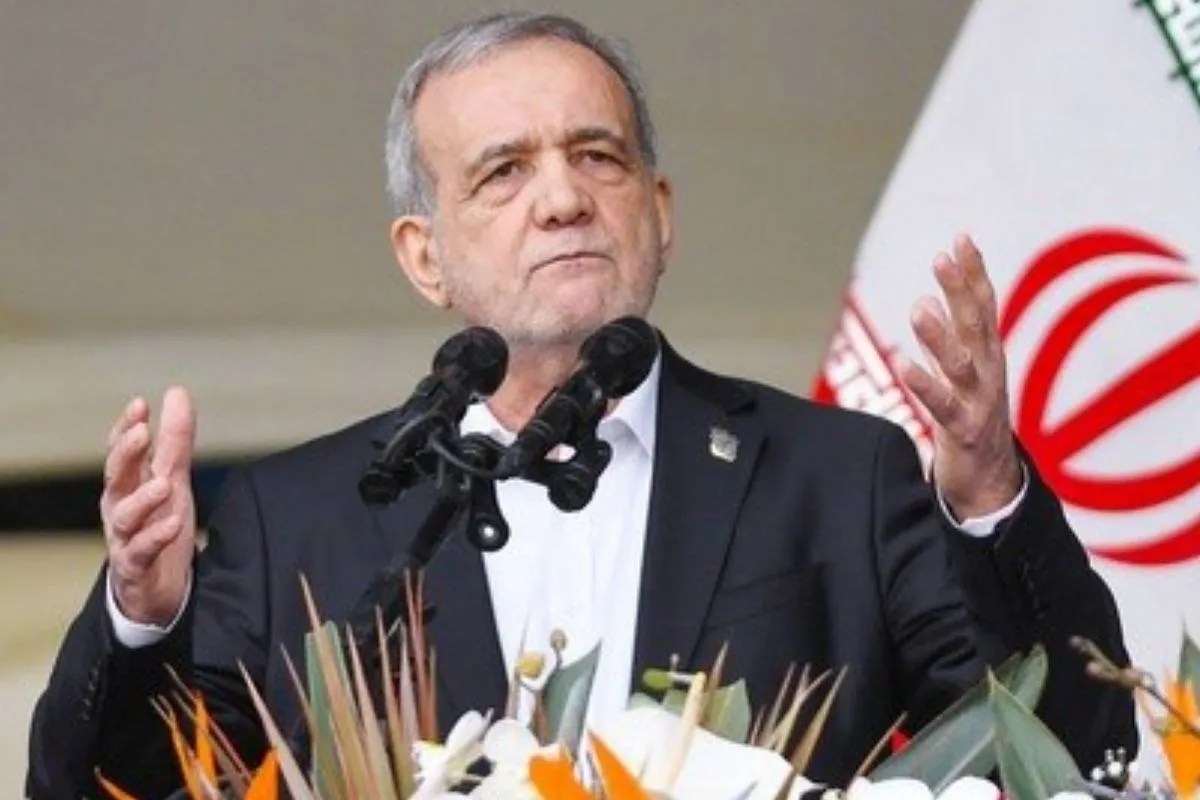
Iranian President Masoud Pezeshkian is fighting for the political survival of his administration's signature diplomatic achievement, publicly insisting that the high-stakes memorandum of understanding signed with the United States serves Tehran, the broader Middle East, and global stability. Months after Washington and Tehran inked the interim 14-point framework aimed at halting a grinding regional conflict, the agreement hangs by a frayed thread. Pezeshkian's recent defense of the text—promoted heavily via state channels and social media—masks deep domestic turmoil, fierce pushback from hardliners, and an increasingly fragile enforcement mechanism over the Strait of Hormuz.
The accord, hammered out to bypass a state of "neither war nor peace," was designed to freeze active hostilities, lift crippling naval blockades, and open a sixty-day window for permanent negotiations on Iran's nuclear infrastructure. Yet, as the initial implementation deadlines fracture under the weight of mutual distrust, the structural flaws of the agreement are catching up to both capitals.
The Anatomy of an Imperfect Framework
To understand why Pezeshkian is forced to repeatedly justify the document, one must examine what the text actually demands. Signed remotely in mid-June following months of direct and indirect friction, the document outlines a step-by-step de-escalation. It promises the phased removal of American naval blockades, toll-free commercial passage through the vital Persian Gulf chokepoints, and a massive three-hundred-billion-dollar international reconstruction package backed by regional partners. In exchange, Tehran pledged to maintain the status quo on its nuclear enrichment programs while eschewing the development of atomic weapons.
Sounds pragmatic on paper. On the ground, the mechanics are breaking down.
The Iranian parliament and powerful elements within the security apparatus view the framework with unmasked hostility. Critics inside Tehran have publicly labeled the terms an act of economic colonization, pointing to provisions requiring transparency over energy transit and foreign oversight on asset tracking. Pezeshkian has countered these domestic salvos by claiming the agreement was vetted and greenlit collectively by the Supreme National Security Council, attempting to shield himself from accusations that his cabinet caved to foreign pressure.
Enforcement Battles in the Persian Gulf
The immediate operational flashpoint remains the Strait of Hormuz. Under the terms of the memorandum, Iran agreed to ensure safe, toll-free passage for commercial vessels for an initial sixty-day window. Concurrently, Washington committed to issuing Treasury waivers for Iranian oil exports and winding down naval pressure.
Yet, implementation has stalled into a game of geopolitical chicken. Iranian deputy foreign ministers and military officials have maintained that shipping lanes will not resume normal operations until Washington demonstrates total compliance with financial sanctions relief. Meanwhile, American and allied warships have adjusted their postures, with long-deployed carriers rotating out of the theater amid reports of exhausted crews and logistical strain, leaving a vacuum of verified enforcement.
This creates a dangerous feedback loop. Without verifiable economic relief flowing into Tehran, domestic hardliners use the delay to torpedo the diplomatic track entirely. Without secure, predictable maritime traffic, Washington views the entire framework as a hollow exercise in buying time.
The Domestic Political Cost
Pezeshkian faces a bifurcated political landscape. While the executive branch argues that foreign investment is impossible under persistent warfare conditions, powerful domestic factions remain fundamentally opposed to any accommodation with the West. Following the transition of supreme leadership earlier in the year, messaging from the top tiers of the clerical establishment has swung between calls for broader regional solidarity against Western influence and hardened skepticism toward any written pact with Washington.
The president's insistence that the agreement acts as a shield against American and Israeli destabilization is an argument tailored for public consumption, designed to reframe a compromise as a tactical victory. Behind closed doors, the reality is far more transactional. The administration needs capital inflows and oil revenue to stave off compounding domestic inflation. The United States needs a stable energy corridor and a ceiling on enriched material stockpiles.
What Happens When the Grace Period Expires
As the timeline stretches past its initial markers without a permanent accord, the risk of a military reversion climbs exponentially. Temporary ceasefires in protracted conflicts rarely survive without institutional momentum. When a framework relies entirely on the political will of leaders who are under immense domestic pressure to show strength, the collapse of trust usually happens swiftly.
Pezeshkian continues to demand that Washington honor its signature, warning that no sovereign nation will bow to external coercion. But declarations on social media do not replace functioning verification mechanisms or alleviate the structural distrust that has defined relations for decades. Unless both sides bridge the gap between paper commitments and verifiable execution, the peace memorandum will be remembered not as a turning point, but as a brief pause in an intractable cycle.