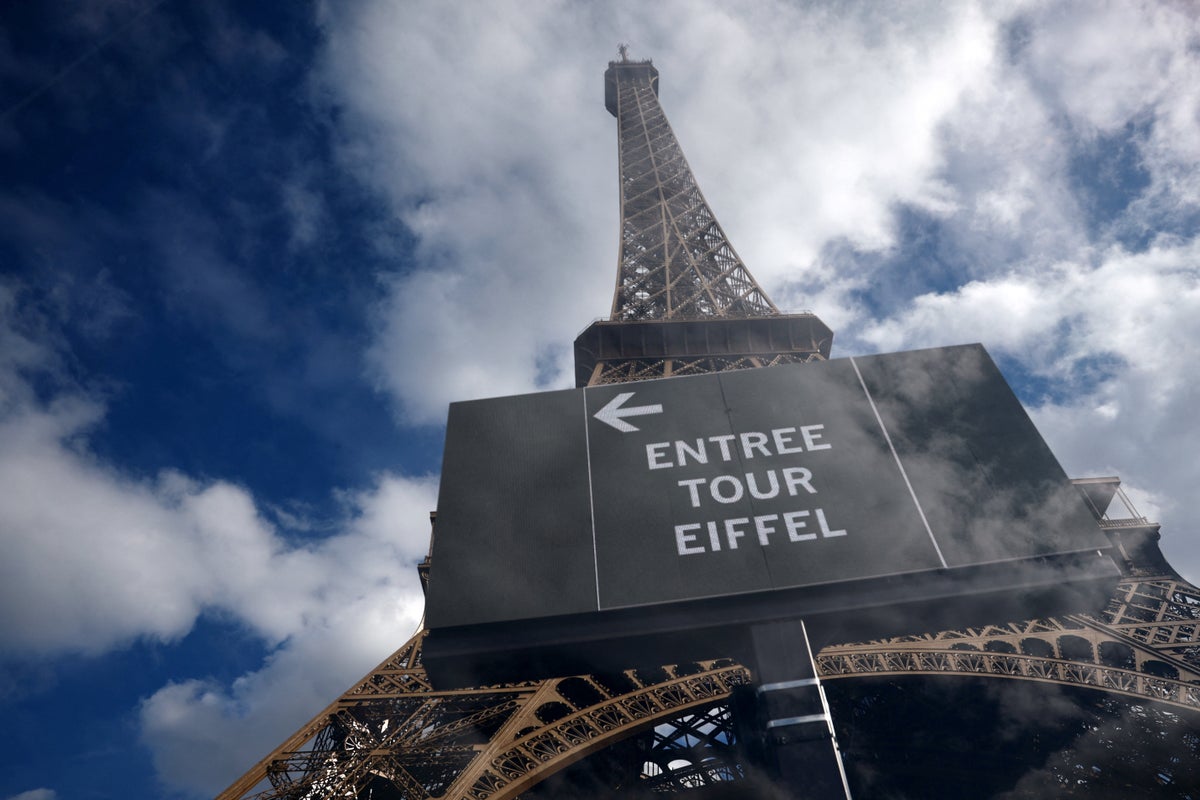
The temporary closure of the Eiffel Tower following a staff revolt over the sidelining of female employees is not merely a localized employment dispute. It is a glaring symptom of a deeper administrative rot. When Société d'Exploitation de la Tour Eiffel (SETE) management agreed to accommodate a private visit from the Bochasanwasi Akshar Purushottam Swaminarayan Sanstha (BAPS) by moving women away from their posts, they did more than commit a severe operational blunder. They exposed how easily institutional values crumble when a major landmark's administration bends backward for influential groups.
The sequence of events is clear. Around one hundred individuals connected to the international Hindu spiritual movement visited the Paris landmark. Union representatives later revealed that female welcome agents and elevator operators were ordered to vacate their workstations so that male colleagues could take their places. The goal was to limit interactions between the delegation and female staff. By Monday morning, workers had staged a walkout, shutting down one of the most visited tourist attractions on Earth and forcing an emergency reckoning across the French political establishment.
The Anatomy of Anticipatory Obedience
Bureaucracies love compliance. They adore it so much that institutional self-preservation often morphs into anticipatory obedience.
Management did not have to acquiesce to these unvoiced or explicitly requested segregations. French labor law and the foundational principles of the Republic explicitly prohibit workplace discrimination based on gender. Yet, mid-level operators and administrative schedulers chose the path of least resistance. They weighed the potential friction of turning down a high-profile religious delegation against the minor inconvenience of subverting their own labor force.
This calculus happens in corporate boardrooms daily. Organizations routinely trade their ethical baseline for diplomatic convenience. When the delegation arrived, the infrastructure of the Iron Lady was weaponized against its own workers. A female elevator operator was pulled from her post simply because her presence conflicted with an outside group's internal orthodoxy. That is not hospitality. That is capitulation.
The Fallout and Finger-Pointing
The political class lost no time positioning themselves on the right side of the television cameras. Figures like former prime minister Gabriel Attal and regional president Valérie Pécresse lined up to denounce the episode, reminding the public that no belief system dictates the place of women in France.
Meanwhile, BAPS issued statements expressing regret and noting that the visit had been coordinated with monument authorities to minimize public disruption. The organization maintained it never explicitly demanded the exclusion of women, stating they only requested a smoothly managed tour.
Here lies the perennial gray area of modern cultural diplomacy. High-net-worth delegations and massive religious bodies operate with a degree of structural gravity that local managers struggle to resist. A request for a "quiet, streamlined visit" is often interpreted by anxious bureaucrats as an order to sanitize the environment. The delegation blames the management for over-correcting. The management blames the logistics. The workers bear the brunt of the humiliation.
Why the Strike Matters
Strikes at monuments of this scale are rare. They require an extraordinary level of workplace fury to materialize on short notice.
When the evening team walked off the floor, they were protesting a direct assault on their professional dignity. In labor markets across Europe, public sector and tourism unions remain fiercely protective of codified egalitarian norms. They understand a slippery slope when they see one. If a landmark can shuffle women out of sight for one foreign delegation today, what stops them from doing it for corporate sponsors or political dignitaries tomorrow?
The speed with which SETE management walked back their actions—promising a thorough review and issuing ticket reimbursements—demonstrates how badly they miscalculated the temperature of their own house. They treated their frontline staff as disposable variables in a diplomatic equation.
Institutions will continue to face these friction points as global tourism intersects with rigid traditional belief systems. Money talks, and international religious bodies command vast global networks. But public monuments embedded in secular republics cannot outsource their labor ethics to visiting pilgrims without courting total collapse.
The Eiffel Tower reopened after a day of internal reckoning, but the institutional habits that permitted female employees to be treated like chess pieces remain intact across tourism capitals worldwide.