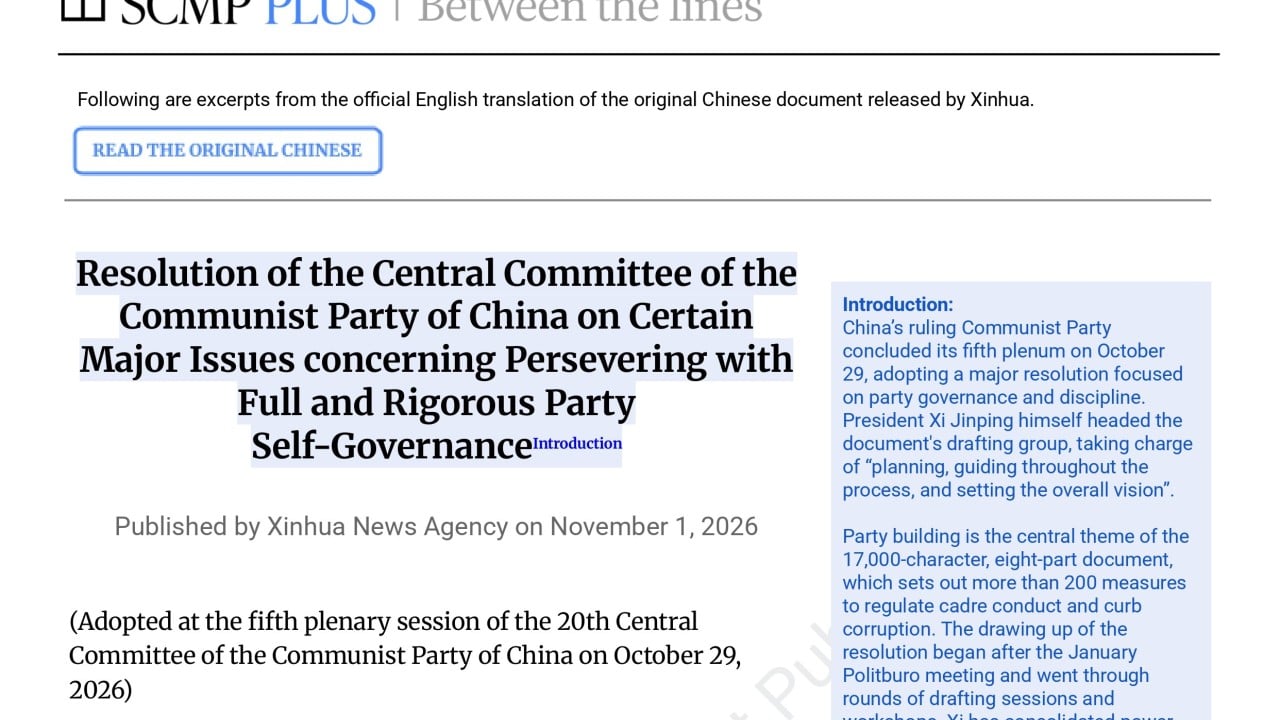
A China fifth plenum resolution is not a press release dressed up in ideological jargon. It is a binding operating manual for the world's second-largest economy, issued at the midpoint of a five-year leadership cycle when the Communist Party of China shifts from grand slogans to hard resource allocation. Read it as poetry and you miss the point. Read it as a procurement order, a credit directive, and a disciplinary warning to provincial governors all at once, and the machinery clicks into focus.
For decades, foreign analysts treated Beijing's fifth plenum gatherings like tea leaves. Analysts counted adjectives, parsed subtle shifts in phrasing, and declared victory when they spotted a new catchphrase. That habit misses how authority actually moves inside the state apparatus. The resolution is the hinge where abstract political will meets concrete fiscal enforcement, state bank lending quotas, and cadre evaluation metrics.
Why Analysts Misread the Fifth Plenum
Most commentary on a China fifth plenum resolution fails before the ink even dries on the communique. Observers look for a dramatic pivot when the system is built for incremental ratchet effects. Beijing rarely scraps a policy overnight; it layers new mandates onto old ones until provincial officials have no room left to maneuver.
A common mistake is treating the document as a literal forecast of quarterly GDP numbers. It is not. Five-year planning cycles set direction, risk tolerances, and institutional priorities, while annual work conferences and cabinet directives translate those broad targets into budget lines. If a plenum elevates industrial upgrading or supply chain resilience, banks and ministries feel the pressure long before a final statistical target shows up in a headline.
Consider a hypothetical example to see how this plays out at the municipal level. Suppose a plenum resolution stresses domestic self-reliance in precision tooling and advanced materials. A mayor in a mid-sized coastal city who spent the last decade chasing real estate tax revenue suddenly sees her promotion prospects tied to high-tech park occupancy, local science grants, and industrial land clearances. She does not wake up reading Marxist theory; she wakes up to a revised performance scorecard.
A plenum resolution rarely announces a sudden revolution. It narrows the exits for local officials until compliance becomes the safest career move.
There is also a blind spot around party discipline and personnel alignment. Foreign coverage often separates economic policy from political control, as if technocrats run the factories and ideologues run the meeting rooms. In practice, those tracks are braided together. Tighter discipline around cadre loyalty determines who gets trusted with strategic capital and who gets sidelined during anti-corruption sweeps.
How the Resolution Moves Money and Power
To understand the real weight of a China fifth plenum resolution, trace the money rather than the rhetoric. State-owned commercial banks, policy banks, local government financing vehicles, and state-owned enterprises do not operate in a vacuum. When top leadership designates a sector as a pillar or a strategic emerging industry, credit lines open faster and regulatory friction drops for approved players.
At the same time, pressure builds on legacy sectors that absorb capital without delivering strategic returns. Property developers, overbuilt local infrastructure projects, and heavily indebted municipal platforms face tighter scrutiny when the center prioritizes financial risk prevention over raw headcount growth. The tension is real. Squeezing old growth engines before new ones reach full scale creates sluggishness on the ground, even as planners insist the transition is healthy.
Provincial governments sit right in the middle of this squeeze. Beijing sets high-level objectives, yet local authorities bear much of the operational burden for social stability, public services, and employment. When central mandates call for both technological self-reliance and strict debt control, mayors and party secretaries have to juggle competing demands with shrinking fiscal wiggle room.
- Credit allocation: Policy banks and state lenders align loan books with central industrial priorities, favoring targeted manufacturing, energy transition, and core components over speculative property.
- Cadre incentives: Local officials are judged not just on headline growth, but on risk containment, environmental compliance, and alignment with central directives.
- Regulatory enforcement: Market oversight, data rules, and industrial standards tighten around sectors deemed sensitive to national security or economic sovereignty.
- State enterprise reform: Central and local state-owned enterprises take on larger roles in stabilizing markets, absorbing talent, and executing long-horizon projects private firms find too costly.
None of this operates without friction. Local evasion happens. Officials sometimes repackage old debt into new vehicles, dress up low-value assembly plants as high-tech hubs, or slow-walk directives that threaten local tax receipts. Beijing knows this game intimately, which is why each cycle tends to pair ambitious economic goals with sharper inspection teams and stricter accountability rules.
The Hidden Trade-Offs Behind the Blueprint
Every China fifth plenum resolution carries trade-offs that official summaries smooth over. Pushing hard for domestic supply chain autonomy lowers exposure to foreign export controls and geopolitical shocks, yet it often sacrifices short-term cost efficiency. Duplicating supply chains inside one country takes years and billions in capital, and it can leave firms with excess capacity if domestic demand lags behind factory output.
There is an equally sharp trade-off between state guidance and private sector vitality. Private entrepreneurs built much of China's export dynamism, consumer internet, and nimble manufacturing base. When state capital takes the lead in strategic industries, private firms can feel crowded out from funding, procurement, or market access, even when official documents pledge support for private enterprise.
External reactions add another layer of strain. As Beijing doubles down on industrial policy and high-value manufacturing exports to offset domestic property weakness, trading partners push back with tariffs, subsidies investigations, and investment screening. A strategy designed to insulate the domestic economy from foreign pressure can end up provoking the very external friction planners want to manage.
| Policy Dimension | Stated Objective in State Planning | Practical Friction on the Ground |
|---|---|---|
| Industrial Upgrading | Shift from low-margin goods to high-value tech and advanced manufacturing | Risk of overcapacity, subsidy waste, and uneven returns across provinces |
| Debt and Risk Control | Curb local government debt and stabilize property and financial markets | Slower short-term municipal spending and tighter liquidity for local projects |
| Supply Chain Security | Reduce reliance on foreign bottlenecks in key inputs and equipment | Higher costs, longer timelines, and friction with major export markets |
| Private Sector Role | Encourage private innovation alongside state-led strategic projects | Unequal access to credit and uncertainty over regulatory boundaries |
Gray areas define the reality more than neat categories do. A factory can be privately owned on paper yet rely heavily on state subsidies and local land grants; a policy can look restrictive in one headline while opening quiet market space in another. Anyone who reads Chinese economic governance as a rigid monolith misses the constant bargaining between central planners, provincial executives, banks, and enterprise managers.
What Market Veterans Watch First
After twenty-plus years watching policy shifts roll out across Asia, seasoned operators rarely wait for months of commentary to judge a China fifth plenum resolution. They watch early execution signals. Do major state banks adjust lending guidance within weeks? Do provincial work plans echo the exact priority sectors, or water them down into vague generalities? Do central inspection teams deploy to regions notorious for debt or policy slippage?
Look also at household consumption versus industrial investment. Planners routinely talk about boosting domestic demand, yet structural habits—high precautionary savings, cautious property sentiment, and uneven social safety nets—change slowly. When policy leans heavily toward production capacity while consumer confidence stays guarded, supply can easily outrun domestic absorption, forcing producers to fight harder for thin margins at home or abroad.
The real test of a China fifth plenum resolution is never the day it is published. It is six to eighteen months later, when credit ledgers, factory orders, local budgets, and enforcement campaigns show which promises had teeth and which ones stayed on paper. Watch the balance sheets, not the applause.