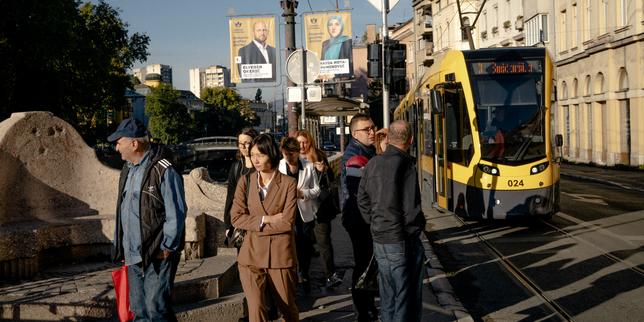
When the polling stations closed across Bosnia and Herzegovina following the general elections, the immediate political math revealed an unyielding continuity rather than a breakthrough for the country's stalled European Union path. With voter turnout hitting historic lows—dipping to roughly forty-three percent—the electorate delivered a verdict defined less by enthusiastic endorsement and more by exhausted alienation. The ballot boxes reinforced the entrenched ethnic divisions engineered by the Dayton Agreement, ensuring that the architecture of the state remains fundamentally mismatched with the rigorous administrative demands of Brussels.
For years, international observers and Western diplomats have treated European integration as a technical checklist of legislative reforms that local politicians could be nudged into passing through financial incentives or mild pressure. That assumption ignores the perverse structural reality of Bosnian politics. Ethno-nationalist elites maintain their grip on power precisely by preserving dysfunction. When governance is treated as a zero-sum game between Serb, Croat, and Bosniak factions, genuine administrative alignment with European standards—such as establishing an independent judiciary, dismantling patronage networks, and streamlining public procurement—threatens the very mechanisms of control that keep these leaders employed.
The election results cemented this defensive equilibrium. While figures like Denis Bećirović continue to rhetorically champion European Union and NATO integration from the collective presidency, the structural capacity to deliver transformative reform remains shackled by institutional vetoes and deep-seated polarization. In Republika Srpska and across the Federation, political parties running campaigns anchored in identity grievance secured their positions, neutralizing the urgency of accession benchmarks. The prize of European membership requires centralization of certain regulatory authorities and compliance with trans-national oversight, concepts that are systematically resisted by leaders who benefit from a fragmented state apparatus.
Compounding this political inertia is the ticking clock of tangible financial penalties. European officials have repeatedly warned that millions in development and integration funds hang in the balance, subject to strict structural milestones that local administrations routinely miss or deliberately stall. For instance, failure to implement localized reforms risks permanently forfeiting hundreds of millions of euros intended to modernize public infrastructure. Yet, local leaders calculate that the political cost of compromising with rival ethnic factions outweighs the long-term economic benefit of European funds. They absorb the financial blow, pass the blame to Brussels or rival groups, and rely on polarization to shield themselves from electoral accountability.
Consider a hypothetical scenario to understand this dynamic. If a municipality requires a unified, transparent digital registry for public contracting to satisfy a core European Union chapter requirement, rival parties will often block the software rollout. Why? Because controlling individual hiring and procurement slots at the local level is the currency of political patronage. Handing over those processes to an objective, merit-based, Brussels-compliant framework drains the lifeblood from party machines. The election outcome ensures that these patronage networks remain intact, rendering high-level promises of European integration little more than diplomatic theater.
Brussels shares a portion of the blame for this prolonged stagnation through its own policy inconsistencies. Years of pursuing stability over democracy—frequently accommodating local strongmen under the fragile pretext of maintaining regional peace—have signaled to the Bosnian electorate that genuine democratic accountability is secondary to containment. When geopolitical expedience trumps the enforcement of rule-of-law standards, local elites learn that they can obstruct reforms indefinitely without facing permanent political exclusion from Western capitals.
The fallout from the October vote is a stark reminder that integration cannot be achieved by bureaucratic fiat alone. As long as the constitutional framework incentivizes ethnic outbidding and administrative paralysis, every election cycle will reset the clock rather than advance the destination. Bosnia and Herzegovina remains trapped in a perpetual transition, where the promise of Europe serves as a distant horizon invoked by politicians who spend their days actively dismantling the road to get there.


