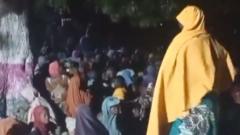
The recent extraction of hundreds of captives from a Boko Haram stronghold in the Mandara Mountains is being celebrated as a straightforward military triumph. Nigerian defense headquarters immediately flooded the airwaves with images of malnourished women and children boarding olive-drab trucks, framing the operation as a decisive blow against a crumbling insurgency. But the official narrative obscures a far more complex and troubling reality on the ground. This was not a surgical raid that caught the enemy by surprise; it was the predictable byproduct of a shifting insurgent strategy that relies on dumping civilian liabilities to survive an escalating logistical crisis.
For the families reunited in regional capitals like Maiduguri, the relief is undeniable. Yet, viewing these mass liberations strictly through the lens of battlefield victory ignores the structural rot within the counter-insurgency framework. To understand why these rescues keep happening without actually ending the conflict, one must look past the press releases and examine the changing economy of terror in the Lake Chad basin.
The Strategy Behind the Surrender
Military commanders like to present every rescued civilian as a trophy won through tactical superiority. The math of guerrilla warfare suggests otherwise. Over the past eighteen months, intense pressure from rival factions—specifically the Islamic State West Africa Province (ISWAP)—and a devastating regional drought have choked off Boko Haram’s supply lines in its mountain redoubts.
Captives are expensive to keep. They require food, water, and medical attention that the insurgents can no longer provide for their own combatants. When the Nigerian military advances into these rugged terrains, they are frequently occupying camps that have already been systematically thinned out. The insurgents are not losing their grip; they are cutting their overhead.
By allowing hundreds of dependents to be swept up by advancing state forces, Boko Haram achieves three distinct tactical advantages. First, they instantly transfer a massive logistical burden to an already strained Nigerian state apparatus. Second, they slow down military advancement, as troops must redirect operational resources, vehicles, and security detail to transport and process civilians. Third, they create a human shield dynamic in reverse, where the military's focus shifts from hot pursuit to humanitarian management, buying the core insurgent fighters time to melt deeper into the borderlands of Cameroon and Niger.
The Invisible Sieve of Rehabilitation
What happens to these hundreds of freed individuals after the cameras stop flashing is where the true crisis resides. They enter a opaque bureaucratic system known as Operation Safe Corridor or related state-level deradicalization initiatives. This is a processing pipeline that is fundamentally broken.
Screening processes are notoriously imprecise. In the chaos of a mass extraction, distinguishing between a woman who was abducted from her village five years ago and a woman who willingly married a commander and embraced the group's ideology is nearly impossible for overstretched intelligence officers. The current vetting reliance on local informants and crude behavioral assessments is a sieve.
"The distinction between victim and perpetrator in the Mandara Mountains evaporated years ago," notes a regional security analyst who requested anonymity due to operational safety. "We are processing thousands of people based on guesswork, hoping that the truly dangerous elements don’t just walk out the front door of a transit camp."
💡 You might also like: The Soho Road Trap and the Fatal Vulnerability of the Streets
Furthermore, the funding for these long-term rehabilitation efforts is drying up. International donors are fatigued, and domestic budgets are heavily diverted toward hardware and kinetic operations rather than social reintegration. The result is a network of overcrowded holding facilities where radical ideologies can ferment among those who were initially entirely innocent, creating a secondary wave of radicalization within the very walls built to prevent it.
The Border Blind Spot
The Mandara Mountains are not just a geographical feature; they are a geopolitical loophole. Spanning the frontier between northeastern Nigeria and northern Cameroon, the terrain is a labyrinth of volcanic peaks, caves, and dense vegetation that renders conventional mechanized warfare useless.
True success in this theater requires seamless, real-time cross-border cooperation. It does not exist. While the Multinational Joint Task Force (MNJTF) exists on paper, national forces remain fiercely protective of their sovereignty and deeply suspicious of their neighbors.
Consider a standard operational scenario. When the Nigerian Army launches an offensive on the western slopes of the Mandaras, Boko Haram units simply pack up their essential assets and walk a few kilometers east into Cameroonian territory. The Nigerian troops stop at the invisible line of the border, hamstrung by international law and a lack of tactical clearance. The Cameroonian forces, occupied with their own internal security challenges in the Anglophone regions, rarely have the assets deployed to intercept the retreating insurgents. The mountain hideout is never truly destroyed; it merely changes jurisdictions.
Until the governments in Abuja and Yaoundé establish a joint command structure with genuine hot-pursuit capabilities—allowing troops from either nation to track and engage targets deep into the other’s territory—these mountain clearances will remain a game of whack-a-mole. The insurgents will return to the exact same caves the moment the Nigerian division pulls back to its base in Gwoza.
The Displacement Economy
The economic vacuum left by over a decade of conflict ensures that the areas cleared by the military cannot stay secure. When hundreds of people are rescued, they cannot return to their original villages because those villages no longer exist. They are fields of ash and unexploded ordnance.
This forces the liberated population into internally displaced persons (IDP) camps, which have become hubs of economic exploitation. Food aid is systematically diverted by corrupt local officials. Access to basic sanitation is traded for sexual favors. Security inside the camps is porous, with insurgent scouts regularly entering to recruit or gather intelligence.
- Aid Diversion: Up to 40% of emergency food shipments destined for northern camps fail to reach the intended recipients, winding up in local commercial markets instead.
- Security Deficit: Armed guards are concentrated at the perimeters, leaving the interior zones of the camps lawless after dark.
- Economic Stagnation: Denied access to agricultural land due to landmine risks, refugees are trapped in a state of permanent dependency.
This bleak reality creates a perverse incentive structure. Life in a poorly managed state camp is often so degrading that some escapees actively choose to return to the bush, preferring the predictable hardships of the insurgent camps to the slow starvation of the state-run facilities. This is the dark truth that military spokesmen omit when they boast about numbers: the door between captivity and freedom is a revolving one.
Information Warfare and the Illusion of Defeat
The focus on high-yield rescues serves a vital political purpose for the administration. It creates the illusion of progress in a war that has dragged on for fifteen years with no end in sight. Every mass liberation article published by mainstream outlets serves to validate defense spending increases and deflect criticism from systemic intelligence failures elsewhere in the country, such as the persistent banditry in the northwest.
This information warfare distorts public perception and warps policy. By convincing the public that Boko Haram is on its last legs because they are abandoning their camps, the government avoids making the difficult, expensive reforms needed to address the root causes of the insurgency.
They do not need to fix the crumbling educational system in Borno State if they can show a video of a hundred children being fed by soldiers. They do not need to tackle the systemic corruption within military procurement if they can display captured weaponry on the evening news. The spectacle of the rescue replaces the substance of strategy.
The insurgency in the northeast will not be solved by clearing mountains or counting the number of dependents handed over by a starving adversary. It will end only when the Nigerian state can project legitimate authority, economic opportunity, and impartial justice into the geographic margins of the country. Until then, the military will continue to march up the Mandara Mountains, drag down hundreds of broken people, declare victory, and watch as the enemy quiet reoccupies the high ground the moment the trucks drive away. The cycle does not break itself; it just waits for the next press release.