The noise is the first thing that strips away your composure. Not the roar of engines, though four massive turbofans are screaming just inches from your hull, but the relentless, low-frequency hum that vibrates straight through the soles of your shoes and settles into your teeth.
You are inside a Boeing VC-25. To the public, it is Air Force One. To the journalists, the Secret Service agents, the military aides, and the Commander-in-Chief packed tightly into its belly, it is a flying panic room, a mobile Oval Office, and a suffocatingly small town hurtling through the stratosphere at six hundred miles per hour.
Imagine stepping off the tarmac at Joint Base Andrews. The wind whips your coat. The flashbulbs blind you. You climb the retractable stairs—not the grand forward staircase reserved for the presidency, but the aft door swallowed by the tail—and you enter a different dimension.
Outside, a nation screams at itself. Inside, there is only the hum.
The Architecture of Power
Space is the ultimate luxury, and aboard this aircraft, it is hoarded with ruthless precision.
Popular imagination pictures the President lounging in a sprawling presidential suite, sipping coffee while staring out at the clouds. The reality is far tighter. Up front, behind the private stateroom with its fold-out couch and oak-trimmed desk, sits a medical suite equipped with a full operating table, blood plasma matching the President's exact type, and a doctor who never sleeps.
Further back, the cabin bleeds into a claustrophobic maze of cramped compartments. There is the press pool section—rows of leather seats that look suspiciously like first class on a commercial airliner, yet feel infinitely heavier because every second spent here is billed to history.
Let us trace a typical journey. It is midnight over the Atlantic. Donald Trump is aboard, staring out the reinforced window into an abyss of absolute black. He does not sleep much on these flights. While aides doze against the bulkheads, their ties loosened and laptops glowing with pale blue light against exhausted faces, the President remains active. He moves between the cramped communications room—a secure bunker filled with banks of cryptographic hardware that can launch a counterstrike from thirty thousand feet—and his private cabin.
There is a distinct theatricality to the movement. Every step is monitored. Every corridor is narrow enough that you must press your shoulder against the wood-paneled wall to let a general pass.
The Weight of the Bubble
To understand what it is like to travel on this plane, you have to understand the isolation.
The outside world vanishes the moment the landing gear locks into the wheel wells. Cell phones are useless. Wi-Fi is heavily filtered, encrypted, and channeled through military satellites that bounce signals across hemispheres. News cycles arrive in delayed, highly curated bursts.
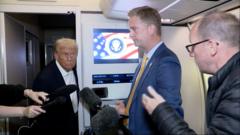
During the Trump administration, this isolation took on a unique flavor. The cabin was rarely quiet. Unlike predecessors who might use the flight to quietly review dense briefing binders or draft policy memos in solitude, Trump operated an airborne salon. He would summon reporters from the press cabin back to his office—a cramped workspace dominated by a heavy wooden desk—for impromptu, off-the-record sparring sessions, policy declarations, or sharp commentary on the morning headlines.
Noise. Friction. Energy.
A reporter squeezed into the small leather chair across from him would watch the President gesture emphatically toward a map or a printout, his voice cutting easily through the background roar of the engines. You could smell the Diet Coke cans cracking open. You could feel the sudden drop in cabin pressure as the aircraft hit turbulence, causing everyone to instinctively grab the armrests while the conversation continued without missing a beat.
It is a strange psychological state, hurtling toward a foreign summit while completely untethered from gravity and geography. You lose track of time. Breakfast is served when it is midnight in Washington. Dinner arrives when the sun is blindingly high outside the window.
The Invisible Engine
Behind the politics, behind the cameras, and behind the towering persona of the man in the front cabin, lies the invisible choreography of the crew.
Master Sergeant Elena Rodriguez—a hypothetical loadmaster modeled entirely on the real, unrelenting standards of the Presidential Airlift Group—stands in the galley, bracing herself against a metal counter as the plane banks sharply over the Mediterranean. Her uniform is immaculate, despite having worked eighteen hours straight. Her job is not just to feed a hundred people, but to ensure that every fork, every napkin, and every container of milk is accounted for, inspected, and verified.
Security is absolute, paranoid, and invisible until it fails.
Every meal served to the President is prepared by military chefs who buy groceries randomly from local supermarkets in ordinary civilian clothes, blending into crowds so no one can trace the ingredients back to the supply chain. If a reporter brings a sandwich aboard, it stays in a sealed bag. If an aide opens a briefcase, an agent's eyes track the movement with the casual intensity of a hawk.
Consider the cost. Every hour in the air burns thousands of gallons of JP-8 fuel. A fleet of transport planes flies ahead of you, carrying the presidential motorcade—armored limousines, decoy vehicles, and electronic jamming gear—so that the moment Air Force One touches down, the President steps directly into an ironclad fortress on wheels.
The Descent
The flight is ending.
You feel the engines spool down. The pitch of the hum changes, dropping an octave as the nose dips downward toward the runway lights of a foreign capital or a domestic rally stop.
In the press cabin, laptops snap shut in unison. Ties are straightened. Faces are rubbed with tired palms to wipe away the gray film of jet lag. Everyone checks their credentials, slings their camera bags over their shoulders, and prepares to re-enter the noise of the world.
When the stairs roll up to the door and the handle turns, the rush of exterior air hits you like a physical blow. It smells of jet exhaust, damp asphalt, and the distinct humidity of wherever you have landed.
The President steps out first, pausing at the top of the stairs, lifting a hand to wave at the distant crowd. For a brief second, framed against the iconic blue and white fuselage, he is completely alone. Then he descends into the roar of the cameras, leaving the metal cage behind him in the sky.