The United States Supreme Court handed the executive branch a significant victory by voting 5-4 to allow construction of a massive, four hundred million dollar White House ballroom project to proceed. This ruling temporarily blocks lower court orders that had previously halted above-ground work on the East Wing renovation. The high court sidestepped the core constitutional question of whether the administration possesses the unilateral authority to alter the historic executive mansion. Instead, the majority ruled on procedural grounds, finding that the National Trust for Historic Preservation lacked the legal standing required under Article III to challenge the project.
Chief Justice John Roberts broke ranks with his conservative colleagues, joining the court's three liberal justices in a sharp dissent. Roberts argued that the sprawling ninety-thousand-square-foot structure is likely unlawful because Congress never granted explicit statutory authority for its construction. This high-stakes legal showdown exposes deep fractures over the separation of powers and the limits of presidential reach into federal property.
The Mechanics of Standing and Judicial Dodge
Standing doctrine remains one of the most effective gatekeepers in American jurisprudence. In this case, the unsigned per curiam majority opinion weaponized that doctrine to shield the executive branch from immediate judicial review. The National Trust based its lawsuit on declarations from architectural historians and preservationists who argued that an oversized, towering ballroom would visually compromise and degrade the historic primacy of the White House.
The Supreme Court flatly rejected that logic.
"This Court has not found standing in circumstances like these before," the majority wrote. "To the contrary, we have repeatedly held that mere offense, disagreement, or distaste does not qualify as a concrete and particularized injury under Article III."
By framing the historic preservationists' objections as mere ideological or aesthetic disagreement, the court avoided ruling on the merits of the demolition. It is a classic judicial maneuver. When the stakes are exceptionally high and the political fallout toxic, courts frequently reach for procedural hurdles to sidestep substantive constitutional collisions. The underlying legality of tearing down a chunk of the East Wing to erect a monumental entertainment hall remains unresolved. Lower courts will eventually have to untangle the mess, but by the time those arguments cycle back up, the concrete will have cured.
The Power of the Purse and the Chief Justice's Warning
Chief Justice Roberts did not mince words in his dissent. He warned that allowing the project to advance unchecked fundamentally undermines the legislative branch's authority.
Pursuant to the Constitution, Congress holds plenary authority over the District of Columbia and federal property. Statutes governing President's Park and the capital explicitly forbid the erection of unauthorized structures on public grounds without express legislative approval. According to Roberts, the executive branch's aggressive push to build the ballroom represents an outright infringement on the power of the purse.
"Today's decision is no victory for the separation of powers," Roberts wrote, closing his opinion with a stark historical invocation from Winston Churchill:
"We shape our buildings, and afterwards our buildings shape us."
The irony of Roberts delivering this defense of institutional boundaries is hard to miss. Critics note that the same court has repeatedly expanded presidential immunities and executive prerogatives in recent terms, only to draw a sudden line at structural architecture. Yet Roberts's underlying point cuts to the heart of administrative overreach. If an administration can bypass Congress to construct multi-hundred-million-dollar entertainment complexes on federal land under the vague banner of security upgrades, legislative oversight over federal real estate ceases to function as a meaningful check.
Outrunning the Judiciary
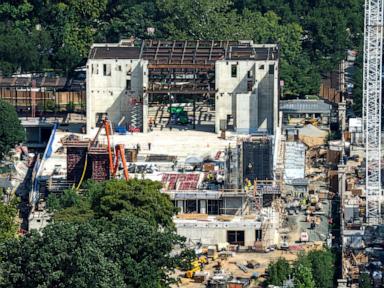
Time is the ultimate currency in modern administrative litigation. The administration understood this dynamic intimately, accelerating construction schedules to operate twenty hours a day with crews racing against judicial calendars. Court filings indicate that the structural framework of the ballroom is slated for completion by November, with the facade moving toward completion in the spring and the entire undertaking targeted for completion ahead of the 2028 election cycle.
Government lawyers pivoted their defense dynamically as the litigation evolved. Initially pitched as a privately funded upgrade to enhance diplomatic entertaining, the justification expanded to include critical national security infrastructure. Legal briefs emphasized that the project incorporates a subterranean military installation, arguing that halting above-ground construction would cause irreparable harm to broader defense postures and emergency operational readiness.
This hybrid justification—blending social hospitality with fortified bunkers—created a formidable shield for the administration. Courts are notoriously deferential to executive claims involving national security. Once the Department of Justice framed the East Wing reconstruction as a matter of presidential protection following heightened security threats, the legal momentum shifted decisively away from the preservation groups.
The legal challenge is far from dead on paper, but reality on the ground moves faster than appellate briefs. Heavy machinery operating around the clock in President's Park ensures that physical facts are being established long before any federal judge can issue a final ruling on statutory compliance. The machinery of the state has successfully outrun the machinery of the courts.