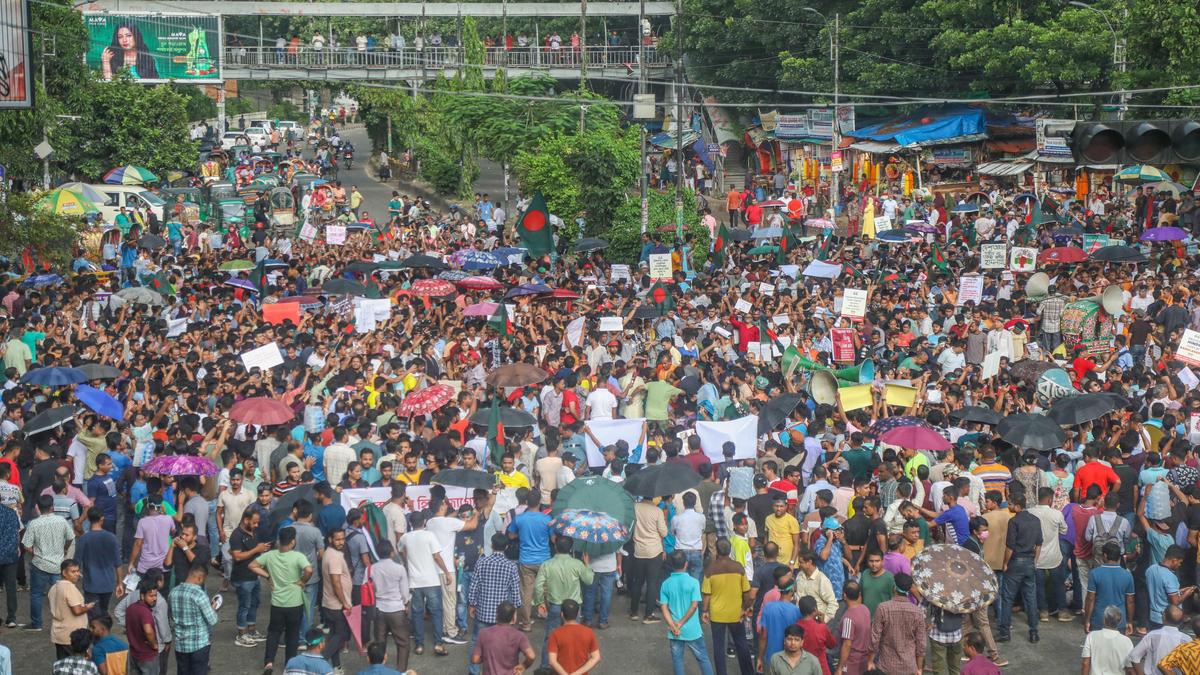
A fresh wave of communal instability is quietly fracturing Bangladesh, away from the immediate glare of global breaking news. In the first four months of this year alone, a prominent rights group documented 505 distinct incidents of violence targeting religious and ethnic minorities across 62 districts. This surge in hostility occurs against a backdrop of deep political transformation, stretching from the fallout of the 2024 Monsoon Revolution through the turbulent months of an interim administration to the return of partisan governance under the Bangladesh Nationalist Party (BNP).
While mainstream media often classifies these flashpoints as random outbursts of religious friction, an investigative dive into the mechanics of the unrest reveals a much more deliberate, structural breakdown. The numbers do not merely represent localized prejudice. They expose a calculated convergence of political retaliation, real estate exploitation, and systemic law enforcement failure that leaves vulnerable communities exposed to organized violence.
The Anatomy of the 505 Incidents
The raw statistics compiled by the Human Rights Congress for Bangladesh Minorities (HRCBM) between January and April provide a grim map of the current security vacuum. The violence spans all eight administrative divisions of the country, indicating that the threat is not confined to historically volatile border zones or isolated rural pockets.
A detailed breakdown of the reported offenses shows a high concentration of aggressive, physically destructive acts.
| Category of Violation | Number of Documented Cases |
|---|---|
| Kidnapping and physical assault | 144 |
| Property attacks, land grabbing, arson, and looting | 132 |
| Murder and suspicious deaths | 100 |
| Temple attacks and religious vandalism | 95 |
| Sexual violence, including rape and gang rape | 28 |
| Blasphemy-related persecution | 6 |
The figures are striking for their severity. One hundred deaths in a four-month window point to something far more lethal than casual intimidation. The 132 property-related offenses reveal the financial and territorial motivations that routinely underpin these communal flare-ups.
The Land Grab Blueprint
To understand why a Hindu temple is targeted or an indigenous village in the Chittagong Hill Tracts is torched, one must look closely at local real estate registries. Religion often serves as a highly effective smoke screen for material theft. In a densely populated country like Bangladesh, arable and commercial land is premium capital.
When a political transition occurs in Dhaka, the local power structures in distant districts fracture. Opportunistic actors utilize the chaos to settle long-standing property disputes.
The mechanism follows a predictable pattern. A local minority family owns a plot of agricultural land or a commercial shop front. Aggressors accuse a family member of digital blasphemy or associate them arbitrarily with the recently displaced political regime. A crowd gathers, intimidation begins, and the family flees for their safety. By the time the immediate physical danger passes, the land has been occupied, deeds are contested, and the legal hurdles to reclaim the property prove insurmountable for a marginalized household.
The Blasphemy Weapon and Mob Governance
The weaponization of social media to incite mob violence has become a repeatable formula across South Asia, and Bangladesh is no exception. Digital blasphemy allegations function as an immediate trigger for physical mobilization, frequently bypassing the state judicial apparatus entirely.
The process relies on a fragile security environment where digital literacy is low but emotional volatility is high. A single Facebook post, often originating from a cloned or fabricated account, is flagged as offensive to the religious majority. Within hours, screenshots circulate through messaging applications. Megaphones from local institutions are sometimes used to gather crowds.
Before local authorities can verify the authenticity of the digital claim, a crowd descends on the target neighborhood. The goal is rarely judicial justice. The intent is immediate, performative punishment designed to terrorize the local community into silence or displacement. Because the state frequently fails to prosecute the primary instigators of these digital lynch mobs, the strategy remains highly effective and virtually risk-free for those who deploy it.
Institutional Inertia and the Enforcement Deficit
The most damaging element of the current crisis is not the aggression of the mobs, but the paralysis of the state. Rights organizations consistently document a pattern of delayed response, half-hearted investigations, and a distinct lack of visible accountability from law enforcement agencies.
This institutional inertia stems from several deeply rooted factors.
- Political Apprehension: Local police chiefs, acutely aware of shifting political winds, are often hesitant to use force against crowds that may enjoy the backing of influential local politicians or religious factions.
- Victim Intimidation: When a minority family attempts to file a First Information Report (FIR), they frequently face intense counter-pressure from the perpetrators, forcing them to withdraw complaints in exchange for basic physical safety.
- The Politicization of Justice: Incidents of violence are routinely filtered through a partisan lens. The ruling party blames opposition elements for orchestrating attacks to destabilize the state, while the opposition claims the government is either complicit or utterly incompetent.
In this political crossfire, the objective pursuit of criminal justice is completely lost.
The Legacy of Political Transitions
The current escalation cannot be analyzed in isolation from the political shocks that have reshaped Bangladesh over the past two years. The collapse of Sheikh Hasina’s Awami League government in August 2024 left a massive structural vacuum. For over a decade, minority communities, particularly the Hindu population, were widely perceived as a reliable support base for the Awami League. This perception, whether accurate or oversimplified, made them immediate targets for retaliatory violence whenever the political pendulum swung.
During the eighteen-month tenure of the subsequent interim government led by Muhammad Yunus, international observers noted a steady rise in targeted attacks. The transition toward a standard party structure under the BNP has yet to restore basic security for minority enclaves. While top-tier political leadership frequently issues public statements urging communal harmony, these declarations rarely translate into effective protection on the ground, where local party cadres operate with substantial autonomy.
The Divergence in Documentation
A significant challenge in addressing the crisis is the stark disagreement over data. While the HRCBM documented 505 cases early this year, and the Bangladesh Hindu Buddhist Christian Unity Council identified 133 severe communal incidents in the first quarter, official state numbers are invariably lower.
This statistical gap exists because state authorities frequently reclassify communal attacks as ordinary criminal acts, private land disputes, or purely partisan altercations. By stripping the communal context away from a murder or an act of arson, the state can present a more stable facade to international human rights bodies and foreign trade partners.
This statistical sanitization comes at a heavy cost. It obscures the targeted nature of the threat, leaving minority communities trapped in a cycle where their lived reality is systematically denied by the official record.
Moving Beyond Temporary Safeguards
Following major incidents, the standard government response follows a familiar, ineffective script. A few temporary police pickets are deployed near prominent temples, a high-level delegation visits the affected district to promise compensation, and a minor administrative inquiry is launched.
These measures are cosmetic. They treat the symptoms of a localized riot while leaving the machinery of intolerance completely intact. Without a fundamental overhaul of how minority protections are institutionalized, the cycle will inevitably repeat during the next political or economic shock.
Genuine stabilization requires an independent judicial commission empowered to investigate communal crimes without political interference. It requires the strict enforcement of existing laws against digital incitement and a transparent mechanism to restore stolen land to its lawful owners. Until the cost of attacking a minority citizen outweighs the political or financial reward of doing so, the numbers compiled by human rights monitors will continue to climb. The 505 cases recorded in early 2026 are not just a collection of data points; they are an explicit warning about the rapid erosion of pluralism in a nation drifting toward majoritarian rule.

.jpg)

