Donald Trump expects full, unhindered access to British sovereign territory to launch military strikes against Iran, believing the Special Relationship grants Washington an automatic green light. Down in London, Prime Minister Keir Starmer faces an administrative and diplomatic nightmare. United Kingdom international law advisors have cautioned Downing Street that permitting American bombers to fly offensive sorties out of joint airfields without explicit legal justification risks dragging Britain into an unauthorized war. Washington wants immediate operational leeway. London wants legal cover. The resulting friction has exposed a fundamental rift in Anglo-American defense policy that threatens to destabilize transatlantic security arrangements from the English countryside to the Indian Ocean.
The Operational Dependence on Sovereign British Soil
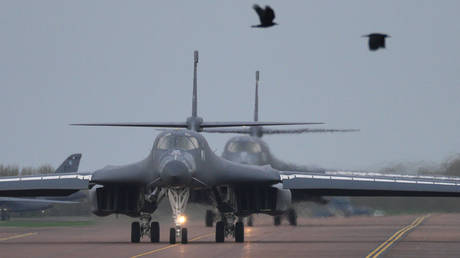
Striking long-range military targets inside Iranian territory requires immense heavy-bomber logistics. The Pentagon can fly B-2 Spirit stealth bombers directly from Whiteman Air Force Base in Missouri, but doing so demands endless aerial refueling cycles and puts extreme wear on airframes. Flying B-52H Stratofortress or B-1B Lancer squadrons from regional installations in the Persian Gulf leaves those aircraft vulnerable to short-range ballistic missile salvos from Tehran.
That reality makes British bases indispensable to American war planners.
RAF Fairford in Gloucestershire serves as the primary forward operating location for United States Air Force heavy bombers in Europe. Diego Garcia, a isolated footprint in the Chagos Archipelago, offers an ideal staging ground outside the effective range of most Iranian tactical strike systems. Equipped with massive fuel storage farms, deep-water naval facilities, and reinforced runways, Diego Garcia allows heavy munitions to be loaded onto long-range aircraft beyond the reach of adversary anti-access networks.
Yet every single American flight departing from these runways requires explicit British political concurrence. Under the original 1966 Exchange of Notes governing the use of British Indian Ocean Territory, as well as longstanding bilateral agreements covering RAF bases on British home soil, the UK retains veto power over offensive operations mounted from its territory.
The United States military operates the machinery on the tarmac. The British Crown holds the keys to the airspace.
                    ┌─────────────────────────────────────────┐
                    │      U.S. AIRFORCE STRIKE ASSETS       │
                    └────────────────────┬────────────────────┘
                                         │
                   ┌─────────────────────┴─────────────────────┐
                   ▼                                           ▼
       ┌───────────────────────┐                   ┌───────────────────────┐
       │   RAF FAIRFORD (UK)   │                   │  DIEGO GARCIA (BIOT)  │
       └───────────┬───────────┘                   └───────────┬───────────┘
                   │                                           │
                   └─────────────────────┬─────────────────────┘
                                         │
                                         ▼
                    ┌─────────────────────────────────────────┐
                    │      UK CABINET & LEGAL CONCURRENCE     │
                    │   (Required under 1966 Exchange Notes)  │
                    └────────────────────┬────────────────────┘
                                         │
                          ┌──────────────┴──────────────┐
                          ▼                             ▼
                 [APPROVAL GRANTED]             [PERMISSION DENIED]
                          │                             │
                          ▼                             ▼
                 Combat Operations           Operational Deadlock /
                 Targeting Iran              Diplomatic Friction
The Legal Trap Facing Downing Street
For the British government, approving strikes against Iranian infrastructure is not merely a matter of political alliance. It is a strict legal calculation.
UK government lawyers operating out of the Foreign, Commonwealth & Development Office remember the painful fallout of the 2003 Iraq intervention. British domestic law requires any military action involving sovereign assets to satisfy strict criteria under international law: explicit authorization from a United Nations Security Council resolution, clear self-defense under Article 51 of the UN Charter, or humanitarian intervention to prevent an imminent catastrophe.
When the White House orders retaliatory strikes in response to regional incidents, military planners in Washington treat the operations as standard force protection. British legal teams see something far more dangerous. If an American bomber takes off from RAF Fairford or Diego Garcia to hit Iranian command centers or nuclear research facilities without an unquestioned international mandate, the United Kingdom could be deemed a co-belligerent under international law.
That legal exposure opens British military installations worldwide to lawful counter-strike by Iranian forces. It also exposes British political leaders to legal challenges in domestic courts and foreign tribunals.
Starmer cannot simply sign off on a target list faxed over from CENTCOM. British civil servants require a detailed legal rationale for every target, every weapon yield, and every collateral damage assessment. That requirement creates an agonizing friction point for an American administration accustomed to unilateral authority.
The Chagos Sovereignty Bargaining Chip
This dispute over airbase access has spilled directly into broader territorial politics, most notably the contest over the Chagos Islands.
The United Kingdom reached a complex diplomatic agreement to transfer sovereignty of the Chagos Archipelago to Mauritius, securing a 99-year lease to guarantee continued operations at the Diego Garcia base. The arrangement was intended to settle decades of international legal disputes over the territory while preserving the military installation indefinitely.
The White House abruptly threw those plans into disarray.
When British leadership hesitated to grant pre-approved, open-ended access to Diego Garcia for potential strikes against Tehran, American posture shifted overnight. Public statements criticized the sovereignty deal, demanding that London abandon the agreement and maintain direct colonial control over the island chain.
The political message from Washington was transparent. If Britain will not guarantee unconditional military utility of the base for American operational needs, Washington will challenge London’s territorial management of the site altogether.
This maneuver placed the British Prime Minister in a corner. Canceling the treaty with Mauritius damages Britain’s standing regarding international court rulings and maritime law. Proceeding with the deal invites open friction with the United States executive branch at a time of severe global insecurity.
The Practical Alternatives for American War Planners
If Downing Street refuses to allow offensive sorties from Fairford or Diego Garcia, where can the United States launch heavy bombers? The options are surprisingly limited and operational costs mount quickly.
- Direct Sorties from the Continental United States: B-2 bombers can fly round-trip missions from Missouri to targets in the Middle East. These operations require up to 30 hours of continuous flight time, multiple mid-air refuelings, and massive strain on bomber crews.
- Regional Gulf Bases: Facilities in Kuwait, Bahrain, Qatar, or the United Arab Emirates sit directly inside the target envelope of Iranian short- and medium-range ballistic missiles, cruise missiles, and strike drones. Using these bases for large-scale offensive campaigns risks heavy host-nation blowback and immediate retaliation.
- Carrier Strike Groups: Aircraft carriers in the Arabian Sea or Eastern Mediterranean carry formidable naval aviation wings, but F/A-18 and F-35C fighters lack the payload capacity and deep-bunker penetrating capabilities of heavy airforce bombers.
None of these alternatives offer the strategic isolation, runway length, and heavy ordnance storage provided by Diego Garcia.
Washington needs the British bases. London knows it. But the White House assumes that allied support should be automatic, while Whitehall insists that sovereignty means having the final vote over when a war begins.
A Fractured Alliance and the Path Ahead
The fundamental friction between Washington and London is not going to vanish through diplomatic handshakes or carefully worded joint press releases. It stems from two incompatible views of international policy. The White House operates on absolute freedom of action, treating overseas airfields as sovereign American platforms regardless of whose flag flies over the perimeter fence. The British state operates under a rigid, process-driven framework where international law and domestic accountability constrain every military decision.
If the conflict in the Middle East escalates further, this operational divide will reach a breaking point. An American commander-in-chief expecting instant operational obedience from an overseas base will eventually collide directly with a British Prime Minister who cannot legally grant it.
When that moment arrives, the Special Relationship will face an unvarnished audit. The United States may discover that relying on foreign territory for global power projection comes with conditions it can no longer unilaterally brush aside.