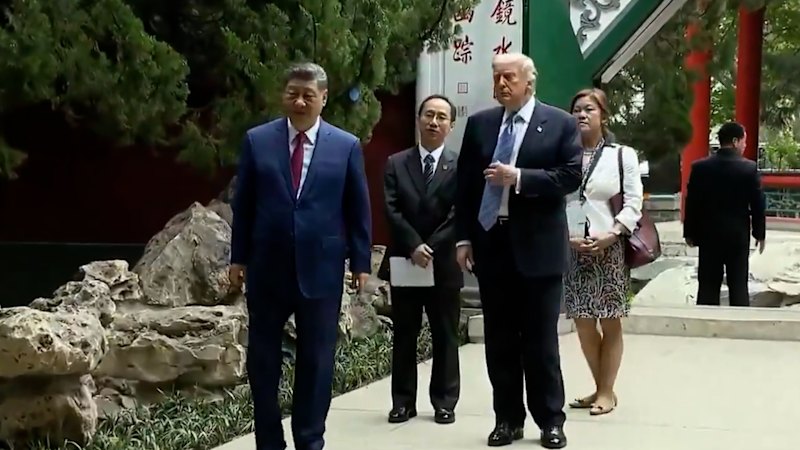
The media remains obsessed with the optics of the "stroll." We see two of the most powerful men on earth walking through the Zhongnanhai or the Summer Palace, and the pundits immediately start salivating over the "human connection" or the "thawing of relations." It is a scripted, expensive theater production that serves zero actual geopolitical function.
If you believe that showing a U.S. President a series of manicured rocks and ancient pavilions changes the calculus of trade tariffs or semiconductor bans, you aren't just naive; you are ignoring how power actually operates in the 21st century. Recently making news lately: The Raúl Castro Indictment Myth and the Bankruptcy of US Foreign Policy.
The Myth of the Personal Rapport
Western observers love the narrative of the "Great Man" theory of history. They want to believe that if Xi Jinping and Donald Trump just share a tea ceremony in a historic garden, the personal bond will override decades of structural economic friction. This is a fairy tale.
In reality, these walks are carefully choreographed exercises in signaling, not substance. For the Chinese leadership, hosting a foreign leader in the imperial gardens isn't about friendship. It is about a specific display of Tianxia—the concept of China as the center of the civilized world. When a U.S. President walks those paths, they aren't a guest of honor; they are being integrated into a visual narrative of historical continuity and Chinese permanence. Additional information on this are explored by The New York Times.
I have watched diplomats spend months arguing over the length of a red carpet or the specific variety of tea served. It is a massive drain on resources. While the cameras capture the serene environment, the real tension remains in the briefing binders that stay closed in the limousines.
Cultural Narcissism vs. Realpolitik
The "Imperial Garden" strategy relies on a flawed premise: that cultural appreciation leads to political concession. This is what I call the Tourism Trap.
When the CCP showcases the architectural wonders of the Qing or Ming dynasties, they are performing a high-stakes version of "face" politics. The goal is to project a sense of ancient authority that makes the American four-year election cycle look like a blip in history.
- The Competitor View: "Shared history builds a bridge for future cooperation."
- The Reality: History is used as a weapon to remind the visitor that the host has survived for millennia and intends to survive the visitor's current administration.
The "nuance" the mainstream media misses is that these tours are often a stalling tactic. If you can keep a President talking about koi ponds for three hours, that is three hours they aren't demanding specific timelines on intellectual property protection or market access. It is the diplomatic equivalent of a filibuster with better scenery.
The Economic Cost of Aesthetic Diplomacy
Let’s talk about the numbers that actually matter. While the press was busy counting the number of steps taken in the garden, the trade deficit didn't move an inch. Currency manipulation doesn't stop because a garden is beautiful.
Consider the opportunity cost. A state visit is a finite window of high-level bandwidth. Every minute spent admiring a 500-year-old pine tree is a minute lost on the granular, painful work of decoupling or trade renegotiation.
Imagine a scenario where a CEO goes to a hostile merger meeting. Instead of looking at the balance sheets, the target company takes the CEO on a tour of their corporate museum. The CEO would be fired by the board the next day. Yet, in international relations, we call this "world-class statesmanship."
The Symmetry of Deception
The U.S. is just as guilty. We take foreign leaders to Mar-a-Lago or Camp David, thinking a gold-plated steak or a golf cart ride will soften a hardline negotiator. It never works.
National interests are baked into the geography, the demographics, and the industrial base of a country. They are not liquid assets that can be traded for a pleasant afternoon. Xi Jinping is a student of history who views the "Century of Humiliation" as a debt to be collected. Trump views every interaction as a zero-sum transaction. Neither of these worldviews has any room for "garden-induced empathy."
Why the Media Keeps Buying the Lie
The press promotes this "garden diplomacy" because it provides easy visuals. It is much harder to write a compelling article about the intricacies of the Foreign Direct Investment (FDI) rules or the specific clauses of the Export Administration Regulations (EAR).
It’s easier to photograph two men in suits standing near a lake. This creates a false sense of progress for the public while the underlying conflict continues to boil. We are being fed a diet of aesthetic fluff to distract from the fact that the two largest economies in the world are in a permanent state of structural competition that no amount of historic sightseeing can resolve.
Stop Asking if They "Got Along"
The "People Also Ask" sections of search engines are filled with queries like "Did Trump and Xi have a good relationship?" or "What did they talk about in the garden?"
You are asking the wrong questions. The "relationship" is irrelevant. You don't need to like your counterpart to sign a treaty, and liking them won't stop them from protecting their own nation's survival.
The focus should be on the mechanics of the standoff.
- Supply Chain Resiliency: Is the garden tour changing the fact that 90% of certain critical minerals are processed in China? No.
- Military Posturing: Does a shared tea ceremony change the "First Island Chain" strategy in the South China Sea? No.
- Technological Sovereignty: Will admiring a pagoda stop the race for AGI supremacy? No.
The Hard Truth for Investors and Policy Makers
If you are an investor watching these televised strolls and feeling "optimistic" about the market, you are the mark. Professional analysts know that the more time spent on "cultural exchange" during a high-stakes summit, the less actual work was accomplished.
A "successful" summit between rivals should be boring, technical, and take place in a windowless room. The presence of a garden is a red flag. It means the parties have reached an impasse and are resorting to the "scenery defense" to save face and avoid admitting the meeting was a stalemate.
The imperial gardens are symbols of a past where the Emperor was the center of the universe. By leading a U.S. President through them, the message is clear: You are a temporary guest in a permanent empire.
Stop looking at the trees. Start looking at the tariffs. Diplomacy is a cold-blooded game of leverage, and the garden is just the graveyard where hard truths go to be buried under a layer of cherry blossoms.
The next time you see a headline about a "historic walk," turn off the TV and go read a trade ledger. That is where the real history is being written.