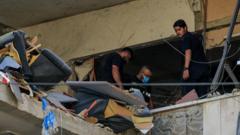
The smoke rising over the Dahiyeh district on Sunday shattered the short-lived diplomatic theater orchestrated in Washington. When Israeli airstrikes hammered Beirut’s southern suburbs just days after the Lebanese and Israeli governments renewed a fragile, U.S.-brokered ceasefire, the immediate western narrative focused on a sudden "violation" of a peaceful consensus. This perspective misreads the structural realities of the conflict. The truce signed by diplomats in Washington was structurally dead before the ink dried, designed on a fundamental flaw: it treated Lebanon as a centralized state capable of enforcing terms, while ignoring the non-state actors and regional powers that actually dictate the geometry of violence on the ground.
The latest escalation reveals a stark disconnect between diplomatic intent and military reality. While the White House sought a tidy diplomatic achievement, Israeli Prime Minister Benjamin Netanyahu and Defense Minister Israel Katz had already established a highly aggressive strategic baseline. The Israeli defense establishment publicly announced a strict equation: if northern Israeli communities faced cross-border fire, the response would be the systematic evacuation and bombardment of Beirut’s Shiite stronghold. When rockets flew toward northern Israel last week, Jerusalem executed that exact doctrine, bypassing the diplomatic framework entirely to strike command and control centers in the capital's sprawling urban core.
The Phantom Signatory Problem
The core structural failure of the U.S.-brokered diplomatic effort is the complete omission of Hezbollah from the actual negotiating table. The Lebanese state, represented by President Joseph Aoun and the central government, signed the agreement in a desperate bid to assert sovereignty and end a devastating conflict that has already displaced over a million citizens. However, the national government does not wield the monopoly on violence in Lebanon.
Hezbollah immediately and scathingly rejected the Washington deal, branding the terms as unacceptable concessions to Israeli demands. The militant group maintains that Lebanon’s future cannot be decoupled from broader regional realities, explicitly stating that any lasting cessation of hostilities must be brokered through direct coordination between Washington and Tehran. By negotiating exclusively with a Lebanese government that lacks the domestic military leverage to disarm or restrain Hezbollah, western mediators constructed a paper fortress. The agreement required a non-signatory to comply with terms it had already vowed to ignore.
This dynamic leaves the Lebanese military trapped in a catastrophic middle ground. The regular armed forces have largely attempted to remain neutral, focusing on civil stability and humanitarian coordination rather than engaging in direct combat with either Israeli forces or Hezbollah units. Yet, neutrality offers no protection in a collapsing security environment. Just days ago, an Israeli strike hit a military vehicle on the Khardali-Nabatieh road, killing three Lebanese army members, including a brigadier general and a captain. While Jerusalem claimed the vehicle was moving suspiciously near a frontline area where Hezbollah operates, the incident highlighted the impossibility of maintaining a neutral sovereign force in an active combat zone encompassing a fifth of the country.
The Broader Geopolitical Calculus
The fighting in Lebanon is not an isolated border dispute. It is an active front in a wider regional confrontation involving the United States, Israel, and Iran. Earlier this spring, a complex diplomatic track led by Pakistani mediators sought a broader understanding between Washington and Tehran, which briefly yielded an April cessation framework. That track collapsed because the underlying strategic objectives of the primary combatants remain completely irreconcilable.
+-------------------+----------------------------------------------------+
| Actor             | Primary Strategic Objective                        |
+-------------------+----------------------------------------------------+
| Israel            | Establish a permanent security buffer zone;        |
|                   | decimate Hezbollah infrastructure near the border. |
+-------------------+----------------------------------------------------+
| Hezbollah / Iran  | Maintain cross-border leverage; link Lebanon's     |
|                   | security directly to regional negotiations.        |
+-------------------+----------------------------------------------------+
| Lebanese Republic | Assert sovereign state control; prevent complete   |
|                   | economic and territorial collapse.                 |
+-------------------+----------------------------------------------------+
Netanyahu faces intense domestic political pressure with elections approaching later this year. His administration cannot afford to allow citizens from northern border towns to remain permanently displaced. The political survival of the current Israeli coalition depends on demonstrating a decisive transformation of the security environment along the northern border. Consequently, the Israeli military has pushed deep into southern territory, establishing physical control over approximately twenty percent of Lebanon's landmass, a deeper territorial penetration than any operation since the decades-long occupation that ended in 2000.
For Tehran, the Lebanese theater represents a vital element of forward defense. Iranian Foreign Minister Abbas Araghchi made it clear that any unilateral Western attempt to impose terms on Beirut without resolving broader sanctions and strategic issues with Iran would be rejected. When Lebanese leadership publicly criticized Iran for using the country as a "bargaining chip" in global diplomacy, Araghchi countered sharply, underscoring that Iran views the resistance axis as an indivisible strategic front. When Israel strikes Dahiyeh, it is not simply attacking a neighborhood; it is striking a key node in Iran's regional deterrent framework.
Tactical Transformations and Collective Punishment
The nature of the military operations has shifted from targeted assassinations to broad territorial engineering. In southern cities like Nabatiyeh and Tyre, the Israeli military has utilized blanket evacuation warnings followed by intense bombardment. Entire residential blocks have been systematically leveled, a tactical approach that United Nations human rights experts have condemned as a form of urban destruction designed to render areas permanently uninhabitable.
This strategy aims to create a physical buffer zone devoid of civilian infrastructure that could shelter insurgent activity. The consequence is an unprecedented humanitarian emergency. The rate of internal displacement has outpaced previous escalations, forcing thousands of families to flee north beyond the Zahrani River into overpopulated shelters and informal settlements.
The diplomatic rhetoric coming out of Washington continues to emphasize the restoration of state authority and the enforcement of historic frameworks like UN Resolution 1701. These statements ignore the reality on the ground. A state cannot assert authority over its borders when a foreign military controls a fifth of its territory, and a government cannot disarm a domestic militia that possesses a more sophisticated arsenal than the national army itself.
The Washington truce failed because it was an exercise in diplomatic formalism detached from material realities. Israel will continue to strike the capital whenever its northern towns face fire, enforcing its new security equation through air power and artillery. Hezbollah will continue to launch drone and rocket operations to prove that territorial occupation cannot buy security for northern Israel. The Lebanese state will continue to appeal to international law in empty rooms. The conflict will not be resolved by signing ceremonies that exclude the forces pull the triggers; it will continue to burn until the regional powers behind the proxies find a broader, comprehensive balance of power.